
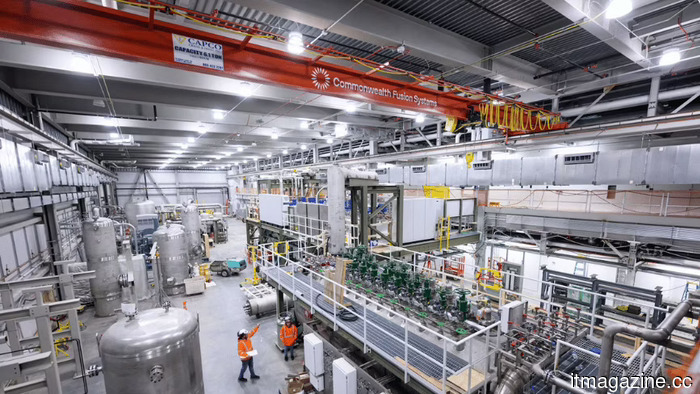
Fusion's most well-financed venture secured an additional $1 billion and recruited the banker responsible for Moderna's initial public offering.
The surge in AI technology demands massive amounts of electricity. This demand has shifted the perception of fusion, often ridiculed as "30 years away," into a compelling investment in the tech sector. Commonwealth Fusion Systems (CFS), based in Massachusetts, has just secured another $1 billion, bringing its total funding to $4 billion, which accounts for approximately 30% of all funds raised for fusion to date. This latest round is the largest since a $1.8 billion investment was secured in 2021. The new investors are mainly institutions such as pension funds, sovereign wealth funds, and infrastructure-focused investors, although CFS has chosen not to disclose their names.
The timing of this fundraising is notable. Tech companies are purchasing electricity at any cost to power AI data centers, and there is a scarcity of clean, continuous energy. CFS has already sold half of the output from its first facility to Google. The potential of fusion to provide unlimited carbon-free energy has attracted a wealthier, more demanding customer base.
In a more discreet yet significant development, CFS has appointed Lorence Kim as its new chief financial officer. Kim previously managed finance at Moderna and was instrumental in taking the biotech company public in 2018. He stated, "Fusion today is where mRNA was a decade ago: scientifically valid but commercially unproven, and closer than most believe."
TechCrunch speculates that this hire indicates CFS might pursue an initial public offering (IPO) within the next two or three years, though CFS itself maintains that an IPO is not necessarily imminent. Regardless, competition is intensifying, as rival General Fusion went public via a SPAC this month, and TAE Technologies is merging with Trump Media.
Despite the influx of capital, scientific validation is still required. CFS is developing tokamaks that utilize strong magnets to compress plasma to the necessary temperature and density for fusion. Its experimental reactor, SPARC, aims to achieve scientific breakeven by 2027, meaning it will produce more energy than it consumes to initiate the reaction. To date, only one facility at Lawrence Livermore has succeeded in this.
Simultaneously, CFS is constructing ARC, a commercial facility in Chesterfield County, Virginia. It has applied to connect to PJM, the largest power market in the U.S., and has secured agreements with buyers, including Google for 200 megawatts and Italy’s Eni for over $1 billion worth of electricity. The company anticipates joining the grid by the early 2030s.
However, many obstacles still lie ahead. Achieving breakeven does not equate to generating electricity, the first-of-its-kind plants may face delays, and the 2030s provide a lengthy period to incur expenses. Nevertheless, the AI data center boom is generating new power consumers, while competing fusion startups are quickly raising funds. CFS is wagering that the opportunity to raise capital—and potentially go public—is currently available, and it aims not to let it pass by.
Other articles
 AI search is becoming fragmented, outdated, and increasingly cluttered with advertisements.
A year ago, AI search was essentially a singular product known as ChatGPT. However, a recent report indicates that this phase has already come to an end. Similarweb's 2026 Generative AI Landscape report examines a market that is experiencing both rapid growth and diversification simultaneously. Generative AI we
AI search is becoming fragmented, outdated, and increasingly cluttered with advertisements.
A year ago, AI search was essentially a singular product known as ChatGPT. However, a recent report indicates that this phase has already come to an end. Similarweb's 2026 Generative AI Landscape report examines a market that is experiencing both rapid growth and diversification simultaneously. Generative AI we
 The true advantage of AI arises when entrepreneurs cease to restrict their own capabilities.
Kirk Drake, the founder of CU 2.0, points out that the primary barrier to adopting AI is not related to cost or complexity, but rather the preconceived notions entrepreneurs hold about the technology. Many organizations possess the knowledge required for AI, but they've yet to structure it effectively.
The true advantage of AI arises when entrepreneurs cease to restrict their own capabilities.
Kirk Drake, the founder of CU 2.0, points out that the primary barrier to adopting AI is not related to cost or complexity, but rather the preconceived notions entrepreneurs hold about the technology. Many organizations possess the knowledge required for AI, but they've yet to structure it effectively.
 AI search is becoming fragmented, outdated, and cluttered with advertisements.
A year ago, AI search was largely represented by a single product known as ChatGPT. However, a recent report indicates that this phase has already come to an end. The 2026 Generative AI Landscape report by Similarweb highlights a market that is both thriving and diversifying simultaneously. Generative AI we
AI search is becoming fragmented, outdated, and cluttered with advertisements.
A year ago, AI search was largely represented by a single product known as ChatGPT. However, a recent report indicates that this phase has already come to an end. The 2026 Generative AI Landscape report by Similarweb highlights a market that is both thriving and diversifying simultaneously. Generative AI we
 A $2 sticker undermines the single element that keeps Meta's 'pervert glasses' intact.
Meta's solution to the issue of "pervert glasses" involved a small light that activates when the camera is recording, serving as a warning to those nearby. However, a sticker priced at a few dollars can turn it off. Karissa Bell from Engadget evaluated these workarounds.
A $2 sticker undermines the single element that keeps Meta's 'pervert glasses' intact.
Meta's solution to the issue of "pervert glasses" involved a small light that activates when the camera is recording, serving as a warning to those nearby. However, a sticker priced at a few dollars can turn it off. Karissa Bell from Engadget evaluated these workarounds.
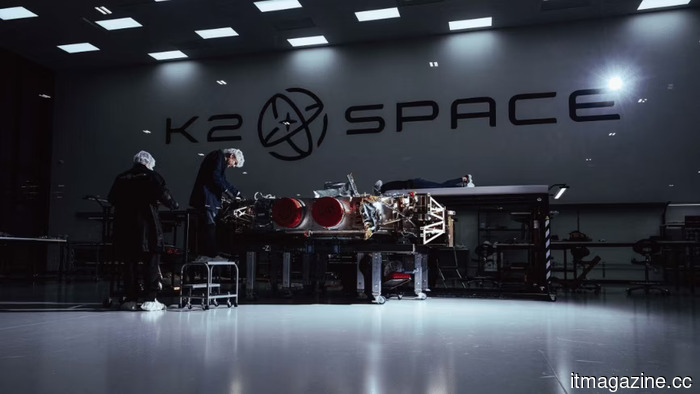 While others are reducing the size of satellites, K2 has secured $500 million to create large satellites and deploy AI in space.
While most satellite startups are competing to develop smaller systems, K2 Space is intentionally taking a different approach by focusing on larger designs. The company recently secured $500 million from investors to continue its expansion. K2 announced on Thursday that it raised a $500 million Series D round at a valuation of $6.8 billion.
While others are reducing the size of satellites, K2 has secured $500 million to create large satellites and deploy AI in space.
While most satellite startups are competing to develop smaller systems, K2 Space is intentionally taking a different approach by focusing on larger designs. The company recently secured $500 million from investors to continue its expansion. K2 announced on Thursday that it raised a $500 million Series D round at a valuation of $6.8 billion.
 Oracle incorporated its cloud competitor's AI into its business applications, resulting in an 8% increase in its stock.
Oracle has integrated its competitor's AI technology into the software that its customers utilize for their businesses, prompting a positive reaction from investors. The company announced on Thursday that it is enhancing its collaboration with Google Cloud to incorporate Gemini into Oracle's enterprise offerings.
Oracle incorporated its cloud competitor's AI into its business applications, resulting in an 8% increase in its stock.
Oracle has integrated its competitor's AI technology into the software that its customers utilize for their businesses, prompting a positive reaction from investors. The company announced on Thursday that it is enhancing its collaboration with Google Cloud to incorporate Gemini into Oracle's enterprise offerings.
Fusion's most well-financed venture secured an additional $1 billion and recruited the banker responsible for Moderna's initial public offering.
The surge in AI technology requires vast quantities of electricity, which has transformed fusion—long ridiculed as “30 years away”—into one of the most promising opportunities in the tech sector. The leading player in this field has recently secured an additional $1 billion in funding. Commonwealth Fusion Systems, based