
Tesla's cash expenditure will challenge investors' confidence in its artificial intelligence investments.
Tesla will release its second-quarter results on Wednesday, and the pivotal issue is not whether it can still sell cars, but how long it can continue spending more than it earns. The company just achieved its highest delivery quarter on record; however, Wall Street anticipates it will deplete around $3.25 billion in free cash flow, illustrating the gap between Elon Musk's promises regarding autonomy and the expenses required to support them.
A significant portion of those expenses is already allocated. Tesla has increased its capital budget for 2026 to over $25 billion, up from approximately $20 billion just three months ago, with nearly $20 billion earmarked for AI-related projects, including Dojo compute, data center expansions, the Cybercab, and the Optimus robot.
Deliveries were undoubtedly the highlight of the quarter, with Tesla delivering 480,126 vehicles, a 25% increase from the previous year, surpassing the roughly 406,000 predicted by analysts, marking its best performance in three months.
These gains are largely driven by pricing. The increased volume was propelled by lower-cost Model 3 and Model Y variants, along with a wider rollout of Full Self-Driving in Europe, with these two mainstream models accounting for about 97% of the total deliveries.
The issue lies with the timing. The spending is heavily front-loaded, whereas the revenue has not yet materialized, and CFO Vaibhav Taneja informed investors in April that Tesla would experience negative free cash flow for the remainder of 2026. The expected negative cash flow of $3.25 billion for the second quarter would negate a positive cash flow of $1.4 billion in the first quarter.
The magnitude of this commitment signifies a substantial shift. With a budget exceeding $25 billion, the 2026 plan is approximately three times Tesla’s historical levels, transforming the company, once known for its capital discipline, into a capital-intensive AI and robotics enterprise.
The autonomy business that justifies this expenditure remains relatively small. Tesla's robotaxi service is operational in Austin, Dallas, and Houston, yet its fleet is still significantly smaller than Waymo's, with substantial revenue not projected until at least 2027.
The Optimus project is further back on the timeline. Musk has portrayed the humanoid robot as Tesla's most significant future product, though production is just beginning to increase, contributing nothing to current cash flow.
Analysts' opinions are mixed regarding whether the potential justifies the expenses. Morgan Stanley’s Andrew Percoco has labeled the scaling of robotaxis as the “most important catalyst” for the stock, maintaining a neutral rating while raising his price target to $417. Similarly, UBS’s Joseph Spak has adopted a cautious hold.
The long-term outlook is more optimistic. J.P. Morgan forecasts that Tesla's revenue will grow from around $95 billion in 2025 to approximately $203 billion by 2030, driven by robotaxi and Optimus; however, these predictions rely on products that are not generating significant income at present.
The short-term outlook appears less favorable. Consensus estimates suggest revenue around $27.6 billion, a gross margin of approximately 19.5%, and adjusted earnings of about $0.55 per share, with automotive margins pressured by less expensive Model 3 and Model Y variants that increased volume but did not enhance profits.
The markets are prepared for a significant response in either direction. Options pricing indicates a post-results move of about 7% in either way, and the stock has declined this year, despite the record delivery figures.
Energy storage remains a notable bright spot, with 13.5 GWh deployed during the quarter, up from 9.6 GWh a year prior, although it is still insufficient to cover the costs associated with autonomy. Tesla continues to hold over $40 billion in cash, providing a cushion even as outflows increase.
Removing the projections reveals a company in transition, investing in a future with autonomous machines while its core car business experiences slower growth and shrinking margins. Investors have generally accounted for the AI narrative as a settled reality.
This is why the forward guidance will be more significant than the quarterly results themselves. Any indication that capital expenditures might rise again or that robotaxi timelines might be delayed could test the patience that the current valuation assumes.
Tesla will report after the market closes on July 22, with the earnings call set for 5:30 PM ET.
Other articles
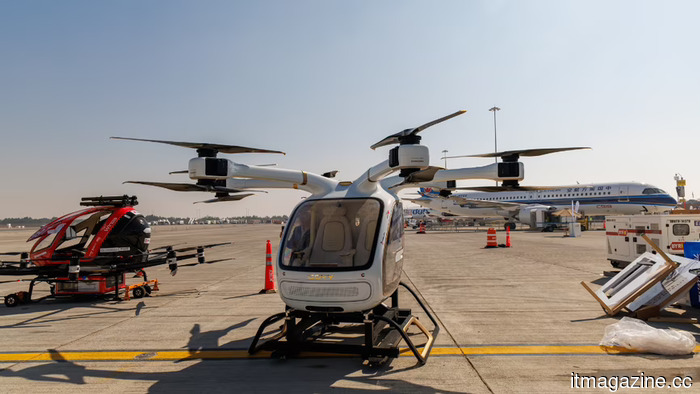 The US is preparing the runway for air taxis and supersonic aircraft.
The FAA is expediting the introduction of electric air taxis and civil supersonic flights into the market by lifting the 1973 ban on overland Mach travel and fast-tracking the testing of eVTOLs.
The US is preparing the runway for air taxis and supersonic aircraft.
The FAA is expediting the introduction of electric air taxis and civil supersonic flights into the market by lifting the 1973 ban on overland Mach travel and fast-tracking the testing of eVTOLs.
 Netflix aims for ‘AI fluency’ among all its employees, yet expertise in the field remains limited.
Elizabeth Stone, the technology chief at Netflix, describes AI fluency as a goal for all positions, while noting that exceptional talent is becoming increasingly rare.
Netflix aims for ‘AI fluency’ among all its employees, yet expertise in the field remains limited.
Elizabeth Stone, the technology chief at Netflix, describes AI fluency as a goal for all positions, while noting that exceptional talent is becoming increasingly rare.
 Brazil's Pix is emerging as a focal point for trade tensions with the United States, and it is drawing global attention.
A US Section 301 investigation into Brazil's central bank payment system, Pix, has resulted in 25% tariffs and is subjecting state-run instant payments to scrutiny.
Brazil's Pix is emerging as a focal point for trade tensions with the United States, and it is drawing global attention.
A US Section 301 investigation into Brazil's central bank payment system, Pix, has resulted in 25% tariffs and is subjecting state-run instant payments to scrutiny.
 AI has recently disproven the 87-year-old Jacobian conjecture.
Anthropic's Fable 5 discovered a counterexample to the Jacobian conjecture, a mathematical problem that has been around for 87 years, consisting of 216 characters. Experts have differing opinions on its implications.
AI has recently disproven the 87-year-old Jacobian conjecture.
Anthropic's Fable 5 discovered a counterexample to the Jacobian conjecture, a mathematical problem that has been around for 87 years, consisting of 216 characters. Experts have differing opinions on its implications.
 Google Photos introduces a convenient switch between AI and traditional search.
Individuals who have chosen to use Ask Photos can now toggle between results powered by Gemini and standard search results directly from the results page.
Google Photos introduces a convenient switch between AI and traditional search.
Individuals who have chosen to use Ask Photos can now toggle between results powered by Gemini and standard search results directly from the results page.
 deltaVision secures €10.2M to develop the infrastructure for in-orbit refueling.
The Munich-based startup deltaVision has secured €10.2 million in its initial funding round to expand its spacecraft valves and develop components for refueling satellites in orbit.
deltaVision secures €10.2M to develop the infrastructure for in-orbit refueling.
The Munich-based startup deltaVision has secured €10.2 million in its initial funding round to expand its spacecraft valves and develop components for refueling satellites in orbit.
Tesla's cash expenditure will challenge investors' confidence in its artificial intelligence investments.
Tesla reports record deliveries for Q2 but is expected to use around $3.25 billion in cash as its $25 billion expenditure on AI, robotaxis, and Optimus strains investor patience.