

deltaVision secures €10.2M to develop the infrastructure for in-orbit refueling.
DeltaVision, a space startup based in Munich, has successfully secured €10.2 million in its initial funding round from external investors, which will be used to increase the production of valves, pumps, and pressure regulators to manage propellant in spacecraft.
The company also aims to contribute to the development of the emerging market for in-orbit refuelling, allowing satellites to be refuelled while in flight instead of being decommissioned when their fuel runs out. The funding round attracted support from Futury Capital, KT Ventures, and Valemount Capital, with reports indicating that KT Ventures and Valemount Capital took the lead.
This funding comes at a time when a new wave of European space tech startups is pursuing opportunities in in-orbit servicing, a sector previously led by a few American companies.
In principle, orbital refuelling is straightforward, but in practice, it is challenging. Most satellites are launched with a fixed amount of fuel; once depleted, they are either moved to a graveyard orbit or left to drift, even though their electronics may still function. The difficulty lies in precisely docking two vehicles to transfer volatile fluids in a vacuum and at orbital speeds.
Implementing a refuelling architecture could change this dynamic, allowing operators to extend a satellite’s operational life, reposition it, or maintain its position for years, transforming a disposable asset into something that can be serviced.
This concept supports a larger vision of an “in-space economy,” where servicing vehicles, fuel depots, and orbital tugs create a reusable infrastructure rather than relying on one-time missions. Each satellite that remains operational represents revenue that doesn’t necessitate a new launch, thus minimizing the mass that needs to reach orbit.
Investors have been drawn to this proposition in the servicing sector for several years, but there are currently more prototypes than actual paying missions. DeltaVision’s strategy does not involve conducting refuelling missions; instead, the company focuses on producing components like fluidic couplers, utility interfaces, and integrated refuelling modules that facilitate docking and fluid transfer between spacecraft, in addition to the valves and regulators it already provides for launchers, satellites, and landers.
Other European companies are tackling related aspects of the overall challenge, from green propulsion to debris removal. CEO and co-founder Alex Plebuch has emphasized deltaVision’s plan to scale production and support an “open and interoperable” servicing ecosystem rather than adhering to a closed proprietary system.
The company claims to collaborate with over 60 customers across four continents, according to tech.eu, though this figure has not been independently verified. Among its noted projects is the European Space Agency’s Argonaut lunar lander, for which deltaVision states it will supply approximately 50 products, although this detail relies heavily on the company's own disclosures.
There is at least one external indicator of commercial progress; under an agreement made in April 2026, US-based Mott Corp began offering deltaVision’s valve solutions for spacecraft propulsion flow control, a collaboration announced independently of this funding round.
Looking ahead, deltaVision aims to manufacture around 5,000 valves annually, establish a subsidiary in France, and begin valve production in the United States, which would position the company strategically on both sides of the Atlantic and closer to important launch clients.
The broader context clarifies the investor interest: Europe has been working to reduce its dependence on SpaceX over the last two years and to develop sovereign launch and servicing capabilities, with component suppliers like deltaVision being essential to the missions that this ambition relies on.
At present, however, the refuelling market remains largely theoretical. Verification beyond tech.eu and the company's statements is scarce, with SpaceWatch.GLOBAL confirming the €10.2 million funding round and its investors but providing little additional information.
The immediate narrative is less about conducting satellite refuelling in orbit and more about a supplier making a bet on the infrastructure necessary for a thriving in-space economy.
Other articles
 AI has recently disproven the 87-year-old Jacobian conjecture.
Anthropic's Fable 5 discovered a counterexample to the Jacobian conjecture, a mathematical problem that has been around for 87 years, consisting of 216 characters. Experts have differing opinions on its implications.
AI has recently disproven the 87-year-old Jacobian conjecture.
Anthropic's Fable 5 discovered a counterexample to the Jacobian conjecture, a mathematical problem that has been around for 87 years, consisting of 216 characters. Experts have differing opinions on its implications.
 South Korea is investing $540 billion in a southwestern chip hub that the current power grid is not equipped to support.
South Korea's $540 billion Honam chip cluster offers the potential for AI-era scale, but the rural southwest lacks sufficient power and water resources to support it.
South Korea is investing $540 billion in a southwestern chip hub that the current power grid is not equipped to support.
South Korea's $540 billion Honam chip cluster offers the potential for AI-era scale, but the rural southwest lacks sufficient power and water resources to support it.
 Ghost Recon might finally be making the return that fans have been longing for.
After years of speculation and quietness, Ubisoft has officially announced that fans of Ghost Recon won't have to wait too much longer for updates.
Ghost Recon might finally be making the return that fans have been longing for.
After years of speculation and quietness, Ubisoft has officially announced that fans of Ghost Recon won't have to wait too much longer for updates.
 Samsung establishes a robotics division led by its CEO to pursue humanoid robots.
Samsung Electronics has established a new robotics division called RX, which will report directly to its CEO, as the company seeks to develop humanoid robots and physical AI to drive future growth.
Samsung establishes a robotics division led by its CEO to pursue humanoid robots.
Samsung Electronics has established a new robotics division called RX, which will report directly to its CEO, as the company seeks to develop humanoid robots and physical AI to drive future growth.
 AI-generated misinformation is fabricating rare bird sightings and negatively impacting scientific research.
AI-altered images are creating false reports of rare bird sightings on iNaturalist, and scientists caution that this AI-generated content could compromise biodiversity records.
AI-generated misinformation is fabricating rare bird sightings and negatively impacting scientific research.
AI-altered images are creating false reports of rare bird sightings on iNaturalist, and scientists caution that this AI-generated content could compromise biodiversity records.
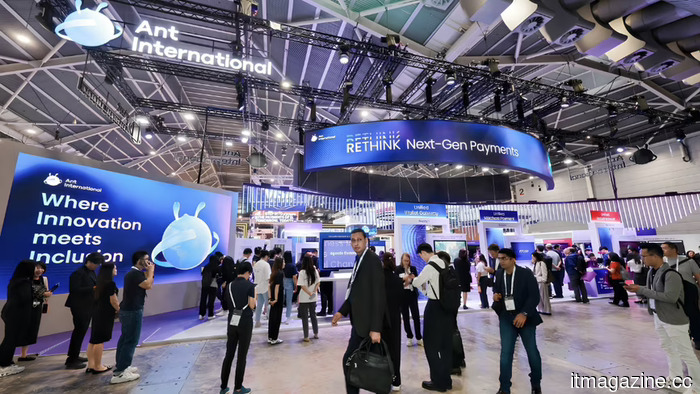 Ant International secures $1.2 billion to support its expansion in payments outside of China.
Ant International, an affiliate of Ant Group, has secured approximately $1.2 billion, supported by Alibaba and Ant Group, to expand its cross-border merchant payments operations.
Ant International secures $1.2 billion to support its expansion in payments outside of China.
Ant International, an affiliate of Ant Group, has secured approximately $1.2 billion, supported by Alibaba and Ant Group, to expand its cross-border merchant payments operations.
deltaVision secures €10.2M to develop the infrastructure for in-orbit refueling.
The Munich-based startup deltaVision has secured €10.2 million in its initial funding round to expand its spacecraft valves and develop components for refueling satellites in orbit.