
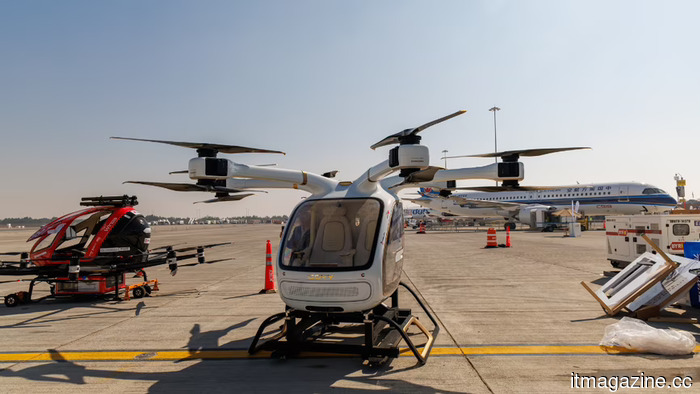
The US is preparing the runway for air taxis and supersonic aircraft.
The United States is aiming to advance two long-delayed aviation innovations into commercial use simultaneously, employing federal regulations and pressure from the White House to accelerate the introduction of electric air taxis and civil supersonic flight to the market. This initiative brings together the Federal Aviation Administration (FAA), the Department of Transportation, and a series of executive orders enacted in June 2025, potentially transforming travel for Americans in the coming decade.
On the supersonic front, the FAA has released a proposed rule that seeks to lift a ban that has been in effect since 1973, marking a possible pivotal moment for the anticipated revival of supersonic travel. This prohibition, outlined in 14 CFR 91.817, has prevented civil aircraft from exceeding Mach 1 over U.S. land for over fifty years, originating from public backlash in the 1960s when test flights above cities like Oklahoma City resulted in sonic booms that shattered windows and led to numerous damage complaints.
In its place, the FAA suggests an interim, noise-based standard instead of a fixed speed limit. Aircraft would be permitted to fly faster than the speed of sound over land as long as the sonic boom's overpressure at the surface does not exceed 0.11 pounds per square foot, a threshold designed to ensure the boom is not audible on the ground. The proposal, cataloged as FAA-2026-6935, is open for public comment until August 17, 2026, and a subsequent rule related to takeoff and landing noise is anticipated later this year. The FAA aims to finalize both regulations by mid-2027. “This allows us to ultimately lift the 1970s ban on supersonic travel over U.S. territory while minimizing noise disturbances,” stated FAA Administrator Bryan Bedford.
This development follows executive order 14304, “Leading the World in Supersonic Flight,” which mandated the agency to eliminate the ban on overland supersonic flights and establish the interim noise standard. It represents a significant victory for companies investing in faster travel, such as Colorado's Boom Supersonic, which has secured pre-orders for its Overture jet from major airlines, and Atlanta’s Spike Aerospace. United Airlines has committed to purchasing up to 50 Overture jets, with service expected to begin toward the end of the decade. However, the technology remains costly, and ticket prices are likely to be high.
Meanwhile, air taxis are progressing along a similar path. Companion orders issued on the same day initiated an eVTOL (electric vertical takeoff and landing) integration pilot program, with the FAA selecting eight projects across 26 states to operate over three years, allowing operators to fly before achieving full certification. Companies like Joby Aviation, Archer Aviation, Beta Technologies, and Wisk are among those involved, and testing may commence as early as this summer. Planned projects include heliport services in Manhattan facilitated by the Port Authority and regional connectivity in Texas linking Dallas, Austin, San Antonio, and Houston, reflecting a belief that short electric flights can alleviate congested road traffic.
The commercial potential is already being showcased. Joby recently completed a seven-minute flight from JFK that it plans to market, a trip that could take an hour or more by car. Additionally, its work on airspace management underscores the need for careful coordination amidst dense eVTOL traffic.
Importantly, neither Joby nor Archer has received full FAA type certification at this stage. Joby has completed four of the FAA's five certification levels, with the last remaining, and the pilot program serves as an expedited way to collect operational data rather than bypass safety evaluations. This precaution remains a key consideration in the overall push. European competitors have frequently faced delays amid rigorous certification challenges, illustrating that regulatory goals and airworthiness do not always align.
Noise remains another unresolved factor. The 0.11 psf supersonic standard is temporary, the community-noise regulation is still in development, and residents living beneath new eVTOL routes have yet to express their opinions on a larger scale. Next steps involve a period of public feedback, flight testing, and certification decisions that will influence whether the proposed timelines can be met. For the moment, Washington has indicated its desire for both technologies to enter commercial operation soon.
Other articles
 deltaVision secures €10.2M to develop the infrastructure for in-orbit refueling.
The Munich-based startup deltaVision has secured €10.2 million in its initial funding round to expand its spacecraft valves and develop components for refueling satellites in orbit.
deltaVision secures €10.2M to develop the infrastructure for in-orbit refueling.
The Munich-based startup deltaVision has secured €10.2 million in its initial funding round to expand its spacecraft valves and develop components for refueling satellites in orbit.
 Netflix aims for ‘AI fluency’ among all its employees, yet expertise in the field remains limited.
Elizabeth Stone, the technology chief at Netflix, describes AI fluency as a goal for all positions, while noting that exceptional talent is becoming increasingly rare.
Netflix aims for ‘AI fluency’ among all its employees, yet expertise in the field remains limited.
Elizabeth Stone, the technology chief at Netflix, describes AI fluency as a goal for all positions, while noting that exceptional talent is becoming increasingly rare.
 Xiaohongshu took a risk with a 40-day livestream experiment during the World Cup to investigate the future of long-form content.
When Spain raised the FIFA World Cup trophy on Monday, it marked the conclusion of the 2026 tournament as well as Xiaohongshu's inaugural full-scale World Cup experience.
Xiaohongshu took a risk with a 40-day livestream experiment during the World Cup to investigate the future of long-form content.
When Spain raised the FIFA World Cup trophy on Monday, it marked the conclusion of the 2026 tournament as well as Xiaohongshu's inaugural full-scale World Cup experience.
 Adobe’s Project Indigo camera application can now enhance photos using AI.
Adobe's Project Indigo camera application introduces an AI Playground that evaluates, modifies, and reconstructs your images utilizing Google's Nano Banana instead of Firefly.
Adobe’s Project Indigo camera application can now enhance photos using AI.
Adobe's Project Indigo camera application introduces an AI Playground that evaluates, modifies, and reconstructs your images utilizing Google's Nano Banana instead of Firefly.
 Kanishka Narayan is appointed as the UK’s inaugural cabinet-level minister for AI.
Kanishka Narayan is appointed as the inaugural AI minister in the UK, participating in the cabinet following the decision of new Prime Minister Andy Burnham to dissolve the DSIT and restructure Whitehall to focus on technology.
Kanishka Narayan is appointed as the UK’s inaugural cabinet-level minister for AI.
Kanishka Narayan is appointed as the inaugural AI minister in the UK, participating in the cabinet following the decision of new Prime Minister Andy Burnham to dissolve the DSIT and restructure Whitehall to focus on technology.
 I discovered an iPhone app that creates a skincare regimen based on a 30-second facial scan.
This independent iPhone application develops a skincare routine for the morning and evening based on a facial scan, and it adjusts the routine as your scores fluctuate.
I discovered an iPhone app that creates a skincare regimen based on a 30-second facial scan.
This independent iPhone application develops a skincare routine for the morning and evening based on a facial scan, and it adjusts the routine as your scores fluctuate.
The US is preparing the runway for air taxis and supersonic aircraft.
The FAA is expediting the introduction of electric air taxis and civil supersonic flights into the market by lifting the 1973 ban on overland Mach travel and fast-tracking the testing of eVTOLs.