

Australia instructs AI data centres to return more power than they consume.
Anthony Albanese has informed the AI industry that Australian literature, music, and journalism cannot be utilized as free training data and that any new data centre established in the country must contribute more to the electricity grid than it consumes. These measures have not yet been enacted into law.
In a speech at the University of Sydney on Wednesday, the Prime Minister announced the immediate establishment of an Office of AI within his department and proposed Australian Standards regarding energy, water, copyright, and site selection.
This comes two days after reports indicated that Anthropic and other companies were considering investing tens of billions in data centres, despite a copyright exemption that Canberra has already dismissed.
The energy requirement outlined is the most significant aspect of his address. Operators of future large data centres will be required to support new power supplies, pay their entire share for grid connections to ensure that costs do not fall on households or businesses, and contribute an amount of energy to the grid that is at least equal to their consumption.
“To be net-generators, not net-users,” Albanese said. This entails funding new renewable energy generation and stability rather than simply waiting in line for power from others, which is a more demanding requirement than those faced by hyperscalers in Europe or the US, where power grids are already under strain from connection requests.
Water management was addressed similarly. Operators will have to reduce their water consumption, enhance energy efficiency, and cover the costs of any extra water infrastructure they may require, on a continent that Albanese described as both the sunniest and the driest in the world.
On copyright, he stated, “Let me make this crystal clear: not everything produced in Australia is up for grabs,” adding, “Not at all.” He emphasized that Australian writers, musicians, artists, and journalists "must retain ownership and control of their work," and no organization should use it without the artist’s authority over its pricing and value. “Anything less is theft.”
However, the speech lacked a specific enforcement mechanism. The policy has been interpreted as requiring AI companies to negotiate with local artists and media before utilizing their content, but Albanese didn't specify how this control would be implemented, and the attorney-general’s consultation on copyright is still ongoing.
The gap between what was announced and what will be legislated is noteworthy. Nothing presented on Wednesday has binding authority: the Office of AI is a creation of the executive, the standards will be presented to the National Cabinet next month, and legislation is planned for introduction early next year.
Albanese acknowledged that he does not seek an exhaustive rulebook. “It is not our goal to try and legislate for every possible eventuality or risk,” he stated. This approach is less stringent than the terminology suggests and aligns more closely with the evolving stance of Brussels than with the drafted AI Act.
His assertion that Australia “will be the first country in the world to bring these issues into a single, national framework” is a claim that may not stand. The EU enacted the AI Act in 2024 and created an AI Office to oversee it, as legal experts pointed out shortly after.
Reactions to the timeline varied. Greenpeace Australia's Joe Rafalowicz labeled the data centres as “water-guzzling energy vampires,” accusing the government of creating an inviting environment while keeping them unregulated until at least 2027. Opposition Leader Angus Taylor criticized the office for merely adding more bureaucracy.
Just hours before Albanese's speech, New York postponed large data centre constructions for a year, a pause that Australia has opted not to take. Washington continues to debate who will shoulder the costs when data centres increase electricity bills, a question that Albanese believes he has preemptively addressed.
Anthropic, which informed Treasurer Jim Chalmers that its A$21.6 billion investment in Australia hinges on copyright clarity, stated that it respects the process and will comply with the government's requirements. This indicates a company awaiting the specifics.
APRA AMCOS chief executive Dean Ormston welcomed the certainty but noted that the Office of AI “must seriously interrogate the numbers AI platforms are presenting.” No figures are available yet, and neither is the bill.
Other articles
 The Summer Sale on the PlayStation Store kicks off on July 15, offering discounts of up to 75% on hundreds of games.
The Summer Sale on Sony's PlayStation Store starts on July 15, featuring discounts of up to 75% on a wide range of PS5, PS4, and PS VR2 games.
The Summer Sale on the PlayStation Store kicks off on July 15, offering discounts of up to 75% on hundreds of games.
The Summer Sale on Sony's PlayStation Store starts on July 15, featuring discounts of up to 75% on a wide range of PS5, PS4, and PS VR2 games.
 Doubao's AI companions are no longer available. Users have three months to take screenshots of any remaining content.
On July 15, Doubao and Qwen eliminated custom AI agents. Doubao provides users with read-only access until October 15, while Qwen offers no access at all. Neither platform offers a means to exit with the data.
Doubao's AI companions are no longer available. Users have three months to take screenshots of any remaining content.
On July 15, Doubao and Qwen eliminated custom AI agents. Doubao provides users with read-only access until October 15, while Qwen offers no access at all. Neither platform offers a means to exit with the data.
 It's really warm outside, but please refrain from placing your heated phones in the refrigerator.
Experts and smartphone manufacturers caution that placing an overheating phone in the refrigerator can result in condensation, which may cause internal damage that could be significantly more expensive to repair than the overheating issue itself.
It's really warm outside, but please refrain from placing your heated phones in the refrigerator.
Experts and smartphone manufacturers caution that placing an overheating phone in the refrigerator can result in condensation, which may cause internal damage that could be significantly more expensive to repair than the overheating issue itself.
 India commits $20 billion to enhance chip production and smartphones as Modi advocates for a domestic mobile brand.
Modi's cabinet has authorized $13.3 billion for semiconductors and $6.5 billion for smartphones. The minister indicated that Modi aims for India to "develop an Indian mobile brand."
India commits $20 billion to enhance chip production and smartphones as Modi advocates for a domestic mobile brand.
Modi's cabinet has authorized $13.3 billion for semiconductors and $6.5 billion for smartphones. The minister indicated that Modi aims for India to "develop an Indian mobile brand."
 Australia instructs AI data centers to contribute more power than they consume.
Albanese unveiled an Office of AI, regulations for data centres regarding net generation, and stringent copyright provisions. However, none of these measures are legally binding as of now.
Australia instructs AI data centers to contribute more power than they consume.
Albanese unveiled an Office of AI, regulations for data centres regarding net generation, and stringent copyright provisions. However, none of these measures are legally binding as of now.
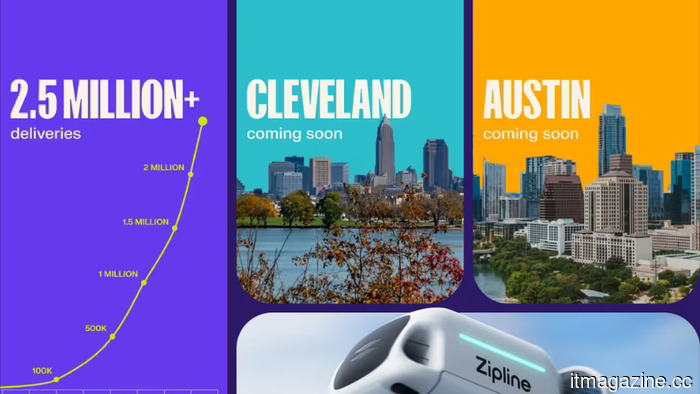 Zipline is starting a healthcare drone delivery service in partnership with Cleveland Clinic. It has recruited former employees from Tesla and Waymo to help expand the initiative.
Zipline has reached 2.5 million deliveries and is set to commence healthcare delivery in partnership with the Cleveland Clinic. The company has brought on former executives from Tesla, Waymo, and Uber to facilitate further expansion.
Zipline is starting a healthcare drone delivery service in partnership with Cleveland Clinic. It has recruited former employees from Tesla and Waymo to help expand the initiative.
Zipline has reached 2.5 million deliveries and is set to commence healthcare delivery in partnership with the Cleveland Clinic. The company has brought on former executives from Tesla, Waymo, and Uber to facilitate further expansion.
Australia instructs AI data centres to return more power than they consume.
Albanese revealed plans for an Office of AI, new regulations for data centres regarding net generation, and stringent copyright provisions. However, none of these measures have become law at this time.