
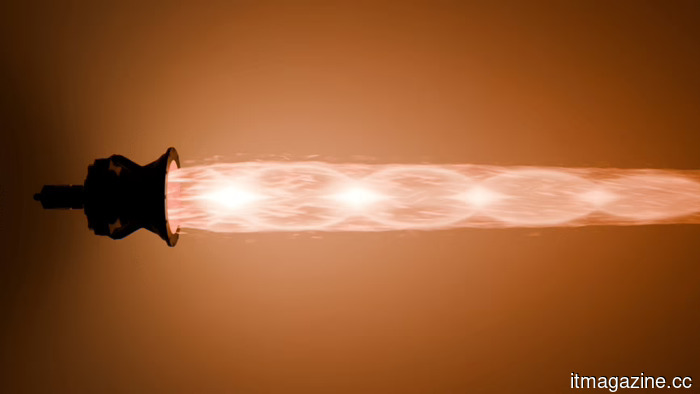
Venus Aerospace secures $91 million for its detonation engine.
A startup from Texas has successfully secured $91 million to develop a rocket engine that many in the industry previously deemed too challenging. Venus Aerospace has announced a $91 million Series B funding round to advance its Rotating Detonation Rocket Engine (RDRE), with Mercury Fund leading the investment.
The list of investors resembles a defense industry lineup, including Lockheed Martin Ventures, MESH, PEAK6, Draper Associates, Starboard Star Venture Capital, Green Sands Equity, among others. This funding will support testing and the design of vehicles tailored for specific clients. Although it represents only a small portion of the investment seen in Europe’s space enterprises, it is still significant.
A novel approach to rocketry
Traditionally, most rockets combust fuel in a cylindrical chamber. In contrast, the RDRE generates a continuous supersonic combustion wave that circulates around a ring. This design theoretically utilizes propellant more efficiently. However, the underlying physics have proven to be quite challenging, leading to many years of stagnation for the concept.
Advancements in 3D printing and simulation technology have changed the landscape. The first successful test occurred in 2020 at the University of Central Florida, followed by a ground demonstration by NASA in 2022, and Japan’s JAXA conducting a space test in 2021. A significant milestone was achieved last May when Venus's RDRE became the first to successfully launch a rocket into flight.
Shifting focus from passenger transportation to defense
Initially, Venus had a more aspirational goal. Founders Sassie and Andrew Duggleby, a married couple, established the company in 2020 with the vision of creating environmentally friendly hypersonic jets for passengers. The success of the May flight transformed their business direction. “The world looked at us and said, ‘Oh my gosh, you have a working RDRE, would you sell us one?’” stated CEO Sassie Duggleby in an interview with TechCrunch.
The company is now pivoting toward defense applications. Its aim is to substitute the solid motors used in many missiles with its own thruster, as well as to develop high-speed space vehicles for military use. Chief Technology Officer Andrew Duggleby noted that the engine “integrates efficiency, throttling, reusability, and manufacturability in a way that meets customer demands for real defense and space missions.”
Significance of this development
The primary challenge now is achieving endurance. Throughout 600 tests, Venus has managed to ignite its engine for a maximum of 32 seconds. Customers will require performance ranging from six to 15 minutes. A grant from the Texas Space Commission is funding the construction of a larger test stand to address this requirement. If successful, this 70-year-old concept could finally be materialized as a viable product, allowing a small startup to become a key player in the defense technology sector.
Other articles
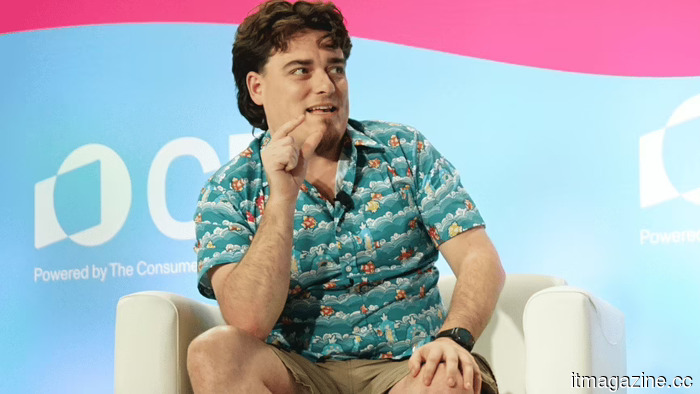 Palmer Luckey: American universities are lagging behind those in China.
Palmer Luckey of Anduril claims that U.S. universities cultivate "architecture astronauts," whereas China develops genuine engineers, a sentiment also expressed by the CEO of Pfizer.
Fi places Starlink satellites inside a dog collar.
Fi's latest product, the Fi Ultra, is the inaugural dog collar that utilizes Starlink's direct-to-cell satellites, allowing for pet tracking beyond the reach of mobile towers, according to Fortune.
Palmer Luckey: American universities are lagging behind those in China.
Palmer Luckey of Anduril claims that U.S. universities cultivate "architecture astronauts," whereas China develops genuine engineers, a sentiment also expressed by the CEO of Pfizer.
Fi places Starlink satellites inside a dog collar.
Fi's latest product, the Fi Ultra, is the inaugural dog collar that utilizes Starlink's direct-to-cell satellites, allowing for pet tracking beyond the reach of mobile towers, according to Fortune.
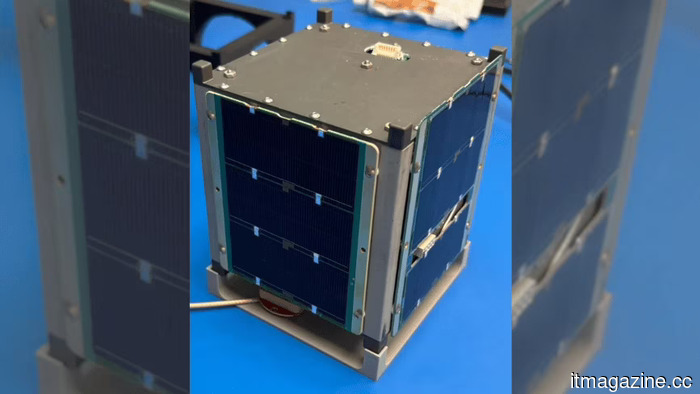 City Labs introduces the inaugural commercial nuclear satellite.
City Labs' BOHR is the inaugural commercial nuclear power source located in orbit, a tritium betavoltaic battery designed to operate in areas where solar panels are ineffective.
City Labs introduces the inaugural commercial nuclear satellite.
City Labs' BOHR is the inaugural commercial nuclear power source located in orbit, a tritium betavoltaic battery designed to operate in areas where solar panels are ineffective.
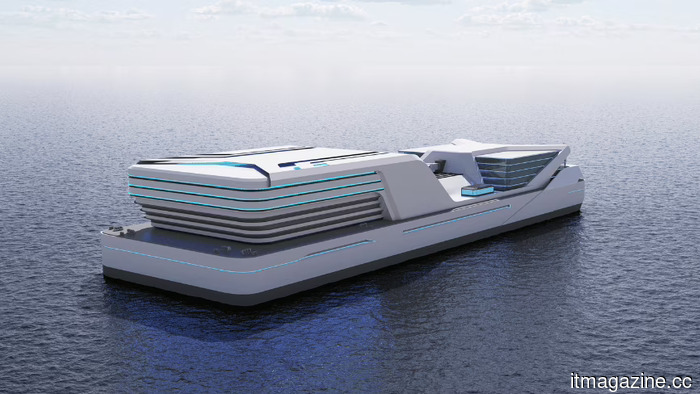 Samsung intends to establish a floating AI data center by 2028.
Samsung Heavy Industries intends to develop a specialized 50MW floating data center by 2028, as onshore AI projects face challenges related to land, water, and community opposition.
Samsung intends to establish a floating AI data center by 2028.
Samsung Heavy Industries intends to develop a specialized 50MW floating data center by 2028, as onshore AI projects face challenges related to land, water, and community opposition.
 HubSpot retracts its decision on utilizing customer data for AI purposes.
HubSpot has abandoned its proposal to consolidate customer data for an AI feature following a four-day wave of criticism, highlighting how sensitive the issue of AI and data collection has become.
HubSpot retracts its decision on utilizing customer data for AI purposes.
HubSpot has abandoned its proposal to consolidate customer data for an AI feature following a four-day wave of criticism, highlighting how sensitive the issue of AI and data collection has become.
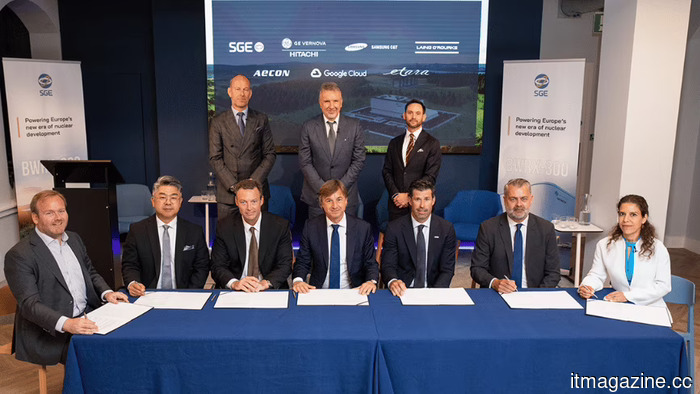 A £35 billion initiative to construct 14 small nuclear reactors in the UK.
Michał Sołowow's SGE intends to develop 14 GE Vernova Hitachi BWRX-300 small modular reactors at three locations in the UK, making a £35 billion investment in power for the AI era by 2034.
A £35 billion initiative to construct 14 small nuclear reactors in the UK.
Michał Sołowow's SGE intends to develop 14 GE Vernova Hitachi BWRX-300 small modular reactors at three locations in the UK, making a £35 billion investment in power for the AI era by 2034.
Venus Aerospace secures $91 million for its detonation engine.
Venus Aerospace has secured $91 million in a Series B funding round to develop its rotating detonation rocket engine into physical technology for missiles and high-speed space vehicles.