
Apple M7 chips: it’s bypassing the premium M6.
Apple is deviating from its established approach. It will bypass the high-end versions of its M6 chip and instead introduce an AI-centric M7 series. The M7 chips, rather than the M6, will power Apple's top Macs starting in 2027.
The company is altering its Mac chip rollout strategy, and this change is more significant than it appears. Apple plans to launch a base M6 processor as soon as this year for entry-level Macs, but, for the first time, it will not produce Pro or Max variants of this chip. The higher-end versions will instead debut in 2027 as part of the new M7 series, according to Bloomberg, citing sources familiar with the situation. Apple, which is currently utilizing its M5 series, has chosen not to comment.
This adjustment is important as it breaks a trend Apple has maintained since 2020, where every chip series from M1 to M5 included Pro and Max variants. The M1, M2, and M3 even featured a top-tier Ultra version. Having a series with only a base chip is unprecedented.
This division is significant because it determines which machines utilize which chip. Apple's Pro and Max versions are used in its high-performance Mac minis, Mac Studios, and MacBook Pros, while entry-level MacBook Pros, more budget-friendly Mac minis and iMacs, as well as some iPad Pro and iPad Air models, are powered by the base chips. By skipping the high-end M6, Apple is limiting the capabilities of its more demanding computers rather than its lower-end offerings.
The rationale behind the leap is speed. Apple aims to accelerate the introduction of technology that was initially slated for a later release. The goal is to fulfill the demand for on-device AI and more intensive graphic work. Sources indicate that the M7 line is primarily designed for on-device AI processing.
However, there is also a less optimistic interpretation. The entire industry is currently dealing with a shortage of chips and memory, leading to increased costs, reduced profit margins, and delays. Apple raised prices on all existing Mac and iPad models on the same day this new information was leaked. Presenting a streamlined "AI fast-track" narrative serves as a convenient explanation for a roadmap altered by scarcity.
Regarding what the M6 actually offers, the base M6 is a significant upgrade. Apple has tested it in a refreshed entry-level MacBook Pro, codenamed J804, and has engineered it to lead its category. Internally referred to as Komodo, the chip boasts a notable increase in memory bandwidth, an important metric for data transfer, which is crucial for AI capabilities.
The M6 is expected to achieve around 200GB/s, an increase from approximately 153GB/s on the M5. It incorporates a new memory structure, an enhanced neural engine for AI tasks, and faster cores overall. A revamped graphics processor now boasts up to 12 cores, which is two more than the M5, enabling simultaneous AI processing and rendering.
The downside lies in the timeline. Apple plans to release the base M7 as early as the first half of 2027, with the M7 Pro and Max potentially not arriving until late that year. The M7 Ultra, which will power the most robust Mac Studio, is not expected until 2028. The base M7 is anticipated to have around 240GB/s of bandwidth.
Thus, anyone seeking Apple's fastest silicon will need to wait. A customer considering a high-end MacBook Pro or Mac Studio has two choices: accept a machine from the M5 generation or hold out until well into 2027, with an even longer wait for the Ultra version.
One interim solution remains. Apple is still set to introduce an M5 Ultra, likely arriving this year in a new Mac Studio, although its release has been delayed due to supply and cost issues. This chip boasts impressive specifications, with around 36 processing cores and 80 graphics cores, and has been tested with up to 768GB of memory. However, the pressure is palpable, as Apple has reduced new orders for the existing M3 Ultra Mac Studio from 512GB to just 96GB.
This reshuffling occurs at a critical juncture. Apple's chips are a significant advantage over competitors that rely on Intel and Qualcomm. The silicon division now reports to Johny Srouji, who has recently been appointed chief hardware officer, while John Ternus is moving toward a chief executive position.
The Mac is only part of the equation. Reports indicate that Apple is transitioning iPhone chips to a 2-nanometre process. New silicon is also in development for a foldable phone due to launch this year and for the iPhones celebrating their 20th anniversary in 2027. Designing its own chips continues to be the company's central strength, making a roadmap as convoluted as this one particularly noteworthy.
The overarching theme is AI. Apple is restructuring its chip strategy around on-device
Other articles
 onsemi's Synaptics agreement: a $7 billion investment in physical AI
The onsemi Synaptics agreement, valued at approximately $7 billion, anticipates that the next advancement in AI will occur in vehicles, manufacturing facilities, and robots, rather than in the cloud.
onsemi's Synaptics agreement: a $7 billion investment in physical AI
The onsemi Synaptics agreement, valued at approximately $7 billion, anticipates that the next advancement in AI will occur in vehicles, manufacturing facilities, and robots, rather than in the cloud.
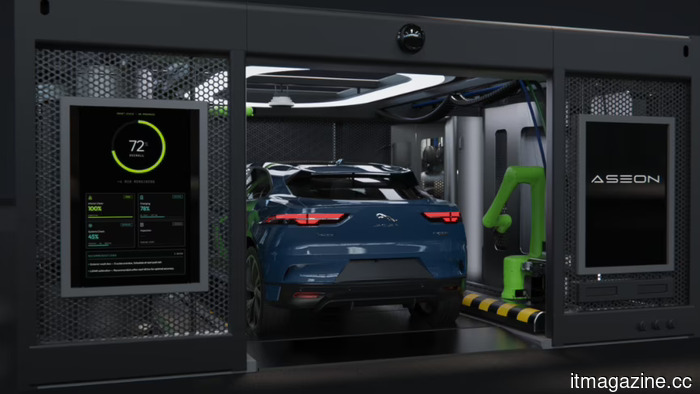 Aseon Labs secures ten million dollars to develop pods the size of parking spaces designed for charging and cleaning robotaxis.
Aseon Labs, supported by Y Combinator, secured $10 million to develop automated pods designed for charging, cleaning, and inspecting robotaxis, reducing the deadhead miles that drain fleet resources.
Aseon Labs secures ten million dollars to develop pods the size of parking spaces designed for charging and cleaning robotaxis.
Aseon Labs, supported by Y Combinator, secured $10 million to develop automated pods designed for charging, cleaning, and inspecting robotaxis, reducing the deadhead miles that drain fleet resources.
 Volkswagen is said to be planning to reduce its workforce by 100,000 positions.
Volkswagen is said to be planning to eliminate 100,000 positions, which constitutes roughly 15% of its workforce, and shut down factories in Germany, marking the largest restructuring in the company’s history.
Volkswagen is said to be planning to reduce its workforce by 100,000 positions.
Volkswagen is said to be planning to eliminate 100,000 positions, which constitutes roughly 15% of its workforce, and shut down factories in Germany, marking the largest restructuring in the company’s history.
 Your Windows 10 computer has received an additional year of security updates. Here's how to obtain it at no cost.
Millions of Windows 10 PCs that are unable to run Windows 11 have received some relief, as Microsoft has extended its free security update program until October 2027.
Your Windows 10 computer has received an additional year of security updates. Here's how to obtain it at no cost.
Millions of Windows 10 PCs that are unable to run Windows 11 have received some relief, as Microsoft has extended its free security update program until October 2027.
 onsemi's Synaptics agreement: a $7 billion wager on tangible AI
The onsemi Synaptics agreement, valued at approximately $7 billion, is based on the belief that the next phase of AI development will occur in automobiles, manufacturing facilities, and robotics rather than in the cloud.
onsemi's Synaptics agreement: a $7 billion wager on tangible AI
The onsemi Synaptics agreement, valued at approximately $7 billion, is based on the belief that the next phase of AI development will occur in automobiles, manufacturing facilities, and robotics rather than in the cloud.
 Apple M7 chips: it is bypassing the premium M6.
Apple's top Macs will feature M7 chips starting in 2027, bypassing the high-end M6 to accelerate on-device AI development during a memory shortage.
Apple M7 chips: it is bypassing the premium M6.
Apple's top Macs will feature M7 chips starting in 2027, bypassing the high-end M6 to accelerate on-device AI development during a memory shortage.
Apple M7 chips: it’s bypassing the premium M6.
Apple's M7 chips will drive its top Macs starting in 2027, bypassing the advanced M6 in order to accelerate on-device AI development during a memory shortage.