
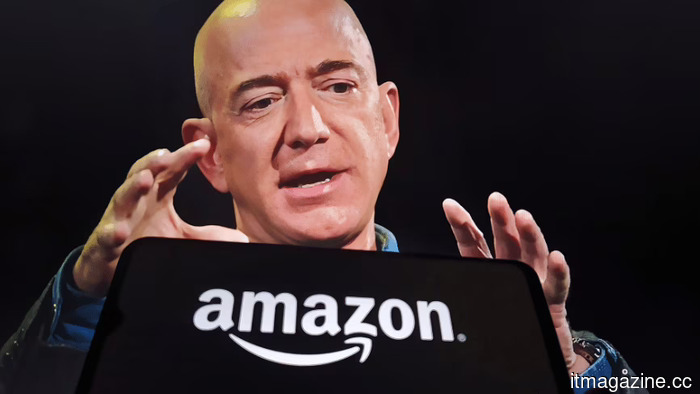
The head of Amazon AI acknowledges that their models fall behind those of OpenAI and Anthropic.
**TL;DR** Amazon's AI leader, Peter DeSantis, acknowledged that the company's models "haven’t been at the very frontier" and expressed a desire to catch up within a year. This admission coincides with Amazon's $33 billion investment in Anthropic while also developing its own competing models.
Peter DeSantis, senior vice president in charge of Amazon’s AI models, custom chips, and quantum computing, confirmed during a CNBC interview that Amazon’s models lag behind in addressing the largest and most demanding workloads. He expressed optimism about Amazon being part of the conversation concerning leading models in the next year, outlining a catch-up strategy that will leverage custom silicon, proprietary data, and the extensive capabilities of Amazon's cloud infrastructure.
**The dual strategy**
Amazon is pursuing two AI initiatives concurrently. Bedrock, its model marketplace, allows cloud customers to access models from OpenAI, Anthropic, Meta, and Mistral through one platform, generating revenue regardless of which model prevails. Nova2, Amazon’s in-house model launched in December, has attracted around 50,000 customers but has not achieved the performance levels of Anthropic’s Claude or OpenAI’s GPT-5.5 for critical enterprise and research tasks, hence DeSantis’s frank acknowledgment.
**The investor hedge**
Amazon has committed as much as $33 billion to Anthropic, which includes a $25 billion deal signed in April that provides Anthropic access to up to five gigawatts of computational power using Amazon’s Trainium chips. In turn, Anthropic has agreed to spend over $100 billion on AWS in the next decade. This partnership enables Amazon to benefit from Anthropic's success through both its equity investment and the cloud revenue generated by Anthropic. Notably, Amazon's Q1 2026 earnings included a $16.8 billion gain related to Anthropic, despite a significant 95% drop in free cash flow.
**The competitive dynamics are stark.** Google has committed up to $40 billion in Anthropic, making it one of Silicon Valley’s most sought-after startups. Additionally, Amazon CEO Andy Jassy reportedly initiated a U.S. government investigation that led to the shutdown of Anthropic’s Fable 5 and Mythos 5 last week, raising concerns about how Amazon balances its role as Anthropic's largest investor with its status as a competitor developing similar models.
**The catch-up plan**
DeSantis’s strategy to bridge the gap focuses on custom AI chips, proprietary training data sourced from Amazon’s retail and logistics sectors, and a large engineering team that encompasses frontier models, silicon design, and quantum research. Most of Bedrock’s inference workloads currently utilize Trainium chips, which are set to see an upgrade with Trainium3, promising four times the performance of its predecessor later this year. Moreover, Jeff Bezos’s separate physical AI lab, Project Prometheus, is raising up to $10 billion, indicating that Amazon's AI ambitions go beyond cloud computing.
The crucial question remains whether custom chips and proprietary data can overcome the significant advantage held by labs that have invested billions into developing frontier models over several years. DeSantis mentioned a timeline of “the coming year,” but did not provide specific metrics for evaluation.
Other articles
 Marcus cautions that OpenAI's IPO might undermine the AI supply chain.
AI researcher Gary Marcus suggests that OpenAI's difficulties with its IPO would have a ripple effect on Nvidia, Oracle, and CoreWeave, especially as enterprise AI investments slow down and the rate of cash burn increases.
Marcus cautions that OpenAI's IPO might undermine the AI supply chain.
AI researcher Gary Marcus suggests that OpenAI's difficulties with its IPO would have a ripple effect on Nvidia, Oracle, and CoreWeave, especially as enterprise AI investments slow down and the rate of cash burn increases.
 The head of Amazon's AI division acknowledges that their models are behind those of OpenAI and Anthropic.
Peter DeSantis mentions that Amazon's AI models "haven't been at the forefront" and expresses his hope to narrow the gap within a year, utilizing custom chips and exclusive data.
The head of Amazon's AI division acknowledges that their models are behind those of OpenAI and Anthropic.
Peter DeSantis mentions that Amazon's AI models "haven't been at the forefront" and expresses his hope to narrow the gap within a year, utilizing custom chips and exclusive data.
 Amazon's AI leader acknowledges that their models are behind those of OpenAI and Anthropic.
Peter DeSantis states that Amazon's AI models "haven't been at the forefront" and expresses a desire to bridge the gap within a year, utilizing custom chips and proprietary data.
Amazon's AI leader acknowledges that their models are behind those of OpenAI and Anthropic.
Peter DeSantis states that Amazon's AI models "haven't been at the forefront" and expresses a desire to bridge the gap within a year, utilizing custom chips and proprietary data.
 Reasons CMOs require a new framework for accountability.
Perion CEO Tal Jacobson discusses how the accountability gap faced by CMOs is an issue of infrastructure rather than measurement, and how AI-driven execution is transforming the way marketing demonstrates its impact on business.
Reasons CMOs require a new framework for accountability.
Perion CEO Tal Jacobson discusses how the accountability gap faced by CMOs is an issue of infrastructure rather than measurement, and how AI-driven execution is transforming the way marketing demonstrates its impact on business.
 Do you have a smartwatch? You can now participate in a study that examines how the football World Cup impacts your heart.
Bielefeld University is calling on smartwatch users to participate in a World Cup research project that monitors how football games influence fans' heart rates, stress levels, movement, and sleep patterns.
Do you have a smartwatch? You can now participate in a study that examines how the football World Cup impacts your heart.
Bielefeld University is calling on smartwatch users to participate in a World Cup research project that monitors how football games influence fans' heart rates, stress levels, movement, and sleep patterns.
 One million Dutch people depend solely on social media for their news.
The 2026 Digital News Report reveals that 7% of Dutch adults rely exclusively on social media for news, an increase from 2% in 2018, although trust and interest are still declining.
One million Dutch people depend solely on social media for their news.
The 2026 Digital News Report reveals that 7% of Dutch adults rely exclusively on social media for news, an increase from 2% in 2018, although trust and interest are still declining.
The head of Amazon AI acknowledges that their models fall behind those of OpenAI and Anthropic.
Peter DeSantis states that Amazon's AI models "haven't been at the forefront" and expresses optimism about bridging the gap within a year, using custom chips and exclusive data.