

U.S. officials have talked about obtaining government shares in AI companies.
The notion is sufficiently unconventional that it took a moment to sink in: the U.S. government owning a portion of the companies developing frontier AI. A report by NOTUS indicated that senior officials from the U.S. government have engaged in initial discussions with major AI companies regarding the federal government acquiring stakes in these firms that are central to the technology it is also attempting to regulate.
This notion involves OpenAI, with CEO Sam Altman having spent the past few weeks in Washington advocating for funding for AI testing rather than mandating model approvals. He has discussed the idea of a government stake with high-ranking officials from the Trump administration since the start of the president's second term, as reported by NOTUS, initially presenting it to Donald Trump in early 2025 and bringing it up again with officials recently.
According to the report, these discussions have focused on companies willingly transferring shares to the government instead of the government purchasing them. The proposal includes ideas about how the government could use the returns, with one suggestion being to allocate the proceeds for public purposes, including a dividend for all American households. This framing transforms government ownership of AI into a means of distributing the technology's benefits directly to citizens.
This concept is politically charged, especially given that, according to polls cited by NOTUS, 55% of Americans believe AI will cause more harm than benefit in their daily lives, paired with OpenAI's current corporate structure being scrutinized amid the Musk v. Altman trial regarding its transition from nonprofit to profit.
The public's skepticism shapes how companies are responding. Tech firms are exploring methods to gain the trust of Americans who are hesitant about AI, and a model that offers the public a stake, whether literal or financial, in the potential benefits serves as a response to the criticism that profits are funneling to a select few. From this perspective, the voluntary ceding of shares is as much about managing reputation as it is about fiscal policy.
However, there is a significant structural concern. A government that holds shares in a company it regulates acts as both a stakeholder and an overseer, which critics highlighted as a conflict. The urge to safeguard the value of such investments stands in stark contrast to the obligation to regulate the company, and no amount of framing focused on public dividends completely alleviates this conflict.
Interestingly, this idea finds unlikely support across the political spectrum. Variants of public equity in AI have been proposed from the left, arguing that if the technology displaces many workers, the public should claim a share of the ensuing profits instead of allowing them to benefit solely private shareholders—a concern OpenAI has acknowledged even while Altman downplays the possibility of an AI-induced job crisis.
The convergence of discussions between the Trump administration and progressive proposals about the state holding an interest on behalf of the public highlights the uncertainty surrounding who benefits from AI technologies.
At this stage, the reporting centers on conversations rather than established policies or agreements. The discussions are characterized as preliminary, the transfer of shares as hypothetical and voluntary, and the dividend as just one among several ideas.
Nonetheless, the mere occurrence of these discussions illustrates the significant shift in the relationship between the U.S. government and the AI industry—from distant regulation to a potential situation where the state could become a co-owner of the technology it is tasked with overseeing.
Other articles
 Meta is alleged to be developing facial recognition capabilities for its AI smart glasses.
A WIRED investigation suggests that Meta has discreetly integrated facial recognition technology into its smart glasses ecosystem, reigniting privacy worries regarding biometric surveillance and wearable AI.
Meta is alleged to be developing facial recognition capabilities for its AI smart glasses.
A WIRED investigation suggests that Meta has discreetly integrated facial recognition technology into its smart glasses ecosystem, reigniting privacy worries regarding biometric surveillance and wearable AI.
 Oura discloses the two activities that its smart ring mistakenly interprets as being involved in unsanitary bed activities.
Oura CEO Tom Hale spoke with the WSJ to address inquiries about the smart ring, and his responses are both intriguing and amusing.
Oura discloses the two activities that its smart ring mistakenly interprets as being involved in unsanitary bed activities.
Oura CEO Tom Hale spoke with the WSJ to address inquiries about the smart ring, and his responses are both intriguing and amusing.
 The top 10 mobile app builders for ecommerce targeted at mid-market and enterprise brands.
From completely managed native applications on any technology stack to AI-powered Shopify builders, these are the mobile app platforms that are effective for high-revenue ecommerce brands.
The top 10 mobile app builders for ecommerce targeted at mid-market and enterprise brands.
From completely managed native applications on any technology stack to AI-powered Shopify builders, these are the mobile app platforms that are effective for high-revenue ecommerce brands.
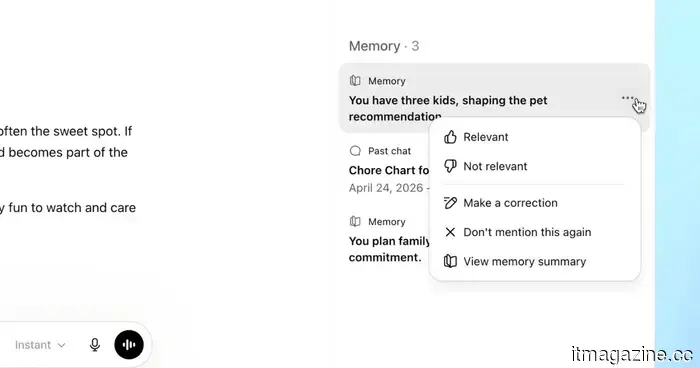 ChatGPT is improving its ability to remember details about your life, making your conversations feel more natural.
OpenAI is launching a revamped memory system for ChatGPT that integrates information from your chat history in the background and refreshes it over time, initially for Plus and Pro users in the US.
ChatGPT is improving its ability to remember details about your life, making your conversations feel more natural.
OpenAI is launching a revamped memory system for ChatGPT that integrates information from your chat history in the background and refreshes it over time, initially for Plus and Pro users in the US.
 Brave Origin is a streamlined browser that removes all the unnecessary details, but obtaining it comes at a cost of $60.
Brave has introduced Origin, a browser priced at $59.99 that eliminates several features. Critics, however, contend that these features can already be turned off at no cost.
Brave Origin is a streamlined browser that removes all the unnecessary details, but obtaining it comes at a cost of $60.
Brave has introduced Origin, a browser priced at $59.99 that eliminates several features. Critics, however, contend that these features can already be turned off at no cost.
 Bowers & Wilkins unveils the revamped 800 Series Diamond D5 range at HIGH END Vienna.
Bowers & Wilkins has introduced its latest 800 Series Diamond D5 speakers, featuring enhanced acoustics, revamped cabinets, and high-end finishes aimed at audiophiles and studio experts.
Bowers & Wilkins unveils the revamped 800 Series Diamond D5 range at HIGH END Vienna.
Bowers & Wilkins has introduced its latest 800 Series Diamond D5 speakers, featuring enhanced acoustics, revamped cabinets, and high-end finishes aimed at audiophiles and studio experts.
U.S. officials have talked about obtaining government shares in AI companies.
According to NOTUS, senior U.S. officials have initiated preliminary discussions with AI companies regarding the government purchasing stakes, a concept that Sam Altman has suggested since 2025.