

China establishes protections for gig workers, covering 200 million platform employees, with a focus on algorithm transparency and a deadline set for 2027.
TL;DR: China's CPC Central Committee and State Council have introduced comprehensive labor regulations for over 200 million gig workers, marking the first formal acknowledgment of protections for this workforce. The new rules set requirements for minimum wage, maximum working hours enforced by the apps, transparency in algorithms subject to collective negotiations with unions, and a compliance deadline of 2027. These regulations aim not only to safeguard workers but also to boost consumer spending in a shift towards consumption-driven economic growth. Gig workers currently earning between $563 and $845 per month need to be empowered as consumers, a scenario feasible given the profitability of major platforms like Meituan, Didi, and Alibaba to cover compliance costs.
On Sunday, China’s foremost governing bodies, the Chinese Communist Party Central Committee and the State Council, announced extensive labor regulations for gig workers—the first time the top authority has formalized protections for the over 200 million individuals engaged in food delivery, ride-hailing, and livestreaming through online platforms. Key mandates require platforms to pay at least the local minimum wage and to limit working hours, after which the app must cease sending orders. There will also be requirements for algorithm transparency when policies impact pay or task allocation, with a target for standardizing labor practices by 2027. Unlike prior regulations, which stemmed from individual ministries and served only as guidelines, these new rules, affecting companies like Meituan, Didi Chuxing, Alibaba’s Ele.me, JD.com, and SF Express, signify a top-down approach following a government initiative for “employment administrative guidance.”
The regulations implement several new concrete protections for gig workers. Platforms are mandated to pay at least the local minimum wage and provide reasonable additional pay for work on public holidays. Businesses must negotiate with labor unions or worker representatives to establish maximum order-taking times and maximum daily working hours. Once workers reach those defined limits, the system must stop dispatching orders and send notifications through the app to encourage rest. Employment contracts are required when a genuine employment relationship exists, while lower-tier workers should have written agreements outlining their terms. Furthermore, enterprises must involve workers in discussions about labor rules, which must be publicly displayed for a minimum of seven days prior to implementation.
The most notable aspect of these regulations is the provisions regarding algorithms, marking a significant shift from previous labor regulations in China and differing from existing frameworks in the European Union and the United States. Platforms must create and update algorithms that dictate tasks, pay rates, and work hours, taking into account the views of labor unions or worker representatives in their design. If requested by unions, companies must engage in negotiations and provide necessary information for those discussions. This represents a move towards collective bargaining concerning algorithms, positioning the algorithms that determine gig workers’ earnings as subjects for negotiation. In the gig economy, where algorithms dictate many job aspects, their regulation becomes critical for labor policy.
The issues these regulations address have been recognized for years. A 2020 investigation by Renwu magazine highlighted the dangers and pressures faced by delivery workers, detailing how algorithms from companies like Meituan and Ele.me led to unsafe practices, such as running red lights. A survey in 2023 found that about half of food delivery riders earned between 4,000 and 5,999 yuan per month (around $563 to $845), with a mere 7% making over 8,000 yuan. In response to criticism from the Renwu investigation, Ele.me introduced a feature allowing customers to extend their wait time, a move seen as evading responsibility. Hyper-surveillance is common in corporations worldwide, as evidenced by tracking software by companies like Meta for employees; however, the depth of algorithmic control in China's gig sector is particularly extensive.
The timing of these regulations reflects China’s current economic state, with youth unemployment reaching 16.5% in December 2025. Some economists estimate that the true figure may exceed 40% when accounting for underemployed individuals. Over 12 million university graduates are anticipated to enter the workforce in 2026, with many likely finding jobs on platforms. The 15th Five-Year Plan, covering 2026 to 2030, emphasizes a transition towards greater domestic consumption. To facilitate this transition, workers in flexible employment, who comprise about 27% of the workforce, need adequate income to contribute to the economy. Those earning around $563 without social insurance do not stimulate consumption; they present a fiscal concern and risk social unrest. Thus, these regulations serve not only as labor policy but also as economic strategy.
China has made significant strides in closing the AI performance gap with the United States, achieving this with considerably less investment. The platform companies employing gig workers are central to this advancement. Meituan, Didi, and Alibaba are not merely delivery and ride-hailing services but also AI-driven companies with sophisticated logistics and automation systems, representing some of the most advanced commercial applications of AI globally. The Chinese government believes it can impose labor costs on these platforms without jeopardizing
Other articles
 Beijing issues a warning to the EU following the inclusion of 27 Chinese companies in the 20th sanctions package against Russia and responds by taking action against European defense firms.
China criticized the European Union's 20th sanctions package, which affects 27 Chinese entities, and responded within a day by targeting seven EU defense companies. Europe's rearmament relies on the rare earth materials that Beijing possesses.
Beijing issues a warning to the EU following the inclusion of 27 Chinese companies in the 20th sanctions package against Russia and responds by taking action against European defense firms.
China criticized the European Union's 20th sanctions package, which affects 27 Chinese entities, and responded within a day by targeting seven EU defense companies. Europe's rearmament relies on the rare earth materials that Beijing possesses.
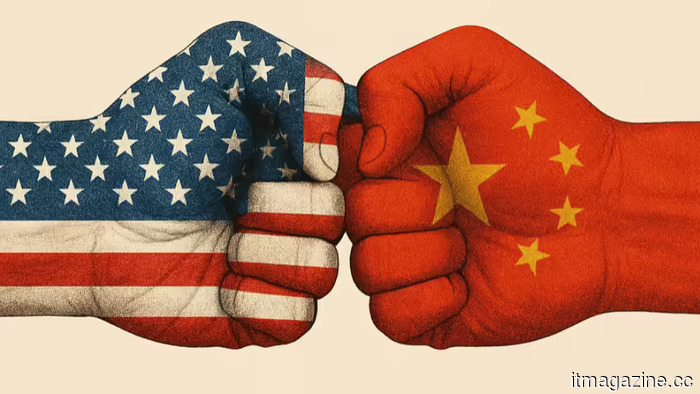 The US aims to restrict China's access to chip manufacturing equipment. In response, China warns that this will disrupt the supply chain for all involved.
China cautions that the MATCH Act could interfere with global semiconductor supply chains as the US Congress progresses with the most extensive export control markup in history.
Sequoia hands out 200 engraved Mac Minis at the AI event as OpenClaw establishes itself as the infrastructure layer that venture capitalists cannot possess.
Alfred Lin distributed 200 engraved Mac Minis that operate on OpenClaw, the open-source AI agent framework that has outperformed Apple's stock and exceeded React on GitHub. Sequoia is unable to invest in it. That is the approach being used.
The trial between Musk and Altman starts, with $150 billion on the line due to OpenAI's shift from a nonprofit to a for-profit model.
Jury selection will begin on Monday for the Musk-Altman trial. In his 2017 diary, Brockman referred to OpenAI's nonprofit pledge as "a lie." The judge has determined there is "ample evidence" and will independently decide on the remedies.
The trial between Musk and Altman commences, with $150 billion on the line regarding OpenAI's shift from nonprofit to for-profit status.
Jury selection will begin on Monday for the Musk-Altman trial. In his 2017 diary, Brockman referred to OpenAI's commitment to being a nonprofit as "a lie." The judge has found "ample evidence" and will independently determine the remedies.
Foundation Future Industries secures $24 million in Pentagon contracts for humanoid robot soldiers, with support from Eric Trump and trials conducted in Ukraine.
Foundation Future Industries has obtained $24 million in contracts from the Pentagon for humanoid robots that have been tested in Ukraine. The company's CEO previously led a bankrupt fintech, and it has Eric Trump as an adviser. The firm is seeking $500 million at a valuation exceeding $3 billion.
The US aims to restrict China's access to chip manufacturing equipment. In response, China warns that this will disrupt the supply chain for all involved.
China cautions that the MATCH Act could interfere with global semiconductor supply chains as the US Congress progresses with the most extensive export control markup in history.
Sequoia hands out 200 engraved Mac Minis at the AI event as OpenClaw establishes itself as the infrastructure layer that venture capitalists cannot possess.
Alfred Lin distributed 200 engraved Mac Minis that operate on OpenClaw, the open-source AI agent framework that has outperformed Apple's stock and exceeded React on GitHub. Sequoia is unable to invest in it. That is the approach being used.
The trial between Musk and Altman starts, with $150 billion on the line due to OpenAI's shift from a nonprofit to a for-profit model.
Jury selection will begin on Monday for the Musk-Altman trial. In his 2017 diary, Brockman referred to OpenAI's nonprofit pledge as "a lie." The judge has determined there is "ample evidence" and will independently decide on the remedies.
The trial between Musk and Altman commences, with $150 billion on the line regarding OpenAI's shift from nonprofit to for-profit status.
Jury selection will begin on Monday for the Musk-Altman trial. In his 2017 diary, Brockman referred to OpenAI's commitment to being a nonprofit as "a lie." The judge has found "ample evidence" and will independently determine the remedies.
Foundation Future Industries secures $24 million in Pentagon contracts for humanoid robot soldiers, with support from Eric Trump and trials conducted in Ukraine.
Foundation Future Industries has obtained $24 million in contracts from the Pentagon for humanoid robots that have been tested in Ukraine. The company's CEO previously led a bankrupt fintech, and it has Eric Trump as an adviser. The firm is seeking $500 million at a valuation exceeding $3 billion.
China establishes protections for gig workers, covering 200 million platform employees, with a focus on algorithm transparency and a deadline set for 2027.
China's top governing authorities have established regulations for over 200 million gig workers, including minimum wage, maximum working hours, and the need for algorithm transparency. Delivery apps are required to halt order assignments once drivers reach their time limits. Full compliance is expected by 2027.