
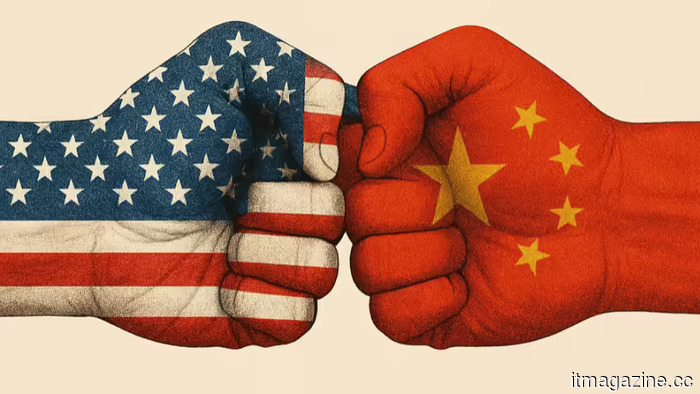
The US aims to restrict China's access to chip manufacturing equipment. In response, China warns that this will disrupt the supply chain for all involved.
**Summary**
China's Ministry of Commerce cautioned that the US chip export legislation could "significantly disrupt" global semiconductor supply chains, in reaction to the House Foreign Affairs Committee's April 22 approval of over 20 export control bills, marking the largest such effort in congressional history. The focal point of this legislation is the MATCH Act, which would mandate the Netherlands and Japan to align their DUV lithography export restrictions with US regulations within 150 days, or face unilateral enforcement that would halt ASML’s remaining sales to China and ban servicing existing equipment. Meanwhile, China has implemented extensive supply chain security rules and rare earth export limits, while the US is simultaneously enhancing its domestic semiconductor capabilities through CHIPS Act investments and the $25 billion Terafab project.
On Friday, China’s Ministry of Commerce expressed that the advancing US legislation would “seriously disrupt the international economic and trade order and significantly undermine the stability of the global semiconductor industry and supply chain." This derogation concerns the MATCH Act, the Multilateral Alignment of Technology Controls on Hardware, which advanced through the House Foreign Affairs Committee on April 22 during what lawmakers characterized as a historic markup of semiconductor export controls. The proposed bill requires the Netherlands and Japan to synchronize their chip equipment export restrictions with US regulations within 150 days or risk unilateral enforcement from the US, including an enhanced Foreign Direct Product Rule, which would extend Washington's jurisdiction over equipment containing any US technology regardless of its origin. If implemented, the MATCH Act would prohibit China's access to remaining DUV immersion lithography machines from ASML, as well as restrict servicing of already deployed machines, a move that would significantly impact every advanced and near-advanced fabrication facility in China.
**Further Details**
On April 22, the House Foreign Affairs Committee, led by Representative Brian Mast, advanced more than 20 export control bills. The MATCH Act, proposed by Representative Michael Baumgartner on April 2, enjoys bipartisan support in both legislative chambers. Senators Jim Risch, Pete Ricketts, Andy Kim, and Chuck Schumer introduced a counterpart Senate version on April 8. The bill identifies SMIC, Huawei, Hua Hong, CXMT, and YMTC as "covered facilities," encompassing all their subsidiaries and affiliates, prohibiting the export of DUV immersion lithography equipment to these entities. It would also restrict allied companies from providing maintenance or upgrade engineering services for machines currently used in Chinese fabs, which would gradually deteriorate existing operational capacity as these machines require consistent upkeep to maintain yield.
Additionally, the committee approved the Chip Security Act, mandating that advanced chips feature location verification mechanisms before export to enable exporters to notify the government if a chip arrives at an unauthorized location. However, the Semiconductor Industry Association has voiced opposition to this requirement, highlighting concerns over “untested and potentially infeasible on-chip mechanisms” that may damage global confidence in American semiconductors. The ECRA Penalty Increase Act would raise civil penalties for export violations to four times the current limit, increasing the per-violation cap from $300,000 to $1.2 million. The ECRA Statute of Limitations Extension Act would extend the prosecution timeframe from five to ten years. The Deterring American AI Model Theft Act would authorize sanctions against Chinese AI companies accused of misusing US-developed models. An incident involving the smuggling of $2.5 billion worth of Nvidia servers to China, as alleged against a co-founder of Super Micro Computer, underscores both the considerable demand for restricted chips and the limitations of an enforcement strategy that relies on declared end-use and corporate compliance efforts.
**Heightened Tensions**
The MATCH Act represents the most significant escalation in US semiconductor export restrictions since the initial measures enacted in October 2022, which barred the export of advanced computing chips and chipmaking equipment to China. These rules were revised in October 2023 to plug loopholes, expanded in December 2024 to encompass high-bandwidth memory and additional equipment, and supplemented in January 2026 when the Trump administration introduced a 25% Section 232 tariff on advanced semiconductor imports, converting the export review policy for Nvidia’s H200 and AMD’s MI325X from a presumption of denial to case-by-case evaluations. Blackwell-class chips continue to be under a presumption of denial. The January 2026 updates were partially in response to Nvidia CEO Jensen Huang's advocacy that excessive restrictions would drive Chinese AI labs toward domestic alternatives. Developing DeepSeek optimizing AI models for Huawei chips instead of Nvidia hardware is, according to Huang, “a terrible outcome” for the US, as it would sever the software dependency on Nvidia’s CUDA ecosystem that currently provides American chips with their competitive edge.
The MATCH Act contrasts with the relaxation introduced in January; where the executive branch eased restrictions on finished chips, Congress aims to tighten controls on the equipment used to manufacture them. The rationale is that managing equipment is more effective than controlling chips since a lithography tool can cost $200 million and
Other articles
 Sam Altman has issued an apology following OpenAI's decision not to report the ChatGPT user involved in the Tumbler Ridge school shooting.
OpenAI identified the Tumbler Ridge shooter's ChatGPT account as a concern 8 months prior to the incident. Staff suggested notifying law enforcement, but their superiors dismissed the recommendation. Altman's apology does not bridge the gap.
Foundation Future Industries secures $24 million contracts from the Pentagon for humanoid robot soldiers, with support from Eric Trump and trialed in Ukraine.
Foundation Future Industries has obtained $24 million in Pentagon contracts for humanoid robots that were tested in Ukraine. The company's CEO previously led a bankrupt fintech, an adviser to the firm is Eric Trump, and it is seeking $500 million at a valuation exceeding $3 billion.
Sequoia hands out 200 engraved Mac Minis at an AI event as OpenClaw emerges as the infrastructure layer that VCs cannot control.
Alfred Lin distributed 200 engraved Mac Minis that operate on OpenClaw, an open-source AI agent framework that has surpassed Apple's stock sales and outperformed React on GitHub. Sequoia is unable to invest in it. This is the approach being taken.
Foundation Future Industries secures $24 million in Pentagon contracts for humanoid robotic soldiers, with support from Eric Trump and having undergone testing in Ukraine.
Foundation Future Industries has obtained $24 million in contracts from the Pentagon for humanoid robots that were tested in Ukraine. The company's CEO previously led a fintech that went bankrupt, and Eric Trump serves as an adviser. They are seeking $500 million at a valuation exceeding $3 billion.
Sam Altman has issued an apology following OpenAI's decision not to report the ChatGPT user involved in the Tumbler Ridge school shooting.
OpenAI identified the Tumbler Ridge shooter's ChatGPT account as a concern 8 months prior to the incident. Staff suggested notifying law enforcement, but their superiors dismissed the recommendation. Altman's apology does not bridge the gap.
Foundation Future Industries secures $24 million contracts from the Pentagon for humanoid robot soldiers, with support from Eric Trump and trialed in Ukraine.
Foundation Future Industries has obtained $24 million in Pentagon contracts for humanoid robots that were tested in Ukraine. The company's CEO previously led a bankrupt fintech, an adviser to the firm is Eric Trump, and it is seeking $500 million at a valuation exceeding $3 billion.
Sequoia hands out 200 engraved Mac Minis at an AI event as OpenClaw emerges as the infrastructure layer that VCs cannot control.
Alfred Lin distributed 200 engraved Mac Minis that operate on OpenClaw, an open-source AI agent framework that has surpassed Apple's stock sales and outperformed React on GitHub. Sequoia is unable to invest in it. This is the approach being taken.
Foundation Future Industries secures $24 million in Pentagon contracts for humanoid robotic soldiers, with support from Eric Trump and having undergone testing in Ukraine.
Foundation Future Industries has obtained $24 million in contracts from the Pentagon for humanoid robots that were tested in Ukraine. The company's CEO previously led a fintech that went bankrupt, and Eric Trump serves as an adviser. They are seeking $500 million at a valuation exceeding $3 billion.
The US aims to restrict China's access to chip manufacturing equipment. In response, China warns that this will disrupt the supply chain for all involved.
China cautions that the MATCH Act could interfere with global semiconductor supply chains as the US Congress progresses with the most extensive export control markup in history.