
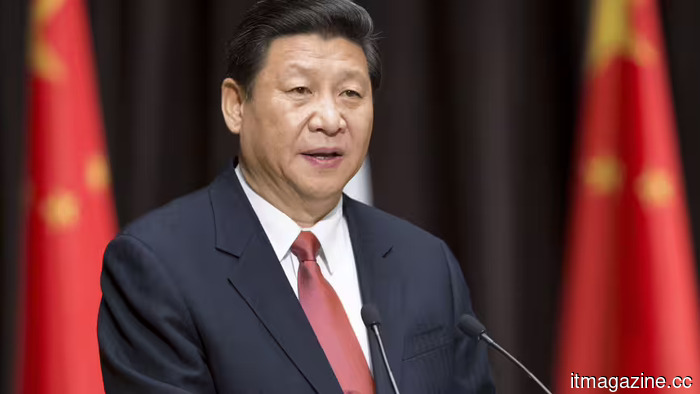
Beijing issues a warning to the EU following the inclusion of 27 Chinese companies in the 20th sanctions package against Russia and responds by taking action against European defense firms.
**Summary**: China criticized the EU's 20th sanctions package, which included around 27 entities from China and Hong Kong for providing dual-use goods to Russia’s military sector. In response, China quickly added seven EU defense companies to its export control list, framing the action as related to Taiwan instead of acknowledging the connection to Russia. The EU faces a dilemma: while its sanctions demand limiting Chinese technology exports to Russia, its defense capabilities rely on critical minerals and rare earth magnets from China, which could be restricted in retaliation.
On Saturday, China's Ministry of Commerce formally condemned the EU’s inclusion of about 27 entities in its largest sanctions package against Russia in two years. China stated this action contradicts the agreement reached between Chinese and EU leaders and undermines bilateral trust and stability, warning of necessary measures to protect Chinese businesses, placing the onus of consequences on the EU. Within a day of the sanctions being implemented on April 23, China added seven EU entities to its export control list, banning all dual-use exports to them. The targeted defense firms were from Belgium, Germany, and the Czech Republic, but China portrayed the action not as retaliation for the Russia sanctions but as a consequence for “arms sales to or collusion with Taiwan,” thus allowing it to escalate tensions without directly addressing the main issue.
**Details of the Sanctions Package**: The EU adopted the 20th sanctions package on April 23 after delays due to vetoes from Hungary and Slovakia, who tied their agreement to the resumption of Russian oil through the Druzhba pipeline. Once the oil resumed, those countries withdrew their objections. This package introduced 120 new sanctions, including targeting 56 entities linked to Russia's military and energy sectors, imposing bans on transactions with 20 Russian banks and four third-country financial institutions believed to be involved in evasion, and designating 46 more vessels as part of a shadow fleet. New restrictions were also placed on cryptocurrency platforms. Notably, the Kyrgyz Republic is the first entire jurisdiction labeled as a "systematic and persistent circumvention risk." Additionally, the EU launched a €90 billion loan package for Ukraine, and Kaja Kallas, the EU high representative for foreign affairs, indicated that preparations for the 21st sanctions package had already commenced.
The entities sanctioned fell into two categories. Sixteen entities from third countries, including China, the UAE, Uzbekistan, Kazakhstan, and Belarus, were frozen for supplying dual-use goods or weapons to Russia. Of the 60 entities added under enhanced export controls, 28 are in China and Hong Kong, facing heightened restrictions on dual-use technology exports. Notably, the China Space Sanjiang Group was sanctioned under Belarus sanctions for its role in producing military chassis. The trend in sanctions packages is concerning; previous rounds have progressively targeted more Chinese entities.
**Trade Dynamics**: China-Russia trade reached $245 billion in 2024, more than double that of 2020, but fell by 6.9% in 2025 due to complications from financial sanctions affecting payment systems and increased caution among Chinese banks. However, not all goods suffered a decline, as China exported $1.9 billion in essential dual-use items to Russia in just the first half of 2025. Full-year dual-use shipments surpassed $4 billion in both 2024 and 2025. There was a dramatic rise in manganese ore exports to Russia, and turbojet engine exports to Russia saw an increase of 37% in comparison to earlier years. Prices for Chinese export-controlled items sent to Russia surged significantly compared to those sent to other markets, suggesting the scarcity is driving higher costs.
The United States has been sanctioning Chinese firms for assisting Russia since 2024, acting more swiftly and aggressively than the EU. In October 2024, the U.S. Treasury sanctioned Chinese drone companies manufacturing drones for Russia. By 2025, over 20 Chinese firms were sanctioned for supplying critical inputs to Russia's defense industry. The dynamic is shifting, with the EU's 20th package drawing its policy stance closer to that of the U.S. The U.S. has seen these sanctions as a mechanism not only against Russian support but also as a way to curb Chinese technological development, which Beijing perceives as a concerted effort to contain it.
**China's Retaliation**: China's immediate response included placing seven EU defense firms on its export control list, prohibiting them from receiving any dual-use exports from China. This was strategically framed as a Taiwan issue, which allows Beijing to impose costs on European industry without reaffirming any support to Russia's military.
**Underlying Contradictions**: The EU is in a precarious situation. Its sanctions policy against Russia necessitates restricting Chinese entities that provide dual-use technology to the Russian military-industrial complex. Simultaneously, its defense strategy relies heavily on rare earth minerals and components predominantly sourced from China. The EU's substantial trade relationship with China, amounting
Other articles
 China establishes protections for gig workers, covering 200 million platform workers, with a focus on algorithm transparency and a deadline set for 2027.
China’s top governing authorities have established regulations for over 200 million gig workers, including minimum wage, maximum working hours, and transparency of algorithms. Apps are required to halt order dispatch when drivers reach their time limits. Compliance is expected by 2027.
China establishes protections for gig workers, covering 200 million platform workers, with a focus on algorithm transparency and a deadline set for 2027.
China’s top governing authorities have established regulations for over 200 million gig workers, including minimum wage, maximum working hours, and transparency of algorithms. Apps are required to halt order dispatch when drivers reach their time limits. Compliance is expected by 2027.
 I'm still enjoying the original Switch in 2026. It’s reliable since everything else has become more complicated.
Although Nintendo's original Switch is less powerful than current handhelds, in 2026, its simplicity appears to be less of a disadvantage and more like its main appeal.
I'm still enjoying the original Switch in 2026. It’s reliable since everything else has become more complicated.
Although Nintendo's original Switch is less powerful than current handhelds, in 2026, its simplicity appears to be less of a disadvantage and more like its main appeal.
 Sam Altman has issued an apology following OpenAI's decision not to report a ChatGPT user involved in the Tumbler Ridge school shooting.
OpenAI marked the ChatGPT account of the Tumbler Ridge shooter as suspicious eight months prior to the attack. Staff suggested notifying law enforcement, but their leadership decided against it. Altman's apology does not bridge the gap.
Sam Altman has issued an apology following OpenAI's decision not to report a ChatGPT user involved in the Tumbler Ridge school shooting.
OpenAI marked the ChatGPT account of the Tumbler Ridge shooter as suspicious eight months prior to the attack. Staff suggested notifying law enforcement, but their leadership decided against it. Altman's apology does not bridge the gap.
 China establishes protections for gig workers, impacting 200 million platform employees, with an emphasis on algorithm transparency and a deadline set for 2027.
China's top governing authorities have required minimum wage, maximum working hours, and transparency in algorithms for over 200 million gig workers. Applications are prohibited from dispatching orders once drivers reach their time limits. Compliance is expected by 2027.
Foundation Future Industries secures $24 million in Pentagon contracts for humanoid robot soldiers, supported by Eric Trump and trialed in Ukraine.
Foundation Future Industries has obtained $24 million in contracts from the Pentagon for humanoid robots that have been tested in Ukraine. The company's CEO previously led a bankrupt fintech firm, an adviser to the company is Eric Trump, and it is seeking $500 million with a valuation exceeding $3 billion.
Sequoia hands out 200 engraved Mac Minis at an AI event as OpenClaw emerges as the infrastructure layer that VCs cannot possess.
Alfred Lin donated 200 engraved Mac Minis operating on OpenClaw, the open-source AI agent framework that has outpaced Apple's stock and exceeded React on GitHub. Sequoia is unable to invest in it. That's the tactic.
China establishes protections for gig workers, impacting 200 million platform employees, with an emphasis on algorithm transparency and a deadline set for 2027.
China's top governing authorities have required minimum wage, maximum working hours, and transparency in algorithms for over 200 million gig workers. Applications are prohibited from dispatching orders once drivers reach their time limits. Compliance is expected by 2027.
Foundation Future Industries secures $24 million in Pentagon contracts for humanoid robot soldiers, supported by Eric Trump and trialed in Ukraine.
Foundation Future Industries has obtained $24 million in contracts from the Pentagon for humanoid robots that have been tested in Ukraine. The company's CEO previously led a bankrupt fintech firm, an adviser to the company is Eric Trump, and it is seeking $500 million with a valuation exceeding $3 billion.
Sequoia hands out 200 engraved Mac Minis at an AI event as OpenClaw emerges as the infrastructure layer that VCs cannot possess.
Alfred Lin donated 200 engraved Mac Minis operating on OpenClaw, the open-source AI agent framework that has outpaced Apple's stock and exceeded React on GitHub. Sequoia is unable to invest in it. That's the tactic.
Beijing issues a warning to the EU following the inclusion of 27 Chinese companies in the 20th sanctions package against Russia and responds by taking action against European defense firms.
China criticized the European Union's 20th sanctions package, which affects 27 Chinese entities, and responded within a day by targeting seven EU defense companies. Europe's rearmament relies on the rare earth materials that Beijing possesses.