
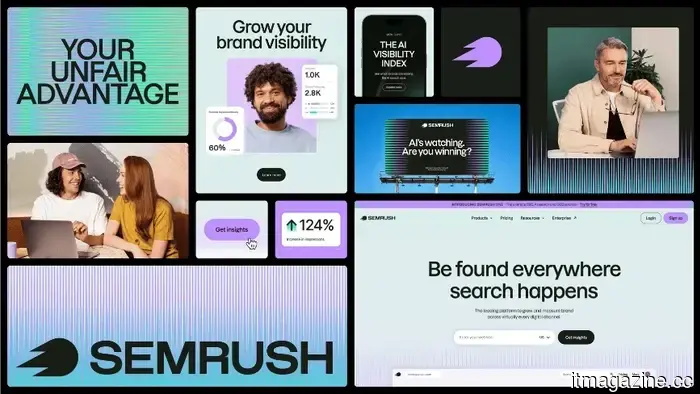
The Semrush Brand Visibility Framework was introduced at the Adobe Summit as AI search redefines the rules of discovery.
Summary: At Adobe Summit, Semrush introduced a Brand Visibility Framework featuring “Agentic Search Optimisation” as a new method to assess brand presence within AI-generated responses, conventional search, and autonomous AI agents, utilizing data from 213 million large language model prompts. This framework comes at a time when organic click-through rates have decreased by 61% for queries with AI Overviews, with 62% of brands deemed invisible to generative AI, while Semrush’s AI product revenue surged by 850% to $38 million ARR, all while the firm awaits the finalization of its $1.9 billion acquisition by Adobe.
During the Adobe Summit in Las Vegas, Semrush unveiled what it terms a Brand Visibility Framework, a strategic model to evaluate how brands are found across traditional search engines, AI-generated answers, and autonomous AI agents. The framework presents “Agentic Search Optimisation” as a novel operational discipline and leverages over 213 million prompts from large language models to illustrate how brands are discussed, recommended, or overlooked in systems that do not require human interaction for link clicks.
The launch is timely as Semrush is in the process of being acquired by Adobe for $1.9 billion, a deal that was announced in November 2025 and is anticipated to close in the first half of this year. This framework enhances Semrush’s role as the visibility component within Adobe’s marketing ecosystem at a pivotal moment when AI is fundamentally changing how brands are perceived.
The framework addresses a critical issue: data reveals troubling trends for businesses reliant on organic search traffic. Gartner predicted in February 2024 a 25% decline in traditional search engine traffic by 2026 due to the rise of AI chatbots and virtual agents, a trend that is proving accurate. Google’s AI Overviews now trigger on 48% of tracked search queries, up 58% from the previous year, and on 80 to 88% of informational queries based on the industry. There has been a 61% drop in organic click-through rates on queries featuring AI Overviews, according to Seer Interactive, while paid search click-through rates fell from about 11% to 3% in just one month last year.
The percentage of zero-click searches, where users receive answers without visiting any website, rose from 56% to 69% of all queries between May 2024 and May 2025. ChatGPT has reached 800 million weekly active users, and Perplexity processed 780 million queries in May 2025 alone. While traffic from AI search converts at 14.2% compared to 2.8% from traditional Google searches, it is significantly lower overall, and brands have limited control over whether AI systems mention them.
A notable finding in the associated research is the disconnect between investment and visibility. Although 94% of brands heavily invest in traditional SEO, 62% are labeled “technically invisible” to generative AI models. There is an 8 to 12% overlap between results appearing in AI-generated answers and those ranking well in traditional search. ChatGPT primarily cites pages ranked 21st or lower, indicating that traditional search engine optimization, which forms the basis of Semrush’s business, does not necessarily translate into visibility in emerging systems.
Semrush defines brand visibility as “the extent to which a brand is discoverable, authoritatively represented, and commercially actionable across both human- and machine-mediated discovery surfaces.” The framework includes a two-part research series: one that explores how to execute a Brand Visibility Operating Model, and the other providing a strategic overview for chief marketing officers dealing with AI search.
The operational focus is on Agentic Search Optimisation, which Semrush differentiates from traditional SEO. Traditional SEO was designed for a scenario where users would sift through a list of links, while Agentic Search Optimisation is developed for a landscape where AI agents assess brand relevance and authority on behalf of users, providing recommendations without showing alternatives. This difference is crucial as AI systems do not rank pages; they generate answers from various sources, and the factors determining a brand's inclusion in those answers differ from those affecting page rankings on Google.
The framework builds on Semrush’s AI Visibility Index, introduced in October 2025, which monitors brand mentions, mention positions, website citations, and share of voice across platforms like ChatGPT, Google AI Mode, Perplexity, and Gemini. The index uses the extensive database of 213 million LLM prompts to offer what Semrush describes as “keyword research for AI,” outlining the topics, intent, and volume of queries directed at AI systems rather than traditional search engines.
On the commercial front, Semrush reported $443.6 million in revenue for fiscal 2025, an 18% year-over-year increase, with annual recurring revenue reaching $471.4 million. The company boasts 117,000 paying customers and over 10 million total users. Most notably, its AI product revenue surged to
Other articles
 The demand for chips in AI may result in memory prices remaining excessively high for several years.
A leading semiconductor executive has indicated that the worldwide wafer shortage could continue until 2030, increasing the likelihood of ongoing pressure on memory prices and the prices of the gadgets you purchase.
The demand for chips in AI may result in memory prices remaining excessively high for several years.
A leading semiconductor executive has indicated that the worldwide wafer shortage could continue until 2030, increasing the likelihood of ongoing pressure on memory prices and the prices of the gadgets you purchase.
 Motorola has just released the Android 17 beta for additional Razr and Edge devices.
Motorola is expanding access to the Android 17 beta for additional premium smartphones, including two Razr models and the Edge 50 Ultra, across multiple regions.
Motorola has just released the Android 17 beta for additional Razr and Edge devices.
Motorola is expanding access to the Android 17 beta for additional premium smartphones, including two Razr models and the Edge 50 Ultra, across multiple regions.
 The LG 77-inch C5 OLED is priced at $1,999, and no other model at this screen size and price range matches its picture quality.
The LG C5 has set a standard for OLED TVs for good reason, and the 77-inch model is currently priced at $1,999.99, reflecting a substantial savings of $1,700 from its comparable value of $3,699.99. At this size and price point, this television transforms the appearance and ambiance of a living room, and the OLED evo panel beneath it [...]
The LG 77-inch C5 OLED is priced at $1,999, and no other model at this screen size and price range matches its picture quality.
The LG C5 has set a standard for OLED TVs for good reason, and the 77-inch model is currently priced at $1,999.99, reflecting a substantial savings of $1,700 from its comparable value of $3,699.99. At this size and price point, this television transforms the appearance and ambiance of a living room, and the OLED evo panel beneath it [...]
 Samsung discreetly released a significant editing upgrade for Galaxy users.
Samsung's Galaxy Enhance-X app has received a significant redesign, featuring new plugin-based effects, enhanced document tools, and batch editing capabilities for both photos and videos.
Samsung discreetly released a significant editing upgrade for Galaxy users.
Samsung's Galaxy Enhance-X app has received a significant redesign, featuring new plugin-based effects, enhanced document tools, and batch editing capabilities for both photos and videos.
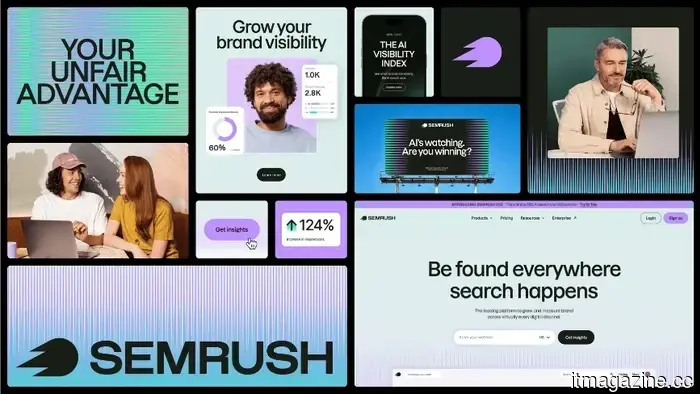 The Semrush Brand Visibility Framework debuted at the Adobe Summit as AI search transforms the guidelines for discovery.
Semrush's latest framework presents Agentic Search Optimisation and utilizes 213 million LLM prompts to assess brand visibility in AI search, as organic CTR experiences a 61% decline.
The Semrush Brand Visibility Framework debuted at the Adobe Summit as AI search transforms the guidelines for discovery.
Semrush's latest framework presents Agentic Search Optimisation and utilizes 213 million LLM prompts to assess brand visibility in AI search, as organic CTR experiences a 61% decline.
 The Elden Ring movie has officially received a release date, boasts an impressive cast, and is being filmed in IMAX.
A24 is currently filming its adaptation of Elden Ring in the UK, with Alex Garland at the helm as director. George R.R. Martin, who collaborated on the game's mythology, is also serving as a producer for the live-action film.
The Elden Ring movie has officially received a release date, boasts an impressive cast, and is being filmed in IMAX.
A24 is currently filming its adaptation of Elden Ring in the UK, with Alex Garland at the helm as director. George R.R. Martin, who collaborated on the game's mythology, is also serving as a producer for the live-action film.
The Semrush Brand Visibility Framework was introduced at the Adobe Summit as AI search redefines the rules of discovery.
Semrush's latest framework presents Agentic Search Optimisation and utilizes 213 million LLM prompts to assess brand visibility in AI search, as organic click-through rates decline by 61%.