
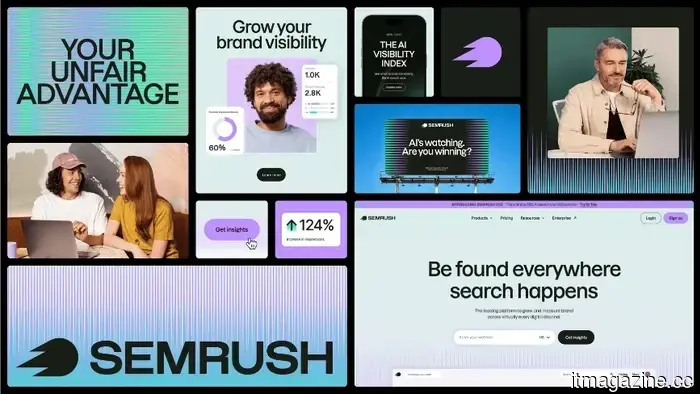
The Semrush Brand Visibility Framework debuted at the Adobe Summit as AI search transforms the guidelines for discovery.
Summary: Semrush unveiled a Brand Visibility Framework at Adobe Summit, introducing "Agentic Search Optimisation" as a novel discipline for assessing brand presence across AI-generated responses, traditional search, and autonomous AI agents, utilizing data from 213 million LLM prompts. The launch coincides with a significant 61% decline in organic click-through rates for queries featuring AI Overviews, with 62% of brands being unrecognizable to generative AI. Additionally, Semrush's revenue from AI products has surged by 850% to an annual run rate of $38 million, all while the company awaits the conclusion of its $1.9 billion acquisition by Adobe.
At the Adobe Summit held in Las Vegas, Semrush introduced its Brand Visibility Framework, a strategic model designed to evaluate how brands are found via traditional search engines, AI-generated responses, and autonomous AI agents. This framework presents "Agentic Search Optimisation" as a new operational discipline, utilizing a database derived from over 213 million large language model prompts to illustrate how brands are mentioned, endorsed, or overlooked in contexts where links are not clicked by users.
The timing of this launch is strategic. Semrush is in the process of being acquired by Adobe for $1.9 billion, a deal that was announced in November 2025 and is anticipated to close in the first half of this year. This framework positions Semrush's capabilities as the visibility layer within Adobe's marketing ecosystem at a time when AI is fundamentally altering where brands are displayed.
The challenges addressed by the framework highlight a grim outlook for businesses reliant on organic search traffic. Gartner forecasted in February 2024 that traditional search engine volumes would decline by 25% by 2026 due to the rise of AI chatbots and virtual agents, a trend that is already evident. AI Overviews from Google now appear in 48% of tracked search queries, marking a 58% increase year-on-year, and on 80 to 88% of informational queries depending on the industry. Organic click-through rates have fallen by 61% for queries featuring AI Overviews, as reported by Seer Interactive, with paid search click-through rates also plummeting from approximately 11% to 3% in just one month last year.
Zero-click searches, where users receive answers without visiting websites, rose from 56% to 69% of all queries between May 2024 and May 2025. ChatGPT boasts 800 million active users weekly, and Perplexity handled 780 million queries in May 2025 alone. Despite AI search traffic converting at 14.2% compared to 2.8% from traditional Google search, the volume is significantly lower, leaving brands with little control over their visibility in AI systems.
A troubling insight from the research linked to the framework is the disparity between investment and visibility. While 94% of brands heavily invest in traditional SEO, 62% remain "technically invisible" to generative AI models, with only 8 to 12% overlap between results that appear in AI-generated answers and those ranking well in traditional search. ChatGPT Search predominantly references pages ranked 21st or lower, indicating that the foundation of search engine optimization, which Semrush relied on, does not consistently lead to visibility in emerging systems.
The framework defines brand visibility as "the extent to which a brand is discoverable, authoritatively represented, and commercially actionable across both human- and machine-mediated discovery surfaces." It introduces a two-part research series: one on implementing a Brand Visibility Operating Model, the other providing strategic insights for chief marketing officers adapting to AI search.
Central to the operation is Agentic Search Optimisation, which Semrush differentiates from traditional SEO. While SEO was crafted for a context where humans sifted through a list of links, Agentic Search Optimisation is aimed at a scenario where AI agents assess brand relevance and authority for users and provide recommendations without presenting alternatives. This distinction is crucial as AI systems do not rank pages but rather synthesize answers based on training data, real-time retrieval, and internal reasoning, with different factors influencing brand inclusion in that synthesis than those affecting traditional rankings.
The framework also builds on Semrush's AI Visibility Index, initiated in October 2025, which monitors brand mentions, mention positions, website citations, and share of voice across platforms like ChatGPT, Google AI Mode, Perplexity, and Gemini. This index leverages the extensive database of 213 million LLM prompts to act as what Semrush describes as "keyword research for AI," charting the topics, intent, and volume of queries directed at AI systems versus search engines.
From a commercial standpoint, Semrush reported $443.6 million in revenue for fiscal 2025, an 18% increase year-on-year, with annual recurring revenue reaching $471.4 million. The firm has 117,000 paying customers and over 10 million total users. However, the most significant statistic
Otros artículos
 The LG 77-inch C5 OLED is now priced at $1,999, and no other option at this screen size and price offers comparable picture quality.
The LG C5 has earned its status as the OLED standard for a valid reason, and the 77-inch model is currently priced at $1,999.99, reflecting a $1,700 discount from its comparison value of $3,699.99. With that size and price, this television transforms the aesthetic and ambiance of a living room, and the OLED evo panel beneath...
The LG 77-inch C5 OLED is now priced at $1,999, and no other option at this screen size and price offers comparable picture quality.
The LG C5 has earned its status as the OLED standard for a valid reason, and the 77-inch model is currently priced at $1,999.99, reflecting a $1,700 discount from its comparison value of $3,699.99. With that size and price, this television transforms the aesthetic and ambiance of a living room, and the OLED evo panel beneath...
 Motorola has recently released the Android 17 beta for additional Razr and Edge devices.
Motorola is expanding access to the Android 17 beta for more premium devices, including two Razr models and the Edge 50 Ultra in different regions.
Motorola has recently released the Android 17 beta for additional Razr and Edge devices.
Motorola is expanding access to the Android 17 beta for more premium devices, including two Razr models and the Edge 50 Ultra in different regions.
 Testing for a WhatsApp Plus subscription priced at EUR 2.49 per month has commenced, joining Instagram Plus in Meta's initiative for cross-app premium offerings.
WhatsApp is piloting a subscription model priced at EUR 2.49 per month, which includes features like chat themes, icons, and ringtones. This comes in the wake of Instagram Plus, as Meta develops paid options within its ecosystem of applications catering to 3.3 billion users.
Testing for a WhatsApp Plus subscription priced at EUR 2.49 per month has commenced, joining Instagram Plus in Meta's initiative for cross-app premium offerings.
WhatsApp is piloting a subscription model priced at EUR 2.49 per month, which includes features like chat themes, icons, and ringtones. This comes in the wake of Instagram Plus, as Meta develops paid options within its ecosystem of applications catering to 3.3 billion users.
 tim-cook-resigns-as-apple-ceo-john-ternus
Tim Cook will assume the role of executive chairman on September 1, while John Ternus, the head of Apple's hardware engineering, will step in as CEO of the $4 trillion company.
tim-cook-resigns-as-apple-ceo-john-ternus
Tim Cook will assume the role of executive chairman on September 1, while John Ternus, the head of Apple's hardware engineering, will step in as CEO of the $4 trillion company.
 How to locate archived emails in Gmail and restore them to your inbox.
Gmail does not have a specific archive folder, but locating archived emails and returning them to your inbox is a simple process that can be completed in just a few steps.
How to locate archived emails in Gmail and restore them to your inbox.
Gmail does not have a specific archive folder, but locating archived emails and returning them to your inbox is a simple process that can be completed in just a few steps.
 Musk disregards Paris prosecutors in the Grok child pornography inquiry while the US Department of Justice declines to provide assistance.
Musk did not show up before Paris prosecutors who are looking into Grok's estimated 23,000 child sexual images, as the US Department of Justice declined to assist with the French investigation.
Musk disregards Paris prosecutors in the Grok child pornography inquiry while the US Department of Justice declines to provide assistance.
Musk did not show up before Paris prosecutors who are looking into Grok's estimated 23,000 child sexual images, as the US Department of Justice declined to assist with the French investigation.
The Semrush Brand Visibility Framework debuted at the Adobe Summit as AI search transforms the guidelines for discovery.
Semrush's latest framework presents Agentic Search Optimisation and utilizes 213 million LLM prompts to assess brand visibility in AI search, as organic CTR experiences a 61% decline.