
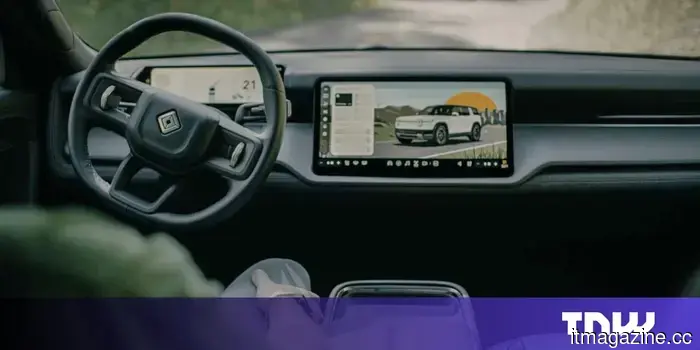
Uber and Rivian finalize a $1.25 billion agreement for robotaxis.
The collaboration leverages Rivian's proprietary chip and complete autonomous technology stack to create a robotaxi service, with plans for commercial rollout in San Francisco and Miami by 2028. While Uber has been rapidly securing robotaxi agreements, this partnership with Rivian stands out due to its unique structure. Unlike previous collaborations with companies like Waymo, Avride, or Zoox, where Uber serves primarily as a distribution channel for existing autonomous vehicle technology, this partnership focuses on a car manufacturer that has developed its own silicon, autonomy software, and manufacturing processes entirely in-house.
On Thursday, Rivian (NASDAQ: RIVN) and Uber (NYSE: UBER) announced that Uber would invest up to $1.25 billion in Rivian by 2031, depending on Rivian achieving various autonomous performance milestones on schedule. A preliminary commitment of $300 million has been made, contingent on regulatory approval. In return, Uber or its fleet partners will buy 10,000 fully autonomous Rivian R2 robotaxis during the initial deployment phase, with an option to negotiate for an additional 40,000 starting in 2030. The overall figure of 50,000 is a cap and not a guaranteed amount.
Commercial operations are set to start in San Francisco and Miami in 2028, expanding to 25 cities in the US, Canada, and Europe by 2031, with the vehicles available exclusively through the Uber platform. All timelines are forward-looking and dependent on milestones, with Rivian’s own financial disclosures indicating that actual outcomes may vary from projections.
The rationale behind the deal is heavily influenced by what Rivian presented at its first Autonomy & AI Day in Palo Alto in December 2025. At this event, the company introduced its complete autonomous driving architecture centered around RAP1, its first in-house processor: a custom 5nm chip capable of delivering 1,600 sparse TOPS of AI computing, manufactured by TSMC.
Two RAP1 chips comprise the company’s Gen 3 Autonomy Compute Module (ACM3), capable of processing 5 billion pixels of sensor data per second. The module utilizes RivLink, a proprietary low-latency connection, which allows chips to be interconnected for enhanced computing capacity.
Rivian has also created its own AI compiler and system software designed to operate on this chip, achieving a level of vertical integration that positions it alongside Tesla as one of the few consumer electric vehicle manufacturers developing proprietary silicon specifically for autonomous driving.
The Gen 3 platform features 11 cameras (totaling 65 megapixels), five radars, and one LiDAR sensor, which is currently undergoing validation and is expected to be integrated into R2 models starting late 2026, based on reports from Autonomy & AI Day by WardsAuto, Edmunds, and Electrek. Rivian confirmed that the first production run of the R2, anticipated earlier in 2026, will launch without the Gen 3 hardware. The robotaxi initiative announced on Thursday is based on the Gen 3 platform, indicating that commercial operations will commence once the hardware validation is successfully completed.
Uber CEO Dara Khosrowshahi highlighted Rivian’s vertical integration as a key reason behind the company’s confidence in the partnership. “We firmly believe in Rivian’s strategy, which involves designing the vehicle, computing platform, and software stack together while retaining end-to-end control of scaled manufacturing and supply within the US,” he stated in the announcement.
This distinction is significant: unlike Uber’s arrangements with Lucid and Nuro, where Nuro supplies the autonomous driving software and Lucid provides the vehicle, Rivian is responsible for constructing and owning the entire technology stack. Uber is licensing access rather than merging technologies from two different companies into a single vehicle.
For Rivian, this agreement not only brings in financing but also provides a critical application for a platform it has meticulously developed over the years. RJ Scaringe, Rivian’s founder and CEO, indicated that the partnership accelerates the company’s journey toward achieving Level 4 autonomy. “The magnitude of Rivian’s expanding data ecosystem along with RAP1, our advanced in-house inference platform, and our multi-modal perception system make us tremendously optimistic about the accelerated development of Rivian's autonomy in the coming years,” he remarked.
As of Q4 2025, Rivian reported total liquidity of $6.59 billion, including nearly $6.1 billion in cash and equivalents, giving the company a solid foundation to absorb the development expenditures implied by the milestone-based investment strategy.
This announcement aligns with a broader surge in Uber's robotaxi initiatives. In the last six months, Uber has formed partnerships with Zoox (Las Vegas this summer; Los Angeles in 2027), Wayve and Nissan (Tokyo in late 2026), NVIDIA and Stellantis (expanding to 28 cities by 2028), and has extended its existing agreements with Waymo, Avride, We
Other articles
 AI analytics agents require boundaries instead of an increase in model size.
AI analytics agents require boundaries rather than larger models. Discover why managed data, common definitions, and semantic layers are more important than the size of the model.
AI analytics agents require boundaries instead of an increase in model size.
AI analytics agents require boundaries rather than larger models. Discover why managed data, common definitions, and semantic layers are more important than the size of the model.
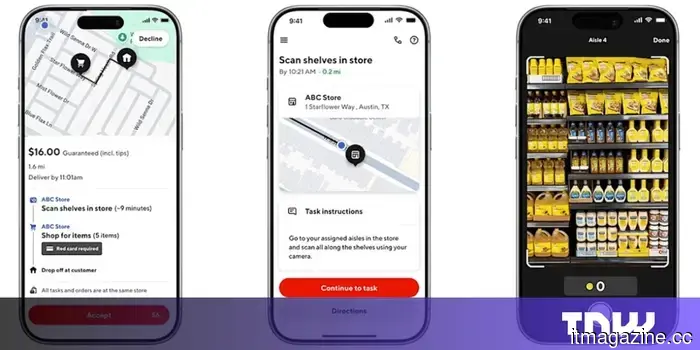 DoorDash introduces Tasks.
DoorDash has introduced Tasks, an independent app that compensates Dashers for capturing videos of household tasks and recording audio to help train AI models.
DoorDash introduces Tasks.
DoorDash has introduced Tasks, an independent app that compensates Dashers for capturing videos of household tasks and recording audio to help train AI models.
 Your inbox serves as a revenue stream for others. It doesn’t have to be that way.
Free email could end up being more costly than you realize. We examine why investing in a paid email service might be the most prudent privacy choice you make this year.
Your inbox serves as a revenue stream for others. It doesn’t have to be that way.
Free email could end up being more costly than you realize. We examine why investing in a paid email service might be the most prudent privacy choice you make this year.
 TACEO introduces its private execution network.
Austrian startup TACEO has introduced the TACEO Network, a private execution layer that is currently operational within World ID's 'proof of human' verification for 18 million users.
TACEO introduces its private execution network.
Austrian startup TACEO has introduced the TACEO Network, a private execution layer that is currently operational within World ID's 'proof of human' verification for 18 million users.
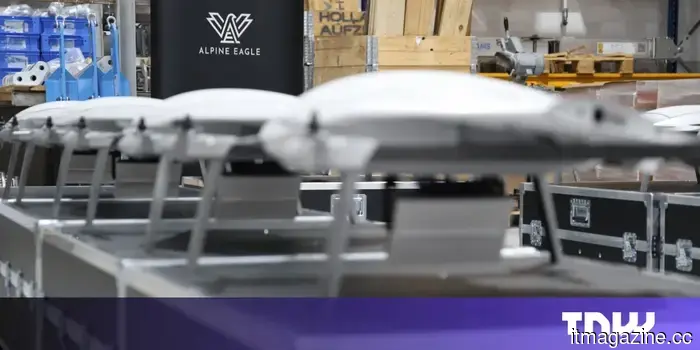 Alpine Eagle is increasing its production of counter-drone systems.
The Munich-based counter-drone startup Alpine Eagle is expanding its Sentinel production through a new facility and a partnership with DeltaQuad.
Alpine Eagle is increasing its production of counter-drone systems.
The Munich-based counter-drone startup Alpine Eagle is expanding its Sentinel production through a new facility and a partnership with DeltaQuad.
 German agritech company eternal.ag secures €8 million in funding.
eternal.ag has secured €8M to implement autonomous tomato harvesting robots that have been trained in virtual greenhouses prior to being deployed in real-world settings.
German agritech company eternal.ag secures €8 million in funding.
eternal.ag has secured €8M to implement autonomous tomato harvesting robots that have been trained in virtual greenhouses prior to being deployed in real-world settings.
Uber and Rivian finalize a $1.25 billion agreement for robotaxis.
Uber plans to invest as much as $1.25 billion in Rivian by 2031, aiming for a fleet of up to 50,000 autonomous R2 robotaxis in 25 cities.