

Your inbox serves as a revenue stream for others. It doesn’t have to be that way.
There comes a moment, typically after the third eerily precise advertisement for something you only mentioned in an email, when you begin to question what your inbox truly knows about you. The answer is, rather concerningly, everything. Moreover, the companies behind the most widely used free email services globally are not keeping that information private.
This article includes affiliate links. If you make a purchase through these links, we could earn a commission at no additional cost to you.
The hidden costs of free email
When Gmail debuted in 2004, the offer of a gigabyte of complimentary storage seemed almost ridiculous. Two decades later, the deal looks altogether different. Google manages around 1.8 billion Gmail accounts globally, and the service remains free because the users are not the customers—advertisers are.
Every email that arrives in a free inbox is analyzed, categorized, and added to a profile used to target ads that follow you online. The contents of your messages, including receipts, travel confirmations, and medical appointment reminders, all contribute to an advertising profile that you never agreed to create and cannot entirely erase. This is not mere speculation but a well-documented business model employed by the largest email services worldwide.
For years, many accepted this trade-off as the alternatives were often costly, unwieldy, or both. However, that's no longer the case.
What private email looks like in 2026
The private email market has advanced significantly. Now, there are services that provide the speed, refinement, and reliability of Gmail without the data exploitation. The concept is straightforward: you pay a reasonable subscription fee, and in return, your provider has no incentive to access your data because the subscription itself is the product, rather than your attention.
Fastmail is among the more intriguing options in this realm, and it's worth understanding why. Established in 1999 in Melbourne, Australia, the company has operated independently for over 25 years, predating Gmail by five years. While much of the tech industry focused on ad revenue in the 2010s, Fastmail discreetly built a subscription email service centered on one seemingly old-fashioned goal: ensuring email functions exceptionally well.
The outcome is a platform that feels significantly quicker than what most users are accustomed to. Full-text searches yield results across your entire inbox in milliseconds rather than seconds. Keyboard shortcuts facilitate nearly every action. Server-side filtering rules enable you to automate sorting and labeling without needing to keep a client open. These might seem minor until you spend a week utilizing them and realize that your previous inbox experience felt laborious.
Key features that hold importance
While it is simple to enumerate features, it is more challenging to articulate their significance. Here's what stands out after extended use.
Custom domains across all plans. If you possess a domain, you can use it with Fastmail right away. This ensures that your email address is owned by you permanently, independent of any provider. If you choose to leave, your address goes with you. For freelancers, small businesses, and anyone considering their email address as professional infrastructure, this feature is quietly one of the most crucial offerings an email service can provide.
Over 600 masked email aliases. Each time you register for a new service, you can create a unique address that forwards to your actual inbox. If that address ends up in the hands of spammers or is exposed in a data breach, you can simply discard it. Fastmail integrates this functionality directly with 1Password, allowing for new alias creation in about two seconds.
Support for open standards. Fastmail natively supports IMAP, SMTP, CalDAV, and CardDAV. This ensures compatibility with any email client you already use—be it Apple Mail, Thunderbird, Outlook, or others that utilize standard protocols. You are not confined to a proprietary app to access your email. This kind of interoperability is surprisingly uncommon among private email providers, some of which necessitate bridge applications or restrict you to their own clients exclusively.
Calendars and contacts included. Each plan encompasses shared calendars, contact management, and file storage. For families and small teams, this eliminates the need for an additional productivity suite. The Duo plan accommodates two users with shared calendars for $8 per month when billed annually, while the Family plan extends to six users for $11 per month.
The privacy issue, explained honestly
Fastmail is clear about its offerings and limitations. It employs TLS encryption during transit and AES encryption at rest, which meets industry standards. However, it does not provide end-to-end encryption, and the company has been candid about the reasons: the usability drawbacks (such as slower searches, limited client support, and complicated key management) do not benefit most users.
If your threat model includes safeguarding against server-side access by a government entity, Fastmail would not be an appropriate choice. For that level of security, a zero-knowledge encrypted service like ProtonMail would be ideal. However, if your main concern is removing your inbox from the advertising ecosystem while enjoying a fast,
Other articles
 Hydrogen fuel vehicles failed to gain popularity, but they could potentially power the next generation of long-range drones.
Hydrogen has not been successful in powering cars, but scientists in Norway have developed a drone that operates on hydrogen, replacing batteries with a fuel cell to manage long-distance tasks such as inspecting power lines.
Hydrogen fuel vehicles failed to gain popularity, but they could potentially power the next generation of long-range drones.
Hydrogen has not been successful in powering cars, but scientists in Norway have developed a drone that operates on hydrogen, replacing batteries with a fuel cell to manage long-distance tasks such as inspecting power lines.
 Microsoft's MAI-Image-2 ranks among the top three AI image generators.
Microsoft's MAI-Image-2 launches at #3 on Arena.ai's text-to-image leaderboard, trailing Google and OpenAI, and starts to be implemented on Copilot.
Microsoft's MAI-Image-2 ranks among the top three AI image generators.
Microsoft's MAI-Image-2 launches at #3 on Arena.ai's text-to-image leaderboard, trailing Google and OpenAI, and starts to be implemented on Copilot.
 TACEO introduces its private execution network.
Austrian startup TACEO has introduced the TACEO Network, a private execution layer that is currently operational within World ID's 'proof of human' verification for 18 million users.
TACEO introduces its private execution network.
Austrian startup TACEO has introduced the TACEO Network, a private execution layer that is currently operational within World ID's 'proof of human' verification for 18 million users.
 Bluesky secures $100 million in Series B funding as a new CEO steps in.
Bluesky announced a $100 million Series B funding round led by Bain Capital Crypto, which was completed last April, and a new CEO has taken over.
Bluesky secures $100 million in Series B funding as a new CEO steps in.
Bluesky announced a $100 million Series B funding round led by Bain Capital Crypto, which was completed last April, and a new CEO has taken over.
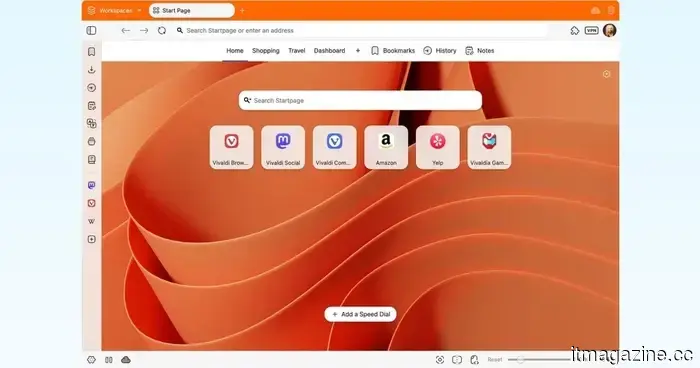 The Vivaldi browser introduces a customizable immersive mode that I wish Safari or Chrome would provide.
Vivaldi 7.9 introduces a more adaptable full-screen mode and improved tab tiling. It surpasses Chrome and Safari, particularly if you're looking for greater control over your browsing experience.
The Vivaldi browser introduces a customizable immersive mode that I wish Safari or Chrome would provide.
Vivaldi 7.9 introduces a more adaptable full-screen mode and improved tab tiling. It surpasses Chrome and Safari, particularly if you're looking for greater control over your browsing experience.
 Hydrogen fuel vehicles never gained widespread popularity, but they could potentially lead to the development of next-generation long-range drones.
Hydrogen has not been effective in cars, but researchers in Norway have developed a drone powered by it, replacing batteries with a fuel cell to manage long-distance tasks such as inspecting power lines.
Hydrogen fuel vehicles never gained widespread popularity, but they could potentially lead to the development of next-generation long-range drones.
Hydrogen has not been effective in cars, but researchers in Norway have developed a drone powered by it, replacing batteries with a fuel cell to manage long-distance tasks such as inspecting power lines.
Your inbox serves as a revenue stream for others. It doesn’t have to be that way.
Free email could end up being more costly than you realize. We examine why investing in a paid email service might be the most prudent privacy choice you make this year.