
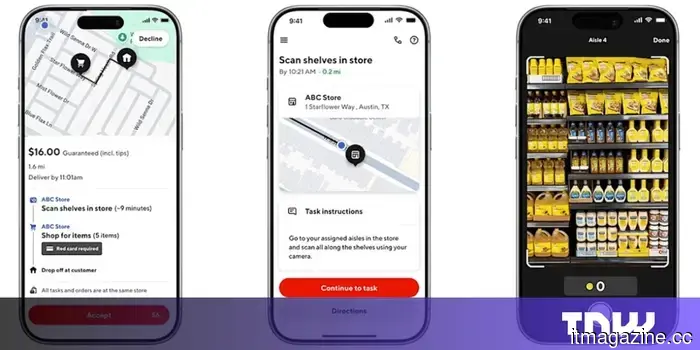
DoorDash introduces Tasks.
In 2026, one example of how the AI data economy operates is a DoorDash courier who puts on a body camera, washes at least five dishes, holds each dish up to the camera for a few seconds, and earns a small amount of money. This unremarkable yet specific footage is exactly what AI and robotics companies require to train models that comprehend physical tasks. A delivery network consisting of eight million individuals, widely distributed across nearly every postal code in the U.S., serves as an incredibly effective means of gathering this data.
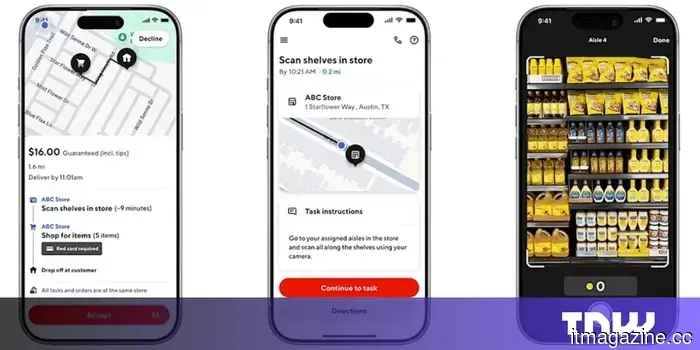
On Thursday, DoorDash introduced Tasks, a new product that formalizes what has gradually developed on the platform over the past year. It functions on two levels.
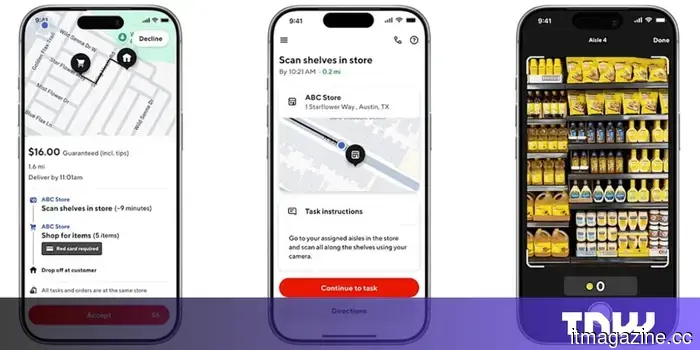
The first involves introducing new task types within the existing Dasher app, such as photographing restaurant dishes for menu updates, capturing images of hotel entrances for drivers to find drop-off locations, or checking inventory on supermarket shelves.
The second level features a standalone Tasks app that focuses on activities unrelated to deliveries, including filming household chores, recording unscripted conversations in different languages, or, notably, collaborating on a project that emerged in February about instructing users to close open doors on Waymo’s self-driving cars in Atlanta.
This Waymo door-closing initiative, which DoorDash and Waymo confirmed to TechCrunch and Bloomberg in February, is already integrated into the Tasks platform. When a Waymo passenger leaves a door ajar, which triggers a safety mechanism preventing the car from moving, nearby Dashers receive a notification and can earn about $11 for driving over to close it. This small transaction carries significant symbolic weight: gig workers, frequently cited as the most vulnerable to displacement by automation, are being compensated by an autonomous vehicle company to resolve an issue that its own technology is currently unable to manage. Waymo has indicated that future vehicles will feature automated door closures.
For DoorDash, the reasoning behind Tasks is clear. The company has invested over a decade into establishing operational infrastructure that can dispatch workers to specific physical locations, verify task completion, and manage payments at scale. This capability aligns perfectly with the requirements for AI data collection and is not easily replicated by companies lacking a similar network.
“There are more than 8 million Dashers who can reach almost anywhere in the U.S. and who want to earn flexibly beyond delivery. That’s a powerful capability to digitize the physical world,” stated Ethan Beatty, General Manager of DoorDash Tasks.
The claim regarding scale is noteworthy: companies like Scale AI have built entire enterprises around remote data labeling workers, and DoorDash is entering that market with an existing distribution network, functioning in-person rather than online, and capable of gathering the kind of physical-world data that is becoming increasingly rare and valuable.
DoorDash reports that Dashers have completed over two million tasks since 2024, a figure that reflects the previous, less-public version of the program before its formal launch on Thursday. Other delivery platforms, such as Uber and Instacart, have also implemented similar initiatives over the past year.
However, the launch leaves several questions unanswered. DoorDash has not provided details regarding consent, data retention, or the rights of workers concerning footage recorded in their own homes. The exclusion of states such as California, New York City, Seattle, and Colorado—regions with much stricter regulations regarding gig workers and data privacy—is notable.
Payment for tasks is decided in advance based on the complexity and effort required, yet no average rates or minimum guarantees have been revealed. For a program that necessitates workers to record in their kitchens and capture their own voices, these are significant omissions.
DoorDash has indicated plans to broaden task types and enter additional countries. For now, what it has released represents a version of something the technology sector has sought to create for years: a human sensing layer over the physical world, compensated by task completion, and available on demand.
Other articles
 Bluesky secures $100 million in Series B funding as a new CEO steps in.
Bluesky announced a $100 million Series B funding round led by Bain Capital Crypto, which was completed last April, and a new CEO has taken over.
Bluesky secures $100 million in Series B funding as a new CEO steps in.
Bluesky announced a $100 million Series B funding round led by Bain Capital Crypto, which was completed last April, and a new CEO has taken over.
 DoorDash introduces Tasks.
DoorDash has introduced Tasks, an independent app that compensates Dashers for filming home chores and recording audio to help train AI models.
DoorDash introduces Tasks.
DoorDash has introduced Tasks, an independent app that compensates Dashers for filming home chores and recording audio to help train AI models.
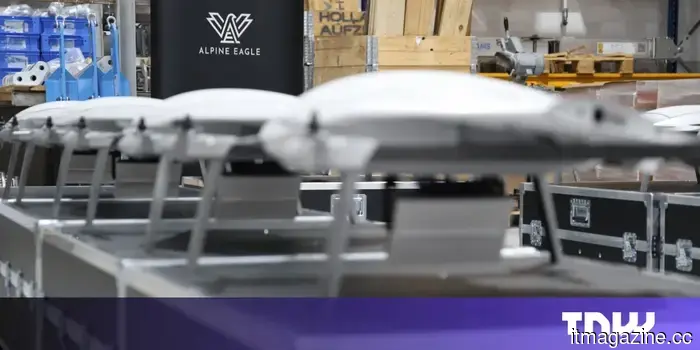 Alpine Eagle is increasing its production of counter-drone systems.
The Munich-based counter-drone startup Alpine Eagle is expanding its Sentinel production through a new facility and a partnership with DeltaQuad.
Alpine Eagle is increasing its production of counter-drone systems.
The Munich-based counter-drone startup Alpine Eagle is expanding its Sentinel production through a new facility and a partnership with DeltaQuad.
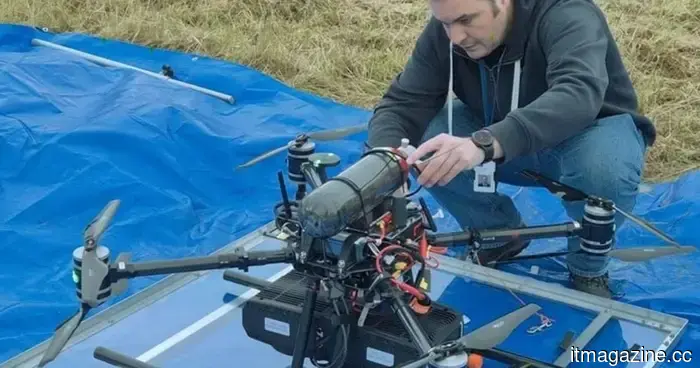 Hydrogen fuel vehicles never gained widespread popularity, but they could potentially lead to the development of next-generation long-range drones.
Hydrogen has not been effective for use in cars, but scientists in Norway have developed a drone powered by hydrogen, replacing batteries with a fuel cell to support long-distance tasks such as inspecting power lines.
Hydrogen fuel vehicles never gained widespread popularity, but they could potentially lead to the development of next-generation long-range drones.
Hydrogen has not been effective for use in cars, but scientists in Norway have developed a drone powered by hydrogen, replacing batteries with a fuel cell to support long-distance tasks such as inspecting power lines.
 Your inbox is a business model for someone else. It doesn't have to be that way.
Free email services can be more expensive than you realize. We explore why investing in a paid email service could be the wisest choice for your privacy this year.
Your inbox is a business model for someone else. It doesn't have to be that way.
Free email services can be more expensive than you realize. We explore why investing in a paid email service could be the wisest choice for your privacy this year.
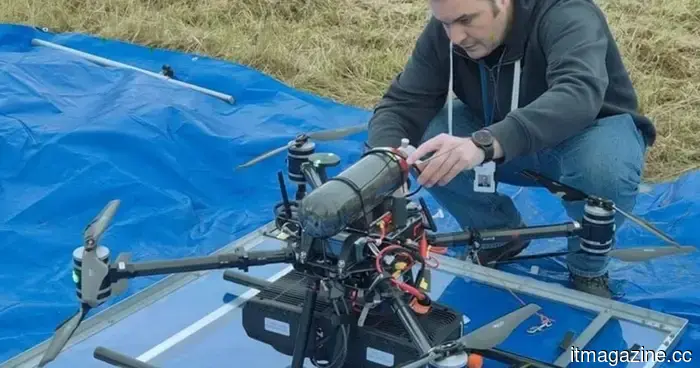 Hydrogen fuel vehicles never gained widespread popularity, but they could potentially lead to the development of next-generation long-range drones.
Hydrogen has not been effective in cars, but researchers in Norway have developed a drone powered by it, replacing batteries with a fuel cell to manage long-distance tasks such as inspecting power lines.
Hydrogen fuel vehicles never gained widespread popularity, but they could potentially lead to the development of next-generation long-range drones.
Hydrogen has not been effective in cars, but researchers in Norway have developed a drone powered by it, replacing batteries with a fuel cell to manage long-distance tasks such as inspecting power lines.
DoorDash introduces Tasks.
DoorDash has introduced Tasks, an independent app that compensates Dashers for capturing videos of household tasks and recording audio to help train AI models.