

TACEO introduces its private execution network.
The TACEO Network, operational within World ID's 'proof of human' verification for over 18 million users, enables organizations to share digital infrastructure while keeping sensitive data secure. When Sam Altman’s World needs to check if a new user's iris has already been registered, it encounters a unique challenge: the computations must be performed on encrypted data throughout the process.
Since 2022, the Austrian startup TACEO has been working on a solution. On Thursday, the Graz-based firm announced the introduction of the TACEO Network, a private execution layer designed for shared digital infrastructure that spans identity, finance, and AI agents. They disclosed that their cryptographic infrastructure is already functioning within World ID, managing 'proof of human' verification for nearly 18 million users in 160 countries.
TACEO addresses a structural issue. Organizations increasingly wish to engage in shared digital platforms, common payment systems, interoperable identity networks, and multi-party financial workflows but are reluctant to expose sensitive elements of these processes to other participants or a central operator.
The standard workaround has been to conduct sensitive processing internally: an internal system manages ‘proof of human' verification, fraud scoring, and routing logic, while other operations leverage shared infrastructure. This approach concentrates risk, complicates compliance, and hinders the full realization of shared system benefits.
TACEO's solution is a private execution layer that supports shared infrastructure. It utilizes two advanced cryptographic methods: Multiparty Computation (MPC), which allows multiple nodes to compute functions on encrypted data without any individual node accessing the unencrypted inputs, and Zero-Knowledge Proofs, which enable a party to demonstrate the correctness of computations without revealing the actual data. TACEO merges these into what it terms coSNARKs: collaborative SNARKs that permit distributed nodes to process encrypted data together and create a verifiable proof of correct execution. The outcome is computation that is both private and auditable.
Founded in 2022 by a team of cryptography researchers from Graz University of Technology, TACEO is led by CEO Lukas Helminger, a former researcher and lecturer there and contributor to the Austrian Defence Department. The team boasts impressive academic qualifications: co-founder and Chief Scientist Christian Rechberger is a professor at TU Graz and co-designer of the Poseidon hash function, a prevalent standard in zero-knowledge cryptography systems.
In July 2025, the company secured a $5.5 million seed round led by Archetype VC, with participation from a16z CSX, the cryptocurrency accelerator of Andreessen Horowitz, which TACEO joined in 2024. The TACEO Network is maintained by a decentralized group of node operators, including Nethermind, a prominent Ethereum infrastructure firm, and the Faculty of Electrical Engineering at the Czech Technical University in Prague. According to the company, nodes are distributed across the US, Europe, and Asia. This decentralized node architecture is vital for the security framework, ensuring that no single operator has control over the entire computation and that no one, including TACEO itself, can access the underlying data.
“For decades, we’ve had to choose between two models: either sensitive data remains private within one organization, or it becomes visible in shared systems,” Helminger stated. “With the introduction of the TACEO Network, that dilemma is beginning to fade. Computation can occur among independent operators while the data stays encrypted.”
The figure of 18 million users mentioned at the launch updates the previous 14 million noted during the July 2025 seed round, indicating ongoing growth in World ID's user base. The data concerning 18 million users and 160 countries originates from TACEO’s press releases and has not been independently verified, although the growth trend aligns with World ID’s announced expansion plans.
Their broader objectives extend beyond biometrics. As stablecoins increasingly mainstream digital settlement and AI agents create new machine-to-machine interactions, the demand for shared digital systems capable of managing sensitive operations without centralization is on the rise. TACEO argues that its private execution layer is the essential infrastructure component that allows financial institutions, identity providers, and AI systems to collaborate on shared networks without relinquishing control over sensitive data to a single entity. The key question for the TACEO Network remains whether it can achieve widespread enterprise adoption.

Other articles
 AI analytics agents require boundaries instead of an increase in model size.
AI analytics agents require boundaries rather than larger models. Discover why managed data, common definitions, and semantic layers are more important than the size of the model.
AI analytics agents require boundaries instead of an increase in model size.
AI analytics agents require boundaries rather than larger models. Discover why managed data, common definitions, and semantic layers are more important than the size of the model.
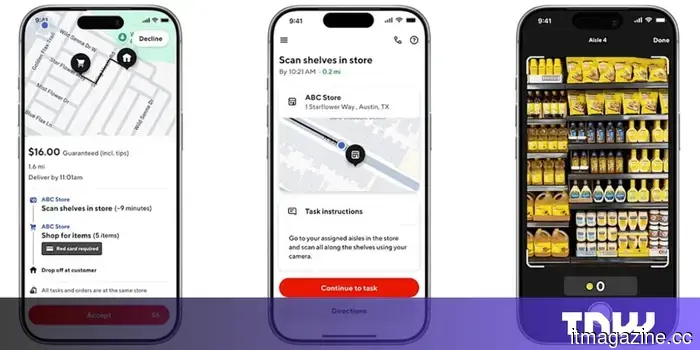 DoorDash introduces Tasks.
DoorDash has introduced Tasks, an independent app that compensates Dashers for filming home chores and recording audio to help train AI models.
DoorDash introduces Tasks.
DoorDash has introduced Tasks, an independent app that compensates Dashers for filming home chores and recording audio to help train AI models.
 Parallel secures $20 million to implement AI agents in healthcare facilities.
Parallel has secured $20 million to implement AI agents that automate medical coding and billing directly within existing hospital software systems.
Parallel secures $20 million to implement AI agents in healthcare facilities.
Parallel has secured $20 million to implement AI agents that automate medical coding and billing directly within existing hospital software systems.
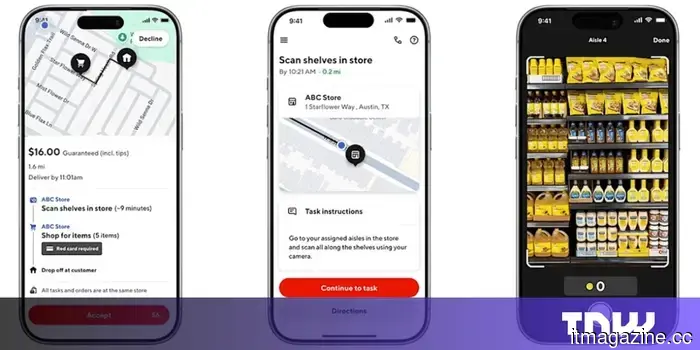 DoorDash introduces Tasks.
DoorDash has introduced Tasks, an independent app that compensates Dashers for capturing videos of household tasks and recording audio to help train AI models.
DoorDash introduces Tasks.
DoorDash has introduced Tasks, an independent app that compensates Dashers for capturing videos of household tasks and recording audio to help train AI models.
 Your inbox serves as a revenue stream for others. It doesn’t have to be that way.
Free email could end up being more costly than you realize. We examine why investing in a paid email service might be the most prudent privacy choice you make this year.
Your inbox serves as a revenue stream for others. It doesn’t have to be that way.
Free email could end up being more costly than you realize. We examine why investing in a paid email service might be the most prudent privacy choice you make this year.
 Hydrogen fuel vehicles failed to gain popularity, but they could potentially power the next generation of long-range drones.
Hydrogen has not been successful in powering cars, but scientists in Norway have developed a drone that operates on hydrogen, replacing batteries with a fuel cell to manage long-distance tasks such as inspecting power lines.
Hydrogen fuel vehicles failed to gain popularity, but they could potentially power the next generation of long-range drones.
Hydrogen has not been successful in powering cars, but scientists in Norway have developed a drone that operates on hydrogen, replacing batteries with a fuel cell to manage long-distance tasks such as inspecting power lines.
TACEO introduces its private execution network.
Austrian startup TACEO has introduced the TACEO Network, a private execution layer that is currently operational within World ID's 'proof of human' verification for 18 million users.