

German agritech company eternal.ag secures €8 million in funding.
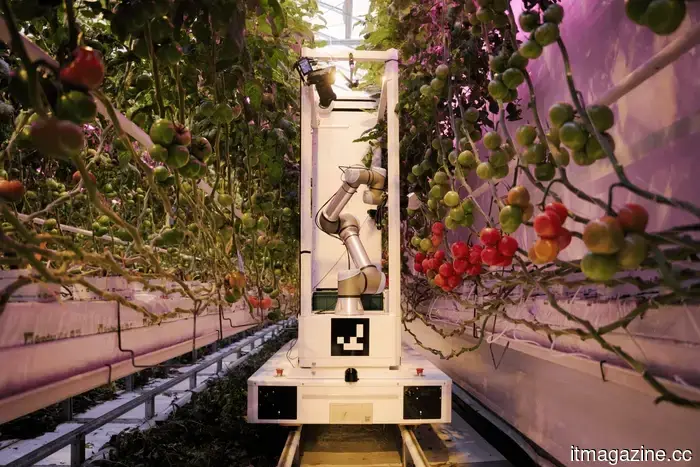
The Cologne-based startup adopts a simulation-first methodology to train robots in virtual greenhouses prior to their implementation in actual greenhouses, aiming to resolve a deployment challenge that has troubled the industry for many years.
The greenhouse automation market is littered with numerous promising-sounding startups. The engineering challenges are genuinely formidable, as harvesting tomatoes or cucumbers necessitates dealing with irregular, delicate, closely packed produce in a humid setting where each plant varies slightly and the arrangement changes seasonally.
Many companies have produced robots that function well in controlled demonstrations but then falter when faced with commercial realities. Bridging the gap between “works in the lab” and “functions reliably for 22 hours a day in a real grower’s greenhouse” has proven to be exceptionally challenging.
Renji John has previously faced this issue. He co-founded Honest AgTech, a Dutch startup focused on autonomous greenhouse robots, which was declared bankrupt by the District Court of Noord-Holland in July 2023 due to liquidity problems.
Now, he returns for a second try with eternal.ag, the German agritech startup he co-founded with Sherry Kunjachan in 2025. On Thursday, the company announced it raised €8 million from Simon Capital, Oyster Bay Venture Capital, EquityPitcher Ventures, and Backbone Ventures. The company operates out of Cologne and has an office in Bengaluru.
The key technical differentiation John is implementing this time is in the development process. Eternal.ag employs a simulation-first approach, constructing and testing robots within virtual greenhouses powered by NVIDIA Isaac Sim before releasing the hardware in actual environments.
This method is said to reduce iteration cycles from months to days, allowing the company to economically test failure scenarios in software instead of relying on costly physical prototypes. Once robots are in operation, all actions generate data that feeds back into the system for ongoing enhancement. Claims surrounding the 22-hours-a-day operational capacity and reduced iteration cycles have not been independently verified, although the underlying strategy aligns with how leading robotics firms mitigate hardware development risks.
The company's inaugural commercial product is Harvester, an autonomous robot designed for tomato harvesting, which is set to operate as part of an AI-driven system that oversees cut quality and consistency. The product is intended to be a modular platform that will eventually expand to facilitate additional greenhouse tasks. Eternal.ag aspires to achieve fully autonomous greenhouse operations by 2040, eliminating the need for human operators.
John has a background that includes working at the Boston Consulting Group on technology strategy, holding an INSEAD MBA, and previous roles at Tata Consultancy Services. Kunjachan, the co-founder and CTO, does not have publicly documented prior positions apart from material released in press communications.
The investor group has a strong connection to the sector. Oyster Bay Venture Capital is a Hamburg-based Food and AgTech fund that manages over €100 million and is backed by the European Investment Fund and KfW. The firm typically leads funding rounds with initial investments ranging from €1 to 5 million. Düsseldorf-based Simon Capital is an early-stage fund with a portfolio that includes companies like waterdrop and Just Spices. EquityPitcher Ventures and Backbone Ventures are early-stage funds based in Switzerland and Germany, respectively.
“Greenhouse horticulture is among the most efficient and sustainable methods for year-round fresh produce cultivation,” remarked Niklas Leske, Principal at Simon Capital, in a statement. “Labour shortages threaten the industry, and robotics represents the only future-proof solution for establishing a decentralized, resilient food supply chain for future generations.”
The labour issue Leske refers to is structural. For decades, European greenhouse growers have relied on seasonal workers predominantly from Eastern Europe and beyond. As this labor pool has diminished — the press release cites a 30% decrease since 2010, though this figure has not been independently verified — growers now face significant operational challenges.
Greenhouses operate year-round unlike outdoor farms and require steady labour to perform physically demanding and repetitive tasks. This combination makes the case for automation particularly compelling, despite the ongoing difficulties in execution.
The €8 million raised will be used to accelerate product development, enhance commercial deployments throughout Europe, and extend the platform to include more crop types beyond tomatoes. For John, this second attempt is weighed with the lessons learned from the first failure.
The simulation-first strategy, modular design, and gradual crop expansion indicate a conscious effort to advance more methodically and cautiously than a startup that raised pre-seed capital and attempted too much too quickly. Whether this disciplined approach can be maintained at a commercial scale is what the coming years will determine.

Other articles
 TACEO introduces its private execution network.
Austrian startup TACEO has introduced the TACEO Network, a private execution layer that is currently operational within World ID's 'proof of human' verification for 18 million users.
TACEO introduces its private execution network.
Austrian startup TACEO has introduced the TACEO Network, a private execution layer that is currently operational within World ID's 'proof of human' verification for 18 million users.
 Parallel secures $20 million to implement AI agents in healthcare facilities.
Parallel has secured $20 million to implement AI agents that automate medical coding and billing directly within existing hospital software systems.
Parallel secures $20 million to implement AI agents in healthcare facilities.
Parallel has secured $20 million to implement AI agents that automate medical coding and billing directly within existing hospital software systems.
 DoorDash introduces Tasks.
DoorDash has introduced Tasks, an independent app that compensates Dashers for filming home chores and recording audio to help train AI models.
DoorDash introduces Tasks.
DoorDash has introduced Tasks, an independent app that compensates Dashers for filming home chores and recording audio to help train AI models.
 Bluesky secures $100 million in Series B funding as a new CEO steps in.
Bluesky announced a $100M Series B funding round led by Bain Capital Crypto, which concluded last April, and has appointed a new CEO.
Bluesky secures $100 million in Series B funding as a new CEO steps in.
Bluesky announced a $100M Series B funding round led by Bain Capital Crypto, which concluded last April, and has appointed a new CEO.
 AI analytics agents require limitations rather than increased model size.
AI analytics agents require safeguards rather than larger models. Discover why governed data, common definitions, and semantic layers are more crucial than the size of the model.
AI analytics agents require limitations rather than increased model size.
AI analytics agents require safeguards rather than larger models. Discover why governed data, common definitions, and semantic layers are more crucial than the size of the model.
 Robots have learned to understand people without complex instructions.
Modern household appliances have long ceased to be just a set of buttons, yet interacting with them still resembles a guessing game. Manufacturers of smart devices have trained us for years to use strict formulations, because only an exact command from the instructions guaranteed that the vacuum cleaner would start cleaning, rather than going into sleep mode. The situation is beginning to change thanks to the introduction of artificial intelligence technologies into the household sphere.
Robots have learned to understand people without complex instructions.
Modern household appliances have long ceased to be just a set of buttons, yet interacting with them still resembles a guessing game. Manufacturers of smart devices have trained us for years to use strict formulations, because only an exact command from the instructions guaranteed that the vacuum cleaner would start cleaning, rather than going into sleep mode. The situation is beginning to change thanks to the introduction of artificial intelligence technologies into the household sphere.
German agritech company eternal.ag secures €8 million in funding.
eternal.ag has secured €8M to implement autonomous tomato harvesting robots that have been trained in virtual greenhouses prior to being deployed in real-world settings.