

Daniel Dines, the founder of UiPath, has authored a book that challenges readers to disprove its claims by the year 2028.
Daniel Dines has released a book titled The Work That Remains, which posits that businesses should allow AI agents to handle work preparation while humans manage crucial decisions and deterministic automation executes the tasks. He frames his argument on an outmoded prediction and specifies the evidence that might undermine it.
Dines' book includes a particularly significant statement in the form of a dated prediction: he envisions that by the close of 2028, any large regulated enterprise conducting a high-consequence workflow autonomously will do so within an engineered environment rather than deploying a general agent into existing systems.
He takes an unusual step for vendor literature by asserting, "If broad enterprise deployment proves otherwise, this framework weakens," and identifies the evidence that could challenge his own stance.
The core idea can be summarized succinctly: AI proposes, humans decide, automation executes, with agents planning and preparing, while humans retain ownership of any consequential outcomes, and deterministic systems perform tasks that have been approved.
He refers to the necessary missing components as the map and the rails. The map serves as a governed representation of a business's actual operations, while the rails are the machinery that accurately executes the stable aspects.
A particularly intriguing assertion is that the expectations have reversed. Agents were initially seen as the quick win while automation was viewed as costly, but it has turned out that the agent at the point of consequence is the challenging aspect, while reliable code has become more affordable.
This premise is not exclusive to him. In July, TNW reported that Forrester indicated 75% of projects are stalling before production, which highlights the gap that Dines’ book claims orchestration addresses.
What distinguishes his book from mere marketing is his transparency. "I run an automation company. That is my declared bias," Dines states, noting that companies like his stand to gain from his conclusions, and he urges readers not to accept or reject his arguments based solely on that context.
He has been publicly discussing these ideas for months, stating to TNW in July that reducing junior hiring denies the enterprise future leaders, which leads to the development of the cartographer role that the book elaborates upon.
Regarding personnel, his argument emphasizes density over headcount. He advocates for fewer passengers and more drivers, arguing in favor of a workforce where talent density transitions from being a theoretical concept to a mathematical reality.
The specific workflows he mentions align with his market, as claims adjudication, loan approvals, and payment approvals represent areas that UiPath has invested in through its acquisition of WorkFusion, a detail worth considering while reading.
Dines’ personal narrative is rooted in Europe. After spending five years at Microsoft in Seattle, he returned to Romania in 2005 and launched his company from his apartment in Bucharest. The company now trades on the NYSE.
The book cover also features two additional names: "with Claude and ChatGPT," which could either illustrate his argument directly or serve as a compelling example of it.
Other articles
 Voltpost is developing an electric vehicle charger that suspends from the ceiling of your garage.
Voltpost reports that installing chargers on ceilings and walls can reduce installation expenses by as much as 70%. Additionally, Europe has granted apartment residents the right to plug in.
Voltpost is developing an electric vehicle charger that suspends from the ceiling of your garage.
Voltpost reports that installing chargers on ceilings and walls can reduce installation expenses by as much as 70%. Additionally, Europe has granted apartment residents the right to plug in.
 Android 17 will ultimately prevent ISPs from tracking the websites and apps you use.
Android 17 introduces Encrypted Client Hello, becoming the first major mobile operating system to widely prevent ISP tracking of your internet activity. It also offers safeguards for home Wi-Fi privacy, protection against fake certificates, and defense against 2G scam attacks.
Android 17 will ultimately prevent ISPs from tracking the websites and apps you use.
Android 17 introduces Encrypted Client Hello, becoming the first major mobile operating system to widely prevent ISP tracking of your internet activity. It also offers safeguards for home Wi-Fi privacy, protection against fake certificates, and defense against 2G scam attacks.
 Claude now has its own browser and does not require the Chrome extension anymore.
Anthropic has integrated a browser into Claude Cowork, which is enabled by default. The DMA choice screen is applicable only to gatekeepers, and Anthropic does not fall into that category.
Claude now has its own browser and does not require the Chrome extension anymore.
Anthropic has integrated a browser into Claude Cowork, which is enabled by default. The DMA choice screen is applicable only to gatekeepers, and Anthropic does not fall into that category.
 Pollen Robotics’ Microduck is designed to simplify and reduce the costs of training physical AI systems, making the process less delicate.
Pollen Robotics' Microduck is a small biped priced at $399, created to facilitate more accessible physical AI training. It allows developers to test new robotic behaviors on a durable platform that can withstand an occasional fall.
Pollen Robotics’ Microduck is designed to simplify and reduce the costs of training physical AI systems, making the process less delicate.
Pollen Robotics' Microduck is a small biped priced at $399, created to facilitate more accessible physical AI training. It allows developers to test new robotic behaviors on a durable platform that can withstand an occasional fall.
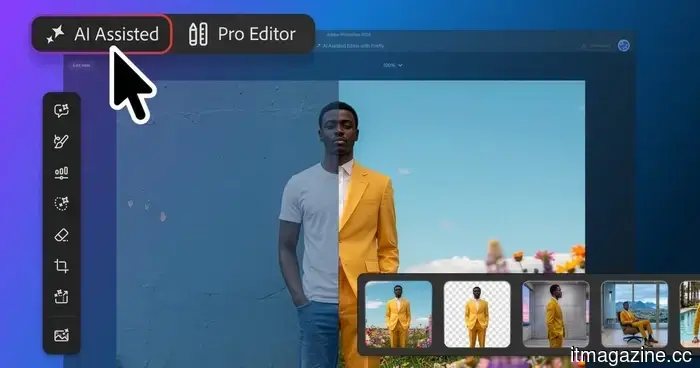 Adobe Photoshop has introduced an AI editor for those who prefer using prompts.
Photoshop's new AI Assisted Editor offers users a prompt-based approach for making edits, while Adobe maintains the classic Pro Editor and introduces new features for masks, markup, lighting, and text.
Adobe Photoshop has introduced an AI editor for those who prefer using prompts.
Photoshop's new AI Assisted Editor offers users a prompt-based approach for making edits, while Adobe maintains the classic Pro Editor and introduces new features for masks, markup, lighting, and text.
 The US is considering tariffs that would increase the prices of laptops, phones, and gaming consoles.
Reports suggest that the US is considering wider semiconductor tariffs that may extend to finished electronics, which could increase costs for laptops, gaming consoles, and potentially smartphones, depending on the specifics of the final policy.
The US is considering tariffs that would increase the prices of laptops, phones, and gaming consoles.
Reports suggest that the US is considering wider semiconductor tariffs that may extend to finished electronics, which could increase costs for laptops, gaming consoles, and potentially smartphones, depending on the specifics of the final policy.
Daniel Dines, the founder of UiPath, has authored a book that challenges readers to disprove its claims by the year 2028.
Daniel Dines anticipates that by the conclusion of 2028, no significant enterprise will conduct high-stakes tasks using a general agent, indicating that his framework is inadequate.