
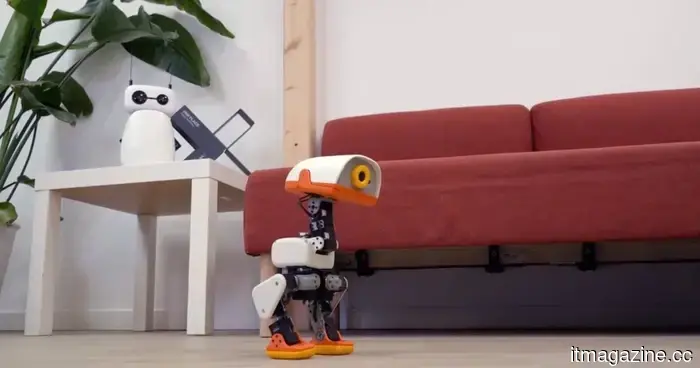
Pollen Robotics’ Microduck is designed to simplify and reduce the costs of training physical AI systems, making the process less delicate.
Microduck is a compact biped priced at $399, designed for developers to explore physical AI, providing an economical method to train and evaluate new robotic behaviors without the risk of damaging costly equipment.
Pollen Robotics has teamed up again with Hugging Face to introduce a new robot that is charmingly eccentric. Microduck stands 25cm tall and is designed to bring AI from the screen to your workspace. Preorders have begun today, with the first units expected to be delivered before Christmas 2026.
In contrast to its predecessor, Reachy Mini, Microduck is focused entirely on action. It operates on 15 motors and features an articulated beak for holding objects, a camera, a depth sensor, two IMUs, and sufficient balance to walk, crouch, and even roller-skate.
Designed to withstand falls
Training movement models in real-world settings often entails significant expenses for hardware and costly repairs when mishaps occur. Microduck changes this scenario. Measuring around 10 inches by 5.5 inches and weighing under two pounds, it is small enough that a fall results in a minor sound rather than a financial setback.
What’s even more impressive is that it can stand back up after most falls, eliminating the need for constant supervision during behavior testing. Pollen Robotics indicates that its duck-like look and waddling motion were unplanned outcomes of its design, which the company embraced.
Although Microduck has a playful appearance, it is not specifically aimed at children. Its target audience consists of developers looking to train physical behaviors, making it a user-friendly testbed for sim-to-real machine learning.
More than just a novelty item
Out of the box, Microduck offers gamepad controls, laser-following, and seven pre-programmed movements. Each unit even generates its own voice the first time it starts up. At first glance, it might resemble a desk toy more than a development kit. However, the underlying technology is intended for developers who are training their own behaviors.
Pollen Robotics has made the SDK, the robot's software, and its reinforcement learning and sim-to-real tools available on GitHub. The aim is to foster collaborative development of physical hardware similar to open-source software, simplifying the process for developers to share trained neural network models, training methods, and custom environments in the same manner as they exchange language models.
Microduck comes in four color options: Cream, Graphite, Lavender, and Sky, and is now available for pre-order at $399, excluding taxes and shipping fees. For those eager to start the training process without waiting for the hardware, Pollen Robotics has also released an interactive browser-based simulator to begin testing code immediately.



Other articles
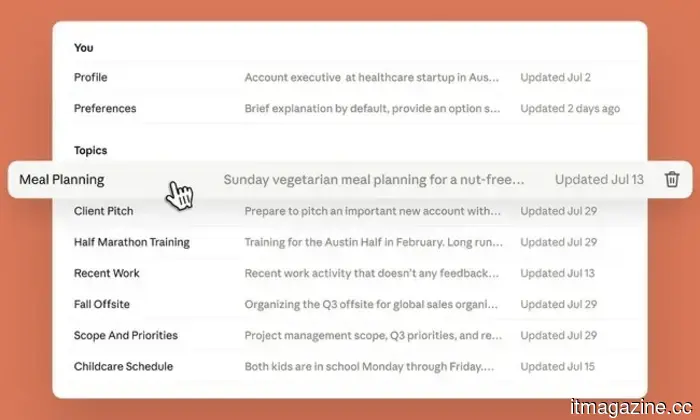
 The future of executive assistance: DonnaPro’s strategy for human-AI teamwork.
DonnaPro prepares executive assistants on AI tools before their commencement and supports them with 2,500 pages of frameworks. Founder Filip Pesek contends that even the most effective AI tools require a human who understands how to think critically.
The future of executive assistance: DonnaPro’s strategy for human-AI teamwork.
DonnaPro prepares executive assistants on AI tools before their commencement and supports them with 2,500 pages of frameworks. Founder Filip Pesek contends that even the most effective AI tools require a human who understands how to think critically.
 The executive assistant of tomorrow: DonnaPro's method for human-AI teamwork.
DonnaPro provides training on AI tools to executive assistants prior to their start, and supports them with 2,500 pages of frameworks. Founder Filip Pesek contends that even the most effective AI tools require a human who understands how to think critically.
The executive assistant of tomorrow: DonnaPro's method for human-AI teamwork.
DonnaPro provides training on AI tools to executive assistants prior to their start, and supports them with 2,500 pages of frameworks. Founder Filip Pesek contends that even the most effective AI tools require a human who understands how to think critically.
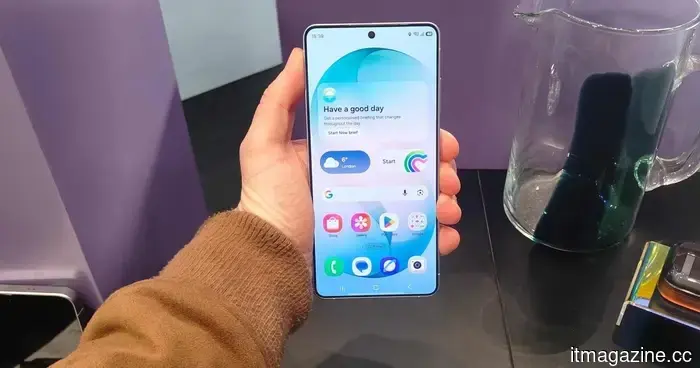 The Galaxy S27 Pro may adopt the Ultra's new design, capturing the essence of the iPhone.
Recent CAD renders allegedly reveal that the Galaxy S27 Pro will feature a significant camera redesign akin to that of the forthcoming Galaxy S27 Ultra.
The Galaxy S27 Pro may adopt the Ultra's new design, capturing the essence of the iPhone.
Recent CAD renders allegedly reveal that the Galaxy S27 Pro will feature a significant camera redesign akin to that of the forthcoming Galaxy S27 Ultra.
 Claude now has its own browser and does not require the Chrome extension anymore.
Anthropic has integrated a browser into Claude Cowork, which is enabled by default. The DMA choice screen is applicable only to gatekeepers, and Anthropic does not fall into that category.
Claude now has its own browser and does not require the Chrome extension anymore.
Anthropic has integrated a browser into Claude Cowork, which is enabled by default. The DMA choice screen is applicable only to gatekeepers, and Anthropic does not fall into that category.
 JPMorgan is leading a $5 billion debt financing project for the construction of Volta's AI data center.
JPMorgan is consulting with lenders regarding a $5 billion financing package for Volta, which will feature its initial building—a Norwegian hydro-powered campus leased from a bitcoin mining company.
JPMorgan is leading a $5 billion debt financing project for the construction of Volta's AI data center.
JPMorgan is consulting with lenders regarding a $5 billion financing package for Volta, which will feature its initial building—a Norwegian hydro-powered campus leased from a bitcoin mining company.
 Android 17 will ultimately prevent ISPs from tracking the websites and apps you use.
Android 17 introduces Encrypted Client Hello, becoming the first major mobile operating system to widely prevent ISP tracking of your internet activity. It also offers safeguards for home Wi-Fi privacy, protection against fake certificates, and defense against 2G scam attacks.
Android 17 will ultimately prevent ISPs from tracking the websites and apps you use.
Android 17 introduces Encrypted Client Hello, becoming the first major mobile operating system to widely prevent ISP tracking of your internet activity. It also offers safeguards for home Wi-Fi privacy, protection against fake certificates, and defense against 2G scam attacks.
Pollen Robotics’ Microduck is designed to simplify and reduce the costs of training physical AI systems, making the process less delicate.
Pollen Robotics' Microduck is a small biped priced at $399, created to facilitate more accessible physical AI training. It allows developers to test new robotic behaviors on a durable platform that can withstand an occasional fall.