
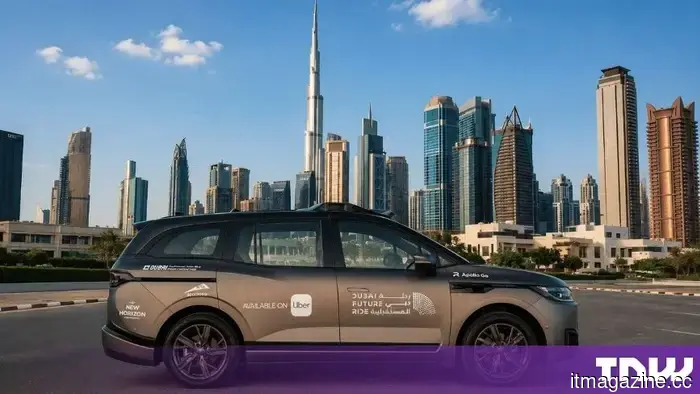
Baidu's Apollo Go has launched on Uber in Dubai, and operates without a safety driver.
Uber has integrated Baidu's driverless robotaxis into its app in Dubai. If you book an UberX or an Uber Comfort there, the app might connect you with an Apollo Go vehicle that is unoccupied. An exclusive "Autonomous" option increases the chances of being matched with a driverless vehicle on purpose.
The service was officially launched on Thursday and is available in specific areas of Umm Suqeim and Jumeirah, both coastal neighborhoods, rather than across the entire city. The fleet is operated by a third party, New Horizon Luxury Transport, but neither Uber nor Baidu has disclosed the number of cars in operation or the cost of rides, including whether a driverless ride is priced the same as one with a human driver.
One interesting aspect is that a rider who books a standard UberX or Uber Comfort in the designated area may unexpectedly be paired with a driverless vehicle unless they specifically opt for the “Autonomous” selection, which increases the likelihood of encountering an empty car.
The timing of this launch is particularly noteworthy. On Wednesday, Uber commenced its first European autonomous rides in Zagreb, partnered with Pony.ai and Croatian operator Verne. Those rides included a safety driver as confirmed in Uber’s announcement.
The very next day, Uber launched Apollo Go in Dubai with no driver present. Both initiatives used the same platform within the same week, showcasing significantly different regulatory responses to similar concepts. Uber did not draw a comparison between the two launches, and details about one did not mention the other.
The Zagreb service operates in key areas of the Croatian capital, including the downtown area, with plans for future expansion. Conversely, Dubai's rollout is smaller in scale and emptier in experience. Which of these factors is more critical will depend on the perspective of regulators versus shareholders.
Regarding the vehicles involved, they are Apollo Go's sixth-generation RT6, specifically designed for autonomous driving and capable of carrying up to three passengers. Baidu reports that the RT6 is equipped with over 30 sensors that process data in real-time.
While Baidu has provided some statistics, these figures have not been independently verified. The company claims Apollo Go has been operational in 28 cities, covering over 350 million kilometers autonomously, with more than 240 million of those being fully driverless. Baidu regards the safety record as exceptional but has not publicly shared detailed incident data.
Uber stated that every autonomous vehicle on its network, including those from Apollo Go, must adhere to its safety standards before transporting passengers. However, these complete guidelines have not been shared publicly.
The announcement claims this is the first global multi-partner autonomous network. However, the two executives quoted offer narrower and differing interpretations of this achievement.
Sarfraz Maredia, Uber’s global head of autonomous, asserted that Dubai represents the first realization of its multi-partner vision on public streets, emphasizing Uber's goals rather than the industry's progress.
Conversely, Nan Yang, a Baidu vice president leading the overseas division of its intelligent driving group, asserted that Dubai is “the first city where we’ve successfully established a dual-model offering both self-operated and partner-based autonomous ride-hailing services internationally,” highlighting Baidu's capability to operate its own vehicles alongside those of partners.
The structure behind this collaboration warrants attention. Uber provides the demand and app infrastructure, Baidu contributes the vehicles and the autonomous technology, and New Horizon Luxury Transport owns and manages the fleet on-site. None of the three parties is responsible for the entire operation.
This arrangement represents a shift for Uber, which has moved beyond being the exclusive front for one company. It previously ended its exclusivity agreement with Waymo in Austin and Atlanta in July and now collaborates with over 30 autonomous vehicle partners. It refers to this collaborative effort as a hybrid network, where autonomous and human-driven vehicles operate concurrently.
The announcement describes Dubai as a launchpad for scaling thousands of Apollo Go vehicles within Uber’s global network, representing a future ambition rather than a current operational reality. Uber notes that it conducts millions of autonomous rides annually across all its partners, compared to over 79 billion trips since 2010. However, the impact of autonomy remains minimal in its overall operations.
Baidu is not alone among Chinese companies seeking to tap into markets beyond China through partnerships. Pony.ai and Uber have recently announced plans to deploy 2,000 Chinese robotaxis in Europe, with Pony.ai also being the driving technology for the Zagreb rollout. Additionally, Apollo Go achieved Level 4 approval in Switzerland in June.
The Gulf region has been a rapidly progressing route, with Dubai ahead of European regulators in terms of granting permissions for driverless operations, as evidenced by this launch without an operator onboard.
Key indicators to monitor whether this initiative is a demonstration or a viable business will include the geographical coverage. Umm Suqeim and Jumeirah represent a limited portion of Dubai, and Uber has indicated plans for broader expansion without specifying a timeline.
Another crucial aspect is transparency. The growth of robotaxi fleets
Other articles
 Android 17 prefers to slow down a single problematic app instead of affecting the performance of your entire phone.
Android 17 implements tougher memory limits for individual apps, which can either slow down or shut down apps that are using excessive memory. This provides Google with a fresh method to safeguard overall phone performance before a single memory-intensive app leads to broader issues.
Android 17 prefers to slow down a single problematic app instead of affecting the performance of your entire phone.
Android 17 implements tougher memory limits for individual apps, which can either slow down or shut down apps that are using excessive memory. This provides Google with a fresh method to safeguard overall phone performance before a single memory-intensive app leads to broader issues.
 Windows 11 will be removing the Drag Tray feature.
Microsoft is eliminating the Drag Tray feature from Windows 11 following user feedback that the file-sharing overlay disrupted regular drag-and-drop operations.
Windows 11 will be removing the Drag Tray feature.
Microsoft is eliminating the Drag Tray feature from Windows 11 following user feedback that the file-sharing overlay disrupted regular drag-and-drop operations.
 OpenAI aims to track AI misuse without requiring customers to submit their data.
OpenAI's Private Safety Processing aims to identify abuse across various interactions while maintaining Zero Data Retention, directly contrasting with Anthropic's 30-day data retention policy.
OpenAI aims to track AI misuse without requiring customers to submit their data.
OpenAI's Private Safety Processing aims to identify abuse across various interactions while maintaining Zero Data Retention, directly contrasting with Anthropic's 30-day data retention policy.
 A data center rack utilizing living neurons has recently begun operation in Singapore.
In Singapore, NUS, DayOne, and Cortical Labs have developed a 20-unit rack of biological computers. However, the assertion regarding its efficiency is made without any accompanying figures.
A data center rack utilizing living neurons has recently begun operation in Singapore.
In Singapore, NUS, DayOne, and Cortical Labs have developed a 20-unit rack of biological computers. However, the assertion regarding its efficiency is made without any accompanying figures.
 Android 17 prefers to throttle one problematic app instead of affecting the performance of your whole phone.
Android 17 implements stricter memory limits for individual apps, which can slow down or stop apps that consume excessive resources. This gives Google a new method to safeguard the overall performance of the phone, preventing a single memory-intensive app from causing broader issues.
Android 17 prefers to throttle one problematic app instead of affecting the performance of your whole phone.
Android 17 implements stricter memory limits for individual apps, which can slow down or stop apps that consume excessive resources. This gives Google a new method to safeguard the overall performance of the phone, preventing a single memory-intensive app from causing broader issues.
 Milan's Domyn secures over $1 billion in the largest AI funding round in Europe, primarily through debt.
Domyn, based in Milan, has secured approximately $1.1 billion, with around 90% of that amount being debt, to enhance the Colosseum supercomputer it developed in collaboration with Nvidia in southern Italy.
Milan's Domyn secures over $1 billion in the largest AI funding round in Europe, primarily through debt.
Domyn, based in Milan, has secured approximately $1.1 billion, with around 90% of that amount being debt, to enhance the Colosseum supercomputer it developed in collaboration with Nvidia in southern Italy.
Baidu's Apollo Go has launched on Uber in Dubai, and operates without a safety driver.
Uber introduced Baidu's Apollo Go in Dubai without a safety driver, just one day following the launch of its first European autonomous vehicle rides in Zagreb, where a safety driver was present.