
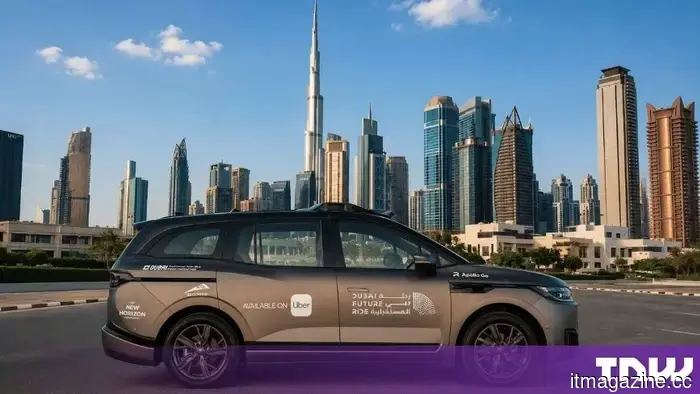
Baidu's Apollo Go has launched in Dubai through Uber, operating without a safety driver.
Uber has integrated Baidu’s driverless robotaxis into its app in Dubai. Now, if you book an UberX or Uber Comfort in that area, the app might connect you with an Apollo Go vehicle that is unoccupied. Selecting the specific “Autonomous” option increases the chances of being matched with one intentionally. This service was launched on Thursday and is available in selected areas of Umm Suqeim and Jumeirah, two coastal neighborhoods, rather than throughout the entire city. The fleet is operated by a third party named New Horizon Luxury Transport. Neither Uber nor Baidu has disclosed the number of vehicles in operation, the cost of a ride, or whether the fare for a driverless journey is the same as for a ride with a human driver.
An interesting detail is that a passenger who books a standard UberX or Uber Comfort within the designated area may be paired with a driverless vehicle without specifically requesting one. Opting for the “Autonomous” choice makes that outcome more likely, but it is not the only pathway to riding in an unoccupied car.
The timing of the launch is particularly noteworthy. On Wednesday, Uber introduced its initial European autonomous rides in Zagreb, collaborating with Pony.ai and the Croatian operator Verne. Those vehicles were launched with a safety driver on board, as confirmed by Uber in its announcement at that time. Just a day later, Uber initiated Apollo Go in Dubai with no one seated in the front at all. It is the same platform and the same week, yet the two locations reflect significantly different regulatory responses to the same issue. Uber did not compare the two services, and each announcement omitted any reference to the other.
The Zagreb service operates in key areas of the Croatian capital, including the city center, with plans to expand coverage over time. In contrast, Dubai’s service is smaller in scale and begins without any occupants in the front seat. The importance of either limitation largely depends on whether one is a regulator or a shareholder.
The vehicles in use are Apollo Go’s sixth-generation RT6, which are specially designed electric cars for driverless operation and can accommodate up to three passengers. Baidu states that the RT6 is equipped with over 30 sensors, processing the data they collect in real time.
Baidu provided the operational statistics, but no external entity has verified these figures. According to Baidu, Apollo Go has been active in 28 cities, with its fleets having covered over 350 million autonomous kilometers, more than 240 million of which were completely driverless. Baidu claims its safety record is exceptional, although it has not publicly disclosed detailed incident data.
Uber states that every autonomous vehicle on its platform, including Apollo Go, must adhere to its own safety standards before transporting passengers. The full details of these guidelines have not been publicly shared.
The release prominently claims to establish the first global multi-partner autonomous network. However, the two executives quoted within the announcement make narrower claims and differ in their statements. Sarfraz Maredia, Uber’s global head of autonomous, asserted that Dubai “marks the first time our multi-partner vision comes to life on public roads,” a statement focused on Uber’s own strategy rather than the broader industry. On the other hand, Nan Yang, a Baidu vice president overseeing its international intelligent driving division, declared that Dubai is “the first city where we’ve successfully established a dual-model offering both self-operated and partner-based autonomous ride-hailing services internationally,” highlighting Baidu's operation of its own vehicles alongside those of partners in one location.
The contract structure is noteworthy. Uber provides the demand and the app, Baidu supplies the vehicles and the autonomy technology, and New Horizon Luxury Transport owns and operates the fleet. None of the three parties handles every aspect.
This arrangement reflects Uber's evolution since it ceased to be solely reliant on a single company's front end. It previously agreed to end its exclusivity with Waymo in Austin and Atlanta last July and now collaborates with over 30 autonomous vehicle partners, creating what it refers to as a hybrid network that combines autonomous cars and human drivers serving passengers side by side.
The announcement describes Dubai as the launchpad for potentially scaling thousands of Apollo Go vehicles across Uber’s global network. This represents an aspiration for the partnership rather than a description of the current operational fleet. Uber claims it conducts millions of autonomous trips each year across its partnerships, while the total number of trips since 2010 exceeds 79 billion. Nevertheless, autonomy remains a relatively minor aspect of its overall figures.
Baidu is not the only Chinese company exploring entry into markets outside China via partnerships. Pony.ai and Uber recently announced plans to deploy 2,000 Chinese robotaxis on European streets, with Pony.ai being the technology provider for the Zagreb rollout. Additionally, Apollo Go received Level 4 approval in Switzerland in June.
The Gulf region has been the most expedited route for this expansion. Dubai has granted driverless permissions more swiftly than European regulators, and the launch without an operator present
Другие статьи
 Windows 11 is eliminating the Drag Tray feature.
Microsoft is eliminating the Drag Tray feature in Windows 11 following user feedback that the file-sharing overlay was disrupting routine drag-and-drop operations.
Windows 11 is eliminating the Drag Tray feature.
Microsoft is eliminating the Drag Tray feature in Windows 11 following user feedback that the file-sharing overlay was disrupting routine drag-and-drop operations.
 A data center rack powered by living neurons is now functional in Singapore.
In Singapore, NUS, DayOne, and Cortical Labs have developed a 20-unit rack of biological computers. However, the assertion of its efficiency is made without any accompanying figures.
A data center rack powered by living neurons is now functional in Singapore.
In Singapore, NUS, DayOne, and Cortical Labs have developed a 20-unit rack of biological computers. However, the assertion of its efficiency is made without any accompanying figures.
 Two senators have set a deadline of September 1 for TikTok to clarify its safety evaluations.
Two senators set a deadline of 1 September for TikTok to respond to 13 inquiries regarding the safety experiment conducted on 15 million users in the US.
Two senators have set a deadline of September 1 for TikTok to clarify its safety evaluations.
Two senators set a deadline of 1 September for TikTok to respond to 13 inquiries regarding the safety experiment conducted on 15 million users in the US.
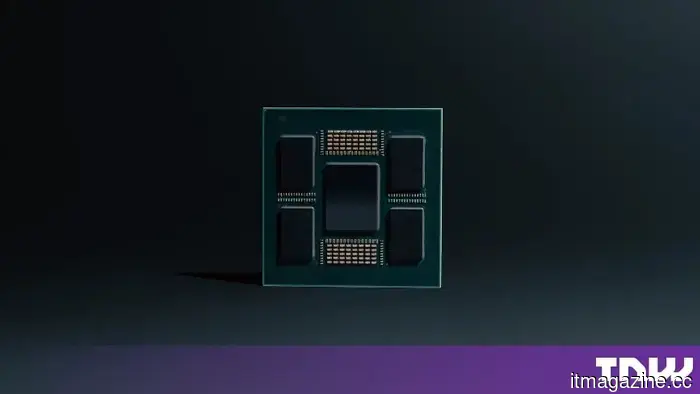 Waymo developed its own chip for robotaxis and released its list of suppliers.
Waymo released details about its robotaxi computing architecture, which includes a custom 5nm chip and its seven suppliers. Nvidia and AMD remain included in the list.
Waymo developed its own chip for robotaxis and released its list of suppliers.
Waymo released details about its robotaxi computing architecture, which includes a custom 5nm chip and its seven suppliers. Nvidia and AMD remain included in the list.
 Alibaba's profit dropped by 75% as its quarterly expenditures on AI reached $10 billion.
Alibaba's expenditure on AI reached $9.98 billion in the June quarter, while profits declined by 75%. However, the cloud division, for which it incurs costs, achieved a segment profit increase of 133%.
Alibaba's profit dropped by 75% as its quarterly expenditures on AI reached $10 billion.
Alibaba's expenditure on AI reached $9.98 billion in the June quarter, while profits declined by 75%. However, the cloud division, for which it incurs costs, achieved a segment profit increase of 133%.
 Cinemas, educational institutions, and ICE are all prohibiting the use of Meta smart glasses.
Cinemas, schools in the US, and ICE are all placing limitations on Meta smart glasses, but their motivations differ significantly. The regulation concerning cinemas has been in place since 2014.
Cinemas, educational institutions, and ICE are all prohibiting the use of Meta smart glasses.
Cinemas, schools in the US, and ICE are all placing limitations on Meta smart glasses, but their motivations differ significantly. The regulation concerning cinemas has been in place since 2014.
Baidu's Apollo Go has launched in Dubai through Uber, operating without a safety driver.
Uber introduced Baidu's Apollo Go in Dubai without a safety driver, just one day after launching its first European autonomous vehicle rides in Zagreb with a safety driver present.