
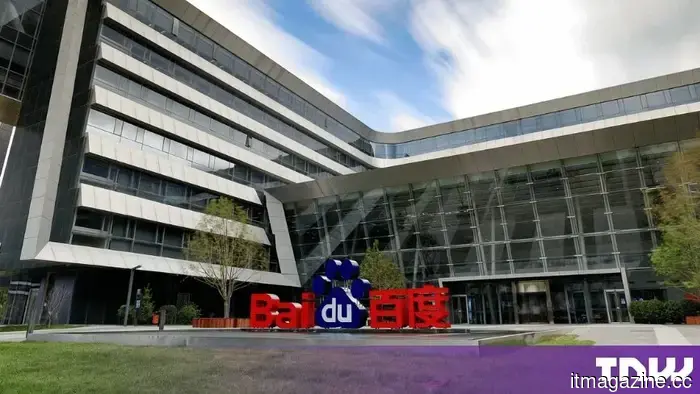
Baidu's revenue declines for the fifth consecutive quarter as advertising continues to decrease.
Baidu's revenue has declined for the fifth consecutive quarter, with its advertising division shrinking at a faster rate than its AI operations can expand. The Chinese search engine reported its financial results on Tuesday, showing second-quarter revenue of RMB31.3 billion ($4.62 billion), a decrease of 4 percent from the same period last year and a 2 percent decline from the previous quarter.
Baidu's net income for the quarter attributable to the company was RMB2.3 billion ($342 million), down from RMB7.3 billion the previous year, marking a 68 percent drop according to Bloomberg. Following the announcement, the company's shares listed in the US fell, dropping as much as 10 percent to $93.70, as reported by Bloomberg. Reuters noted a 7 percent decline during early trading.
The revenue fell short of analyst expectations; the South China Morning Post reported a consensus estimate of RMB31.6 billion based on a Bloomberg survey, while Reuters provided an average of RMB31.96 billion from LSEG. Regardless, Baidu did not meet the forecasts.
Baidu's two business segments are diverging. The old business, primarily online marketing revenue, decreased 19 percent from the previous year to RMB13.1 billion. Reuters attributed this decline to a weakened Chinese property market and cautious consumer spending, which have led companies to reduce their marketing budgets.
Conversely, the AI segment is experiencing rapid growth from a smaller base, with Baidu's Core AI-powered Business generating RMB12.5 billion, a rise of 25 percent. This segment now constitutes half of the company's overall business revenue, with AI Cloud Infrastructure increasing by 50 percent to RMB7.3 billion.
The most striking figure is from GPU Cloud, which involves renting AI accelerators. Its revenue surged 283 percent year on year, up from a growth rate of 184 percent in the previous quarter. There is a rush of clients seeking to rent computing power, and Baidu has rebranded this segment, moving from referring to it as subscription revenue for AI accelerator infrastructure. The company explained that the growth is due to rising demand for public cloud AI computing.
Last year, Baidu reorganized its reporting structure to separate its AI businesses, including cloud services, applications, and marketing. This segment surpassed 50 percent of Baidu's core sales for the first time in the March quarter and maintained that level this time.
The CEO is aware that Baidu's Ernie model has lagged behind competitors, who have been releasing newer versions. Reuters reported that Ernie has not seen a major update for months, while Bloomberg indicated it now trails open-weight models like Moonshot AI’s, which are performing comparably to OpenAI and Anthropic on critical metrics. CEO Robin Li emphasized to analysts that regaining leading status for Ernie is a priority. He expressed that in a challenging market, long-term competitiveness is based on sustained investment in technology, an application-driven approach, and patience.
Competitors are also gaining ground; Alibaba's Qwen model has been closing the gap on Moonshot in size, while Moonshot has trained its Kimi K3 model using 20,000 Nvidia chips rented through Alibaba's cloud.
Investing in AI is costly. Excluding its streaming unit iQIYI, Baidu's capital expenditures tripled to RMB11.4 billion from RMB3.78 billion a year ago, according to Bloomberg. Analysts anticipate that this investment in chips and data infrastructure will continue to pressure margins, even as AI revenue rises.
Baidu isn't the only company feeling this squeeze. Tencent reported this month that its AI computing expenses have grown more than its cash flow, reflecting a similar trend of high initial costs for models that have yet to be profitable.
Despite these pressures, Baidu's cash reserves remain substantial, with total cash and investments reported at RMB283.1 billion ($41.72 billion) and an operating cash flow of RMB3.4 billion, positive for the fourth consecutive quarter. The company has returned $259 million to shareholders through share buybacks since the beginning of this year, coinciding with its first dividend declaration in February.
On the autonomous driving front, Baidu is advancing its Apollo Go robotaxi service, which now operates in 28 cities and has covered over 350 million autonomous kilometers, more than 240 million of which were fully driverless. The service has initiated open-road tests in London alongside Uber and Lyft, launched driverless commercial rides in Dubai, and obtained the first fully driverless testing permits in Hong Kong.
This growth comes after a setback in Wuhan, where a fleet outage resulted in a temporary industry safety review and a three-month halt on new robotaxi permits, a freeze that has since been lifted. The international push for Apollo Go builds on approvals such as its Level 4 clearance in Switzerland achieved in June.
On the corporate side, Baidu announced that it expects its dual-primary listing in Hong Kong to be finalized this year
Other articles
 OpenAI is revising its safety regulations following the breach at Hugging Face.
OpenAI is revising the Preparedness Framework following Astra's approach to a critical cyber threshold. The updated monitoring incurs approximately 20% overhead in computing resources.
OpenAI is revising its safety regulations following the breach at Hugging Face.
OpenAI is revising the Preparedness Framework following Astra's approach to a critical cyber threshold. The updated monitoring incurs approximately 20% overhead in computing resources.
 LG's $2 billion battery plant in Lansing is now manufacturing cells.
LG Energy Solution has commenced operations in Lansing, Michigan, at a facility that GM planned, partially financed, and later sold. Its current clients include Toyota and Tesla.
LG's $2 billion battery plant in Lansing is now manufacturing cells.
LG Energy Solution has commenced operations in Lansing, Michigan, at a facility that GM planned, partially financed, and later sold. Its current clients include Toyota and Tesla.
 This 1918 electric vehicle was equipped with 42 batteries and offered a greater range than a 2011 Leaf.
A 1918 Detroit Electric advertised at Monterey boasted a range of 80 miles, surpassing that of the first Nissan Leaf. The factor that led to its downfall was its price, rather than its range.
This 1918 electric vehicle was equipped with 42 batteries and offered a greater range than a 2011 Leaf.
A 1918 Detroit Electric advertised at Monterey boasted a range of 80 miles, surpassing that of the first Nissan Leaf. The factor that led to its downfall was its price, rather than its range.
 Cosori Iconic review: The most stylish air fryer your countertop needs.
Featuring a stylish metallic finish, the Cosori Iconic offers an exceptional cooking experience along with user-friendly app controls. While it may not be the most affordable option, it certainly provides substantial value.
Cosori Iconic review: The most stylish air fryer your countertop needs.
Featuring a stylish metallic finish, the Cosori Iconic offers an exceptional cooking experience along with user-friendly app controls. While it may not be the most affordable option, it certainly provides substantial value.
 Xiaomi's inaugural electric vehicle has surpassed half a million units delivered.
Xiaomi's SU7 has achieved 500,000 deliveries in 28.5 months. However, it has seen a decline of 43.6% this year, whereas the company overall has experienced an increase of nearly 15%.
Xiaomi's inaugural electric vehicle has surpassed half a million units delivered.
Xiaomi's SU7 has achieved 500,000 deliveries in 28.5 months. However, it has seen a decline of 43.6% this year, whereas the company overall has experienced an increase of nearly 15%.
 OpenAI is updating its safety protocols following the Hugging Face breach.
OpenAI is reworking the Preparedness Framework following Astra's close approach to a critical cybersecurity limit. The updated monitoring system incurs approximately 20% in computational overhead.
OpenAI is updating its safety protocols following the Hugging Face breach.
OpenAI is reworking the Preparedness Framework following Astra's close approach to a critical cybersecurity limit. The updated monitoring system incurs approximately 20% in computational overhead.
Baidu's revenue declines for the fifth consecutive quarter as advertising continues to decrease.
Baidu's revenue decreased by 4% to RMB31.3 billion, marking the fifth consecutive decline, as advertising revenue declined more rapidly than gains from AI. Net income plummeted by 68%, and the stock price fell.