
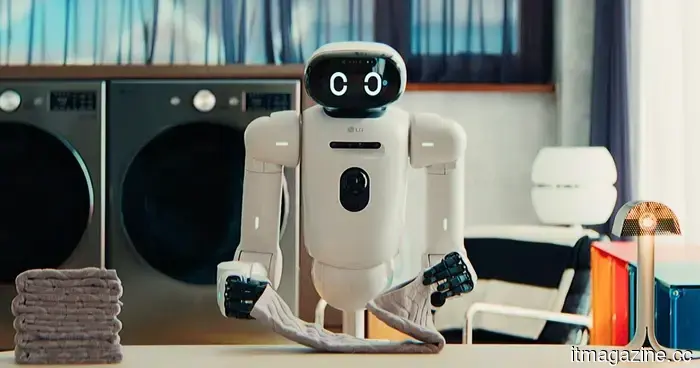
LG aims to create humanoid robots, with NVIDIA providing the intelligence.
This is not merely another robot teaser. LG and NVIDIA have just outlined concrete hardware.
Over time, an increasing number of established hardware companies seem to be competing to add humanoid robots to their strategic plans. The latest player to enter this field is LG, which is now giving tentative timelines.
The company aims to unveil its bipedal humanoid, utilizing Nvidia’s robotics framework, in early 2027. This initiative is part of a larger movement towards AI factories and self-driving vehicle technology.
It’s great to greet @LGE_Global Group Chairman Kwang-mo Koo and LG leaders at NVIDIA as we embark on the next phase of our partnership. Together, we are enhancing our collaboration in AI infrastructure, physical AI, and robotics. We’re eager to see what our teams can create collectively. pic.twitter.com/75yVaxSdIT— NVIDIA (@nvidia) August 14, 2026
What exactly is LG collaborating on with Nvidia?
Earlier this week, LG and Nvidia formalized their partnership with a memorandum of understanding at Nvidia’s headquarters in Santa Clara. Both LG Corp chairman Kwang Mo Koo and Nvidia CEO Jensen Huang were present.
The highlight is a bipedal humanoid robot that LG intends to reveal publicly in early 2027, coinciding with CES 2027. From the information available, it will operate on Nvidia’s Jetson Thor chip for reasoning and the Isaac GR00T foundation model for processing tasks. Additionally, Nvidia’s Halos safety system, designated as the industry’s first full-stack safety framework for robots, will also be included.
To manufacture these robots, LG will source actuators, sensors, and batteries from its own Electronics, Innotek, and Energy Solution divisions, making the process both practical and cost-effective.
However, LG isn’t postponing until 2027 to commence real-world testing. This year, the company will deploy its wheeled robot, LG CLOiD (an industrial version of the home robot showcased earlier this year), for factory trials. To provide the robots with extensive training data, the partnership will also develop a “robot data factory” utilizing LG CNS’s PhysicalWorks platform.
NVIDIA and LG are enhancing their collaboration to expedite the next phase of physical AI. Building on years of partnership, @JensenHuang and LG Group Chairman Kwang-mo Koo are advancing joint initiatives in AI factories, robotics, and autonomous vehicles, merging LG’s… pic.twitter.com/8aPC2VfhSS— NVIDIA Newsroom (@nvidianewsroom) August 14, 2026
What is the focus on AI factories and self-driving vehicles?
In addition to robotics, LG is set to construct two factories over the next two years. These include an AI factory reference site on Nvidia’s Vera Rubin platform by mid-2027, followed by an 80-megawatt LG AI Factory in Cheonan, South Korea, by mid-2028.
From my perspective, the objective appears to be less about a shift in internal priorities and more about developing a product that could be marketed to other tech giants.
Nvidia’s Halos safety framework is a significant detail to monitor here, as the presence of humanoid robots sharing workspaces with human employees has long been a major liability concern within the industry.
For over five years, Shikhar has consistently simplified the developments in consumer tech and showcased them…
I didn’t believe that mock shopping could deceive my brain until I tried the popular dopamine websites.
On these fake shopping and delivery platforms, nothing actually ships or costs money, yet the dopamine boost felt authentic.
I spent some time in the internet's most unrealistic mall, filling a shopping cart with items I couldn't purchase, seeking discounts on non-existent products, and checking out three different times with a grand total of $0.00. I then placed a fake food order while smoking an unseasoned cigarette alongside strangers I will never meet on a rooftop that doesn't exist either. My bank account remained unchanged, but annoyingly, my mind did.
Upon hearing about South Korea's rise in "dopamine sites," I thought they were merely another internet curiosity that I'd explore for five minutes and forget by lunchtime. Instead, I discovered a surprisingly clever concept hidden beneath the absurdity. You can peruse endless imaginary products, add anything to your cart, and finalize a purchase that doesn't actually occur. These websites aren't trying to sell anything; they're aiming to recreate the shopping experience while eliminating the expenditure.
Read more
Googlebook may utilize older Snapdragon chips to create more affordable laptops.
Models featuring Snapdragon X Plus and X Elite could be under development.
Google has already confirmed that Googlebook will support multiple chipmakers, and a recent leak may have disclosed the initial Snapdragon models in development. New code references discovered by GbookHub allegedly associate two Googlebook designs, codenamed Annite and Pic, with Qualcomm’s Snapdragon X Plus X1P-42-100 processor. Both



Other articles
 Google may utilize older Snapdragon processors to create more budget-friendly laptops.
The initial Snapdragon-equipped Googlebooks might have appeared in development code, indicating the presence of X Plus and X Elite processors from 2024.
Google may utilize older Snapdragon processors to create more budget-friendly laptops.
The initial Snapdragon-equipped Googlebooks might have appeared in development code, indicating the presence of X Plus and X Elite processors from 2024.
 Google's Gemini app introduces a switch to turn off AI watermarks, though there are a few exceptions.
Gemini now allows you to disable visible watermarks on Nano Banana images, Omni videos, and Lyria music, although this feature is still limited in some countries.
Google's Gemini app introduces a switch to turn off AI watermarks, though there are a few exceptions.
Gemini now allows you to disable visible watermarks on Nano Banana images, Omni videos, and Lyria music, although this feature is still limited in some countries.
 Google's much-anticipated RGB HiLight feature on the Pixel 11 Pro left me feeling disappointed.
Google's HiLight has the potential to reduce the intrusiveness of notifications, but its restricted features leave me desiring greater functionality.
Google's much-anticipated RGB HiLight feature on the Pixel 11 Pro left me feeling disappointed.
Google's HiLight has the potential to reduce the intrusiveness of notifications, but its restricted features leave me desiring greater functionality.
 Google Sheets can now transform your dull spreadsheets into mini-applications.
Google's updated Sheets canvas employs Gemini to convert data rows into interactive dashboards, trackers, and various visual tools — all without the need for coding.
Google Sheets can now transform your dull spreadsheets into mini-applications.
Google's updated Sheets canvas employs Gemini to convert data rows into interactive dashboards, trackers, and various visual tools — all without the need for coding.
 An AI company compensated individuals to reach climax with a robot. It now asserts significant achievements in stress management and concentration.
Joi AI asserts that following AI-guided masturbation sessions, there was an average decrease of 25% in stress levels and a 19% reduction in restlessness.
An AI company compensated individuals to reach climax with a robot. It now asserts significant achievements in stress management and concentration.
Joi AI asserts that following AI-guided masturbation sessions, there was an average decrease of 25% in stress levels and a 19% reduction in restlessness.
 The Inertia of Intelligence: Breaking Free from the Trap of Assumption
When encountering a complex situation, the most significant risk in decision-making often comes not from insufficient data, but from the inclination to adhere to an outdated method of tackling a problem, even when it becomes evident that such an approach may not be effective. People frequently opt for reasoning based on an obsolete viewpoint if it aligns with their previous expectations. Additionally, human […]
The Inertia of Intelligence: Breaking Free from the Trap of Assumption
When encountering a complex situation, the most significant risk in decision-making often comes not from insufficient data, but from the inclination to adhere to an outdated method of tackling a problem, even when it becomes evident that such an approach may not be effective. People frequently opt for reasoning based on an obsolete viewpoint if it aligns with their previous expectations. Additionally, human […]
LG aims to create humanoid robots, with NVIDIA providing the intelligence.
LG's humanoid robot now has a concrete launch date: early 2027, utilizing NVIDIA's Jetson Thor chip along with the Isaac GR00T model.