

Google may utilize older Snapdragon processors to create more budget-friendly laptops.
Snapdragon X Plus and X Elite models may be in the works
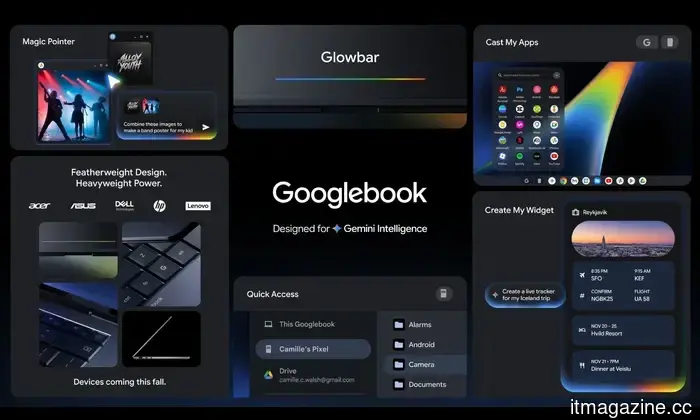
Google has confirmed that Googlebook will support multiple chipmakers, and a recent leak suggests that the first Snapdragon models in development may have been identified.
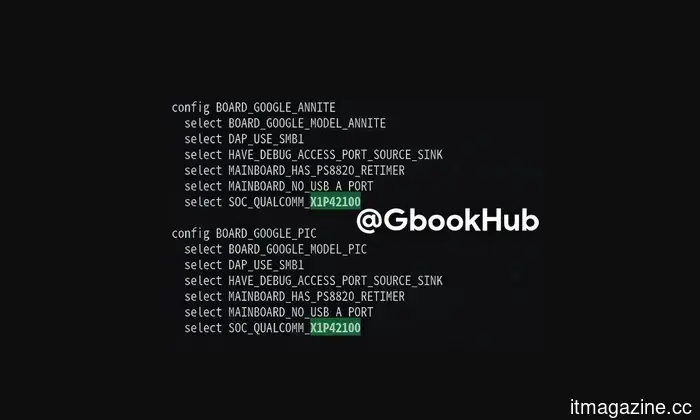
New code references discovered by GbookHub reportedly connect two Googlebook designs, codenamed Annite and Pic, to Qualcomm’s Snapdragon X Plus X1P-42-100 processor. Additionally, these designs appear to be associated with a board platform named Mica.
Snapdragon could provide Googlebook with a more affordable ARM option
The Snapdragon X Plus X1P-42-100 is an eight-core processor capable of reaching speeds up to 3.4GHz. The code also indicates fingerprint support, although USB-A seems to be absent from these specific designs.
GbookHub has also found further references to Quartz and Mica, which it believes could be linked to the more powerful Snapdragon X Elite X1E-80-100, although the connection is less certain.
It is noteworthy that both Snapdragon chips were launched in September 2024. This could result in Googlebook models utilizing these chips being significantly less expensive than those employing the latest hardware, though the exact pricing remains unclear. Current Windows laptops featuring the Snapdragon X Plus typically retail between $700 to $1,100, while devices with Snapdragon X Elite can reach around $1,600. Although more expensive models are available, they usually come with additional memory, storage, or premium features.
Googlebook has always been intended to offer a variety of chip options
Google VP John Maletis confirmed in May that Google is collaborating with Intel, Qualcomm, and MediaTek for Googlebook, making the inclusion of Snapdragon hardware not surprising.
We have already seen leaked images of Intel-powered Googlebook hardware from Acer, featuring up to 32GB of RAM and a 2.8K OLED display, firmly placing it in the premium laptop category. The Snapdragon X Plus could provide hardware partners the flexibility to develop machines focusing on various factors such as price, battery life, and design.
For now, these are only code references and not confirmed products. Until Annite or Pic appear in certification databases or more definitive hardware listings, it is advisable to approach this leak with caution.
---
I didn’t think fake shopping could mislead my mind until I tried the trending dopamine websites
On these fake shopping and delivery platforms, nothing ever ships or incurs a cost, yet the dopamine rush felt authentic.
I spent a while in the internet's most deceptive mall, filling a shopping cart with items that I can't purchase, searching for discounts on nonexistent products, and checking out three times for a total of $0.00. Then I placed a fake food order and had a cigarette I couldn’t taste, alongside strangers I’ll never meet, on a rooftop that also isn’t real. My bank account remained unchanged, but my mindset, frustratingly, did.
When I first learned about South Korea's increasing "dopamine sites," I thought they were just another internet curiosity I would explore for a few minutes and forget by lunchtime. Instead, I discovered a surprisingly clever concept hidden beneath the absurdity. You can browse an endless array of imaginary products, add everything to your cart, and complete a transaction that doesn’t truly exist. These sites aren’t selling anything; they aim to replicate the shopping experience while eliminating the financial cost.
---
LG aims to develop humanoid robots, with NVIDIA supplying the intelligence
This isn’t just another teaser for a robot. LG and NVIDIA have unveiled actual hardware.
More legacy hardware companies appear to be joining the race to add humanoid robots to their agendas. The latest participant is LG, which is entering the competition with tentative timelines. The company’s bipedal humanoid, developed using Nvidia’s robotics technology, is slated for early 2027 and is part of a larger initiative aimed at AI factories and self-driving vehicle platforms.
---
Google’s Gemini app introduces an option to disable AI watermarks, with some exceptions
Your AI-generated creations no longer need to bear a visible watermark.
If you've ever created an image with Gemini and found the stamped watermark bothersome, Google has finally responded. Gemini is rolling out a new feature called Media Watermarks, allowing you to toggle visible watermarks on or off for everything you create, including images generated with Nano Banana, videos made with Omni, and music created with Lyria. Previously, the visible watermark was applied automatically without any option to remove it.





Other articles
 The seven-year spare parts guarantee for Pixel 11 might be ideal for weathering RAMageddon.
The Pixel 11 series will maintain seven years of spare-parts support. In a market where smartphone prices are continuously rising, this could make long-term ownership significantly more feasible.
The seven-year spare parts guarantee for Pixel 11 might be ideal for weathering RAMageddon.
The Pixel 11 series will maintain seven years of spare-parts support. In a market where smartphone prices are continuously rising, this could make long-term ownership significantly more feasible.
 The seven-year spare parts guarantee of the Pixel 11 might be ideal for navigating RAMageddon.
The Pixel 11 series will maintain seven years of spare-parts support. In a market where smartphones are increasingly costly, this could render long-term ownership much more feasible.
The seven-year spare parts guarantee of the Pixel 11 might be ideal for navigating RAMageddon.
The Pixel 11 series will maintain seven years of spare-parts support. In a market where smartphones are increasingly costly, this could render long-term ownership much more feasible.
 The Inertia of Intelligence: Breaking Free from the Trap of Assumptions
When confronted with a complex scenario, the most significant risk in decision-making frequently arises not from insufficient data, but from the inclination to adhere to an obsolete approach to problem-solving, even when circumstances indicate that it may not work. People often opt to reason from an outdated point of view if it aligns with their previous expectations. Additionally, human […]
The Inertia of Intelligence: Breaking Free from the Trap of Assumptions
When confronted with a complex scenario, the most significant risk in decision-making frequently arises not from insufficient data, but from the inclination to adhere to an obsolete approach to problem-solving, even when circumstances indicate that it may not work. People often opt to reason from an outdated point of view if it aligns with their previous expectations. Additionally, human […]
 LG aims to create humanoid robots, with NVIDIA providing the intelligence.
LG's humanoid robot now has a definitive target date: early 2027, featuring NVIDIA's Jetson Thor chip and the Isaac GR00T model.
LG aims to create humanoid robots, with NVIDIA providing the intelligence.
LG's humanoid robot now has a definitive target date: early 2027, featuring NVIDIA's Jetson Thor chip and the Isaac GR00T model.
 Google's Gemini app introduces a switch to turn off AI watermarks, though there are certain exceptions.
Gemini now allows users to disable visible watermarks on Nano Banana images, Omni videos, and Lyria music, although this feature is still limited in specific countries.
Google's Gemini app introduces a switch to turn off AI watermarks, though there are certain exceptions.
Gemini now allows users to disable visible watermarks on Nano Banana images, Omni videos, and Lyria music, although this feature is still limited in specific countries.
 Google's much-anticipated RGB HiLight feature on the Pixel 11 Pro left me feeling disappointed.
Google's HiLight has the potential to reduce the intrusiveness of notifications, but its restricted features leave me desiring greater functionality.
Google's much-anticipated RGB HiLight feature on the Pixel 11 Pro left me feeling disappointed.
Google's HiLight has the potential to reduce the intrusiveness of notifications, but its restricted features leave me desiring greater functionality.
Google may utilize older Snapdragon processors to create more budget-friendly laptops.
The initial Snapdragon-equipped Googlebooks might have appeared in development code, indicating the presence of X Plus and X Elite processors from 2024.