
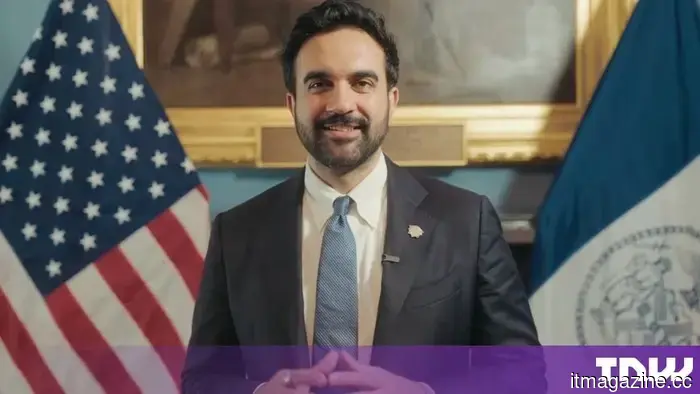
Amazon's $5 million effort against Mamdani's delivery bill serves as a strong justification for its approval.
Amazon is investing $5 million to combat a single bill in New York City, and the size of this payment reveals the most candid truth the company has shared about the ongoing struggle. The proposed legislation, known as the Delivery Protection Act and supported by Mayor Zohran Mamdani, would enforce a requirement that Amazon directly hires the couriers who deliver its packages—something the company has spent years and vast sums trying to avoid.
While Amazon portrays this initiative as a risk to jobs and prices, it fundamentally challenges a deceptive narrative. This narrative is defined by the distinction between the logo on the vest and the name on the payslip. The bill, introduced by Council Member Tiffany Cabán and supported by Mamdani, mandates that any company operating last-mile delivery services in the city must directly employ the delivery personnel.
Amazon is the primary target of this legislation, although FedEx and several regional carriers would also fall under its scope. The bill deserves passage, and other cities should implement it as is.
To understand its implications, consider how Amazon’s delivery model operates. Since its Launch of the Delivery Service Partner program in 2018, drivers wearing blue Amazon vests, driving Amazon-branded vans, and utilizing Amazon’s routing software and performance metrics, are often not directly employed by Amazon. In New York, the deliveries involve over 40 neighborhood contractors. The workers in yellow vests inside the warehouse are Amazon employees; however, the drivers in blue who pick up packages from them are not, and once a package leaves the warehouse, so does the liability.
This intricate arrangement is a strategic maneuver, similar to what Uber defended by refusing to reclassify its drivers as employees. The intent behind this structure is not, as the contractors claim, local knowledge, but rather to maintain deniability.
The ramifications are serious, despite Amazon's contention against the details. Drivers interviewed by Bloomberg have reported issues like faulty van brakes, being urged to continue working despite injuries, and suffering from heat exhaustion in vans with inadequate air conditioning—hazards acknowledged by the city's delivery drivers as well. As Cabán puts it, “When packages are strewn across the street or a van collides with someone, Amazon can say it's not their problem, not their employee.”
Cabán is talking about a company that generates record profits, managed by the third-richest individual on the planet, which has crafted its delivery system such that those taking on the greatest risks are always someone else’s responsibility.
This isn’t just a localized issue in New York; it has broader relevance globally. Economist David Weil, who led wage-and-hour enforcement under Barack Obama and authored a key study on what he refers to as the "fissured workplace," positions the bill as an essential step in establishing Amazon’s role as the employer. The same struggle over gig work has been fought across the globe—from New York courts mandating benefits for Uber and Lyft drivers, to landmark decisions against Uber by the UK Supreme Court, to China’s recently implemented regulations for its platform workers.
Though the technology may evolve, the tactic remains unchanged: create a workforce you can control completely while evading a financial responsibility. Amazon's response to the bill has been a reported $5 million campaign against it, along with warnings that thousands of jobs will disappear and delivery speeds will diminish.
These concerns should not be dismissed, as the approximately 5,000 drivers are right to seek stability. However, the bill includes a one-year grace period for implementation and a hiring preference for current workers, and demand for home delivery is unlikely to decline drastically. The loudest trepidations come from contractors reliant on maintaining the status quo.
The threat to exit the city should also be met with skepticism. An industry-funded report claims that a typical household would incur an additional $664 per year if Amazon were to leave, yet Amazon's primary selling point is rapid delivery—something that necessitates having warehouses located near customers. The company did not open around 15 hubs in the five boroughs for mere sentimental reasons.
Moreover, direct employment is not solely about assigning blame post-factum; it significantly alters the terms of employment for these workers. Under contractors, an employee at a Brooklyn company might pay $266 monthly for the most basic health coverage, which amounts to 43% of its total cost, contrasted with a national average employee contribution of just 16%. Amazon provides considerably better coverage for its warehouse staff, with plans starting as low as $20 a month. Integrating drivers as direct employees would enhance their benefits almost inherently.
This trend carries over to liability insurance as well: small delivery firms generally maintain coverage around $1 million, while UPS, which directly employs its drivers, secures around five times that amount. As such, responsibility and coverage are interconnected, highlighting the essence of the issue.
Acknowledging this does not mean overlooking the complexities. Some contractors, like the Brooklyn firm that pays above the minimum wage and provides vacation days, benefits, and retirement
Other articles
 Microsoft has discovered yet another method to increase the cost of PCs, as if they weren't already expensive enough.
PC prices are on the rise again. Microsoft recently increased Windows licensing fees by as much as 10%, which adds to the higher costs of memory and CPUs.
Microsoft has discovered yet another method to increase the cost of PCs, as if they weren't already expensive enough.
PC prices are on the rise again. Microsoft recently increased Windows licensing fees by as much as 10%, which adds to the higher costs of memory and CPUs.
 Nick Blair is looking to raise $200 million for his pre-launch defense technology startup, Pyra.
Nick Blair, the son of former UK Prime Minister Tony Blair, is looking to raise approximately $200 million for Pyra, a defense-tech startup in London that has not yet launched, amid a surge in European military-tech investment reaching unprecedented levels.
Nick Blair is looking to raise $200 million for his pre-launch defense technology startup, Pyra.
Nick Blair, the son of former UK Prime Minister Tony Blair, is looking to raise approximately $200 million for Pyra, a defense-tech startup in London that has not yet launched, amid a surge in European military-tech investment reaching unprecedented levels.
 Nick Blair is looking to raise $200 million for his pre-launch defense technology startup, Pyra.
Nick Blair, the son of former UK Prime Minister Tony Blair, is looking to raise approximately $200 million for Pyra, a defense-tech startup based in London that is yet to launch, as funding for military technology in Europe reaches unprecedented levels.
Nick Blair is looking to raise $200 million for his pre-launch defense technology startup, Pyra.
Nick Blair, the son of former UK Prime Minister Tony Blair, is looking to raise approximately $200 million for Pyra, a defense-tech startup based in London that is yet to launch, as funding for military technology in Europe reaches unprecedented levels.
 HSBC Asset Management has made an investment in Model ML's 'agentic operating system' designed for banks.
HSBC Asset Management has acquired a share in Model ML, the London-based startup developing an agentic operating system for the financial services sector, as part of its primary venture-capital initiative.
HSBC Asset Management has made an investment in Model ML's 'agentic operating system' designed for banks.
HSBC Asset Management has acquired a share in Model ML, the London-based startup developing an agentic operating system for the financial services sector, as part of its primary venture-capital initiative.
 I came across a peculiar MelGeek lighting feature and transformed my keyboard into a Tetris game.
I found out that the MelGeek MADE68 Ultra V2 is capable of transforming standard GIFs into RGB lighting effects, so I decided to create a 30-second loop of Tetris for it.
I came across a peculiar MelGeek lighting feature and transformed my keyboard into a Tetris game.
I found out that the MelGeek MADE68 Ultra V2 is capable of transforming standard GIFs into RGB lighting effects, so I decided to create a 30-second loop of Tetris for it.
 Amkor is considering a stake sale of over $1 billion in its chip division in China.
Amkor Technology is considering selling a stake in its chip packaging division in China, valued between $1 billion and $1.5 billion, as it shifts its focus to Nvidia and Arizona.
Amkor is considering a stake sale of over $1 billion in its chip division in China.
Amkor Technology is considering selling a stake in its chip packaging division in China, valued between $1 billion and $1.5 billion, as it shifts its focus to Nvidia and Arizona.
Amazon's $5 million effort against Mamdani's delivery bill serves as a strong justification for its approval.
New York's Delivery Protection Act would require Amazon to hire the couriers who currently display its logo. The company's own subcontracting model is the strongest case for why this should happen.