

Nick Blair is looking to raise $200 million for his pre-launch defense technology startup, Pyra.
Nick Blair, the son of former UK prime minister Tony Blair, is attempting to secure approximately $200 million for a defense technology startup that has yet to be launched, according to the Financial Times, which describes the situation as ongoing and unverified.
The London-based company, Pyra, is reportedly in discussions with investors that have not yet concluded, making the target amount notable for a business whose website currently consists largely of the phrase “stand by.”
Pyra was quietly established in November 2023 and claims it is developing technology aimed at integrating various systems into a single source. This type of data and systems integration is increasingly desirable for military organizations that are overwhelmed by incoming data from drones, satellites, sensors, and decades of legacy equipment that do not communicate with one another.
The company expects to launch in the summer of 2026, and a spokesperson framed its mission around sovereignty, stating that Pyra was created to enhance the security interests of the UK and its allies, emphasizing the need for Britain to revamp its domestic industrial capabilities and digital resources.
Nick Blair is the lesser-known son of Tony Blair, sharing familial ties with Euan Blair, whose upskilling venture Multiverse achieved unicorn status. There is a notable parallel in the son of the prime minister who led Britain into Iraq now seeking funding to prepare for future military engagements.
This is not Blair’s first venture in this field. He co-founded and currently chairs Skyral, a UK startup focused on developing strategic digital twins, which are modeling and simulation systems employed to rehearse decisions in defense and national security. Skyral raised £15 million (approximately $20 million) last year in a funding round led by European venture capital firm NOIA Capital.
Skyral is not merely a theoretical exercise, which lends credibility to the new venture. It collaborates with partners in the UK, US, and NATO and is part of a consortium pursuing a contract valued at around £2 billion to become the British Army’s strategic training partner—a deal that would position it alongside major players like Raytheon and Rheinmetall, overseeing the training of about 60,000 soldiers each year.
The timing underscores the ambitious nature of Pyra. Funding for defense-tech in Europe and the UK has surged from being niche to a competitive frenzy in just a year, with startups in the area raising $12.3 billion by late June, nearly double the previous year’s total.
Large funding rounds have become increasingly common, with notable examples including Stark Defence securing €500 million at a €3.5 billion valuation and Cambridge Aerospace raising $300 million at a $3.4 billion valuation, each resetting expectations for early investments in the field.
Government support has been a significant factor in this trend. As defense budgets rise across Europe and the UK commits to increased military spending, investors who once avoided weapons-related ventures are now entering the market. The rising defense stocks have also heightened interest in startups aligned with this trend.
Nonetheless, raising $200 million for a pre-launch company requires significant trust. Pyra currently lacks a public product, disclosed customers, and a named lead investor, and the ambitious promise of integrating various systems into one cohesive platform is one that both defense contractors and startups have made for years without fully delivering.
While the connection to the Blair name may provide some advantages, military procurement processes are often slow, challenging, and intensely political. A well-known name can have both positive and negative implications once a contract is on the table.
The convergence of investment, national security concerns, and a prominent surname reflects a pivotal moment in which defense has rapidly transformed from being considered unfashionable to becoming one of the most sought-after sectors in European technology. Whether Pyra will secure its $200 million remains to be seen, but the situation highlights a significant shift in the landscape.
Other articles
 Vingroup's VinSpace partners with SpaceX to launch Vietnam's inaugural domestically produced satellites.
VinSpace, a subsidiary of Vingroup established a year ago, has entered into a launch agreement with SpaceX to deploy Vietnam's inaugural self-developed satellites into orbit in 2027.
Vingroup's VinSpace partners with SpaceX to launch Vietnam's inaugural domestically produced satellites.
VinSpace, a subsidiary of Vingroup established a year ago, has entered into a launch agreement with SpaceX to deploy Vietnam's inaugural self-developed satellites into orbit in 2027.
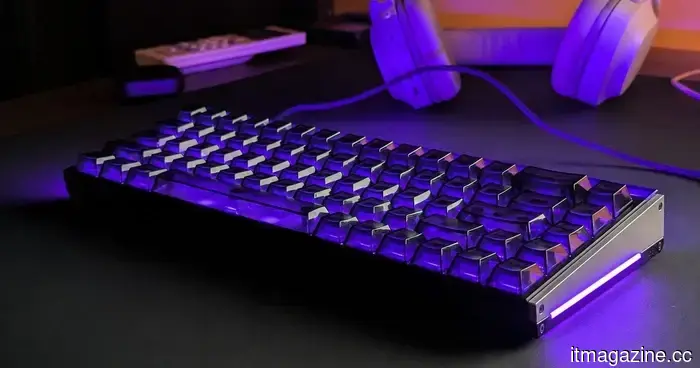 I came across a peculiar MelGeek lighting feature and transformed my keyboard into a Tetris game.
I found out that the MelGeek MADE68 Ultra V2 is capable of transforming standard GIFs into RGB lighting effects, so I decided to create a 30-second loop of Tetris for it.
I came across a peculiar MelGeek lighting feature and transformed my keyboard into a Tetris game.
I found out that the MelGeek MADE68 Ultra V2 is capable of transforming standard GIFs into RGB lighting effects, so I decided to create a 30-second loop of Tetris for it.
 The upcoming iPhone update for WhatsApp may simplify the process of searching through chats significantly.
WhatsApp is developing a new in-chat search button for iPhone that will show up when you scroll up, allowing you to locate previous messages without exiting the conversation.
The upcoming iPhone update for WhatsApp may simplify the process of searching through chats significantly.
WhatsApp is developing a new in-chat search button for iPhone that will show up when you scroll up, allowing you to locate previous messages without exiting the conversation.
 Amkor is considering a stake sale of over $1 billion in its chip division in China.
Amkor Technology is considering selling a stake in its chip packaging division in China, valued between $1 billion and $1.5 billion, as it shifts its focus to Nvidia and Arizona.
Amkor is considering a stake sale of over $1 billion in its chip division in China.
Amkor Technology is considering selling a stake in its chip packaging division in China, valued between $1 billion and $1.5 billion, as it shifts its focus to Nvidia and Arizona.
 Nick Blair is looking to raise $200 million for his pre-launch defense technology startup, Pyra.
Nick Blair, the son of former UK Prime Minister Tony Blair, is looking to raise approximately $200 million for Pyra, a defense-tech startup based in London that is yet to launch, as funding for military technology in Europe reaches unprecedented levels.
Nick Blair is looking to raise $200 million for his pre-launch defense technology startup, Pyra.
Nick Blair, the son of former UK Prime Minister Tony Blair, is looking to raise approximately $200 million for Pyra, a defense-tech startup based in London that is yet to launch, as funding for military technology in Europe reaches unprecedented levels.
 Anthropic has entered into a cloud agreement worth $9.1 billion over 20 years with bitcoin mining company Riot Platforms.
Anthropic has finalized a 20-year cloud agreement valued at $9.1 billion with Riot Platforms, a company that transitioned from bitcoin mining to becoming an AI provider, for 191MW of capacity at its site in Rockdale, Texas.
Anthropic has entered into a cloud agreement worth $9.1 billion over 20 years with bitcoin mining company Riot Platforms.
Anthropic has finalized a 20-year cloud agreement valued at $9.1 billion with Riot Platforms, a company that transitioned from bitcoin mining to becoming an AI provider, for 191MW of capacity at its site in Rockdale, Texas.
Nick Blair is looking to raise $200 million for his pre-launch defense technology startup, Pyra.
Nick Blair, the son of former UK Prime Minister Tony Blair, is looking to raise approximately $200 million for Pyra, a defense-tech startup in London that has not yet launched, amid a surge in European military-tech investment reaching unprecedented levels.