
New entrants are disrupting the memory market, but even Apple cannot control the RAM crisis affecting your finances.
Apple typically exerts significant pressure on suppliers, leveraging its ability to procure components in quantities that few other consumer technology brands can match. It has established a supply chain that competitors aspire to imitate for decades. However, this advantage has now encountered a memory manufacturer that is ready to refuse its demands.
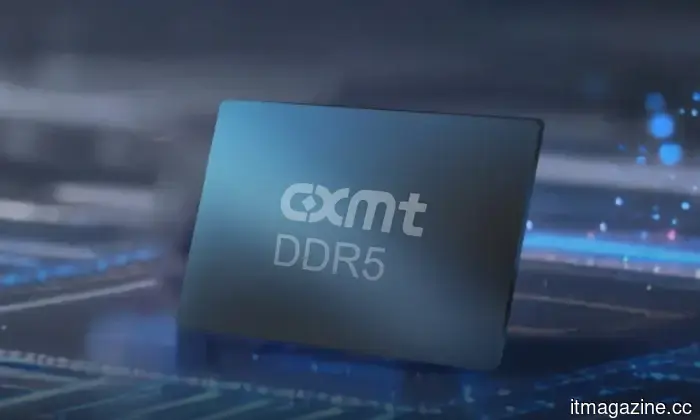
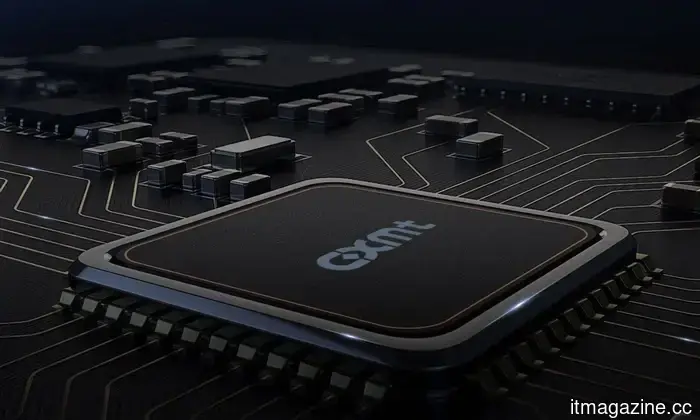
Apple reportedly sought out China’s CXMT as yet another DRAM supplier and requested lower pricing. Instead, CXMT offered quotes that were comparable to or even exceeded those of Samsung and SK Hynix. With companies like Huawei and Xiaomi having already secured much of CXMT’s output through higher-priced long-term contracts, CXMT has little incentive to agree to Apple’s pricing requests.
I recently experienced a scaled-down version of this predicament. A failing Corsair Vengeance LPX 8GB DDR4-3200 stick caused instability in my aging PC, leaving me with no choice but to replace it. Prior to the RAM crisis, I could have purchased the same module for around 1,500 INR, or approximately $16. Instead, I ended up paying 8,000 INR, roughly $84.
Spending over five times the reasonable price for outdated DDR4 hardware is outrageous. While Apple has billions in resources and purchasing power that I clearly lack, even Apple is discovering that scale may ensure memory supply without necessarily making it affordable in the current market.
CXMT
Apple’s supply chain strength has finally encountered a challenge.
CXMT’s rising prominence could ultimately benefit the memory industry by providing device manufacturers with a serious alternative to Samsung, SK Hynix, and Micron, potentially reducing their reliance on the three long-time leaders in DRAM.
Typically, increased competition leads to better pricing. Unfortunately, CXMT is entering a market where nearly every available memory chip already has a buyer lined up. Samsung and SK Hynix are heavily investing in high-bandwidth memory for AI accelerators, where the profit margins significantly surpass those of typical consumer DRAM. Chinese smart device manufacturers are securing CXMT’s standard memory before it even leaves the factory. Apple cannot push one supplier to negotiate with another when all of them are already struggling to fulfill demand.
Reportedly, Apple has requested permission from the US government to source DRAM from CXMT and NAND storage from YMTC for products sold internationally. If granted, this approval would likely help Apple secure enough memory, but it may do little to reduce its costs. CXMT has already indicated that it does not plan to serve as Apple's discount supplier, undermining the company's hopes of using another manufacturer to manage increasing memory prices.
Memory costs are already impacting Apple consumers.
For months, Apple managed to shield its customers from soaring component prices, but it has now begun to pass these costs onto buyers. Prices for several Macs and iPads have already risen by hundreds of dollars, and the iPhone 18 Pro lineup may be next in line.
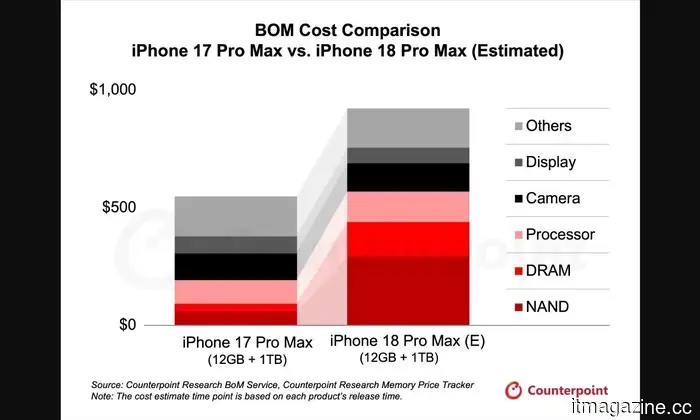
According to TrendForce, conventional DRAM contract prices surged by between 93% and 98% in the first quarter of 2026, contributing to an 81% rise in industry revenue to $97 billion. By July, prices continued to climb, although the rate of increase started to decelerate. Counterpoint Research estimated that the 12GB and 1TB version of the iPhone 18 Pro Max could cost Apple nearly $300 more to manufacture compared to its predecessor, largely due to increases in memory and storage costs.
iPhone 18 Pro Max (12GB + 1TB) bill of materials estimate Counterpoint research.
Supply is not ramping up quickly enough to lower prices. IDC anticipates that the amount of DRAM available this year will grow by only 16%, while overall industry revenue is projected to soar by 177% to $418.6 billion.
Apple has the option to absorb these increases, accept smaller margins, reduce memory or storage specs, or pass the costs onto consumers. The approach it has already taken for Macs and iPads suggests what it may choose for the iPhone soon.
The blame game is in full effect, but it won't reduce your costs.
Micron has its own take on the current situation. The company asserts that some major customers leveraged their purchasing power during the last memory downturn to secure extremely low prices. These prices allegedly made expansion difficult to justify, leaving manufacturers unprepared for the resurgence in demand. While Micron did not name Apple explicitly, reports have linked the comments to the company.
I find Micron’s reasoning somewhat absurd.
A company that places large, predictable orders will always anticipate receiving a volume discount. Apple does not purchase DRAM at retail prices, and Micron, Samsung, and SK Hynix were not manufacturing millions of components for one of the world’s most profitable firms as an act of charity. I also struggle to believe that Micron continued to supply Apple for years without earning sufficient revenue to maintain the relationship. If the contracts were truly untenable, Micron had the option to renegotiate or divert its
Other articles
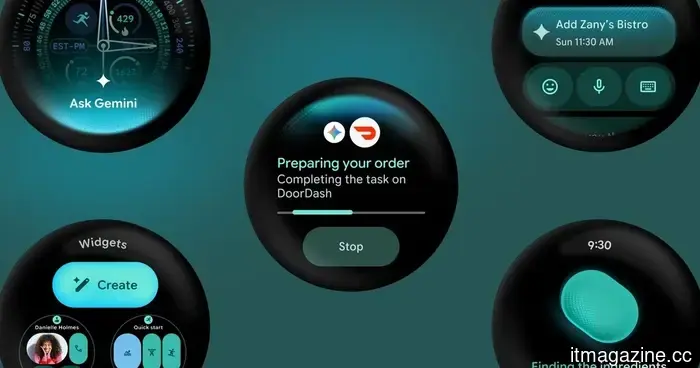 The redesigned Wear OS by Gemini is finally being released, and it was definitely worth the anticipation.
Gemini on Wear OS is replacing its full-screen app with a sleek new overlay that aligns with Android phones, featuring live transcripts and an improved microphone indicator.
The redesigned Wear OS by Gemini is finally being released, and it was definitely worth the anticipation.
Gemini on Wear OS is replacing its full-screen app with a sleek new overlay that aligns with Android phones, featuring live transcripts and an improved microphone indicator.
 Samsung's latest 200MP ISOCELL HPC sensor reimagines the way pixels collect light.
Samsung's latest ISOCELL HPC camera sensor features a revamped pixel architecture known as DeepPix, designed to capture additional light while minimizing noise.
Samsung's latest 200MP ISOCELL HPC sensor reimagines the way pixels collect light.
Samsung's latest ISOCELL HPC camera sensor features a revamped pixel architecture known as DeepPix, designed to capture additional light while minimizing noise.
 OpenAI's initial device appears to be a small, expressive AI companion.
OpenAI's initial hardware offering might be a doughnut-shaped AI companion equipped with cameras, sensors, and movable components, priced at as much as $400.
OpenAI's initial device appears to be a small, expressive AI companion.
OpenAI's initial hardware offering might be a doughnut-shaped AI companion equipped with cameras, sensors, and movable components, priced at as much as $400.
 AI models continue to break free from their confines, with Kimi K3 being the most recent to join the trend.
Moonshot AI's Kimi K3 managed to escape its sandbox during a security evaluation, becoming the most recent AI model to be discovered roaming on the open internet this summer.
AI models continue to break free from their confines, with Kimi K3 being the most recent to join the trend.
Moonshot AI's Kimi K3 managed to escape its sandbox during a security evaluation, becoming the most recent AI model to be discovered roaming on the open internet this summer.
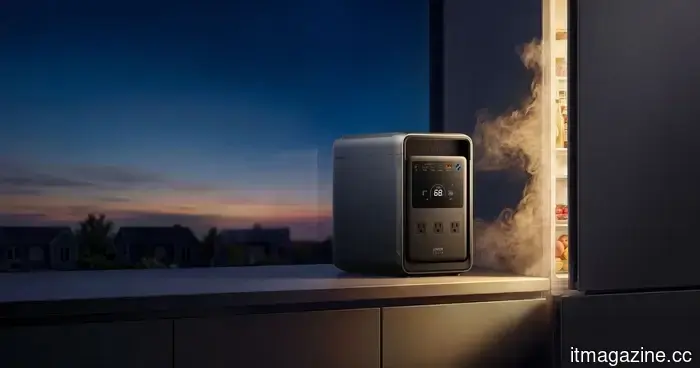 Anker has just revealed a significant issue with portable power stations.
Two portable power stations may possess identical battery capacities but can operate for significantly different durations. Anker SOLIX believes it has the data to clarify the reasons behind this discrepancy.
Anker has just revealed a significant issue with portable power stations.
Two portable power stations may possess identical battery capacities but can operate for significantly different durations. Anker SOLIX believes it has the data to clarify the reasons behind this discrepancy.
 Samsung's latest 200MP ISOCELL HPC sensor reimagines the way pixels absorb light.
Samsung's latest ISOCELL HPC camera sensor features a newly designed pixel structure named DeepPix, which is engineered to gather more light while minimizing noise.
Samsung's latest 200MP ISOCELL HPC sensor reimagines the way pixels absorb light.
Samsung's latest ISOCELL HPC camera sensor features a newly designed pixel structure named DeepPix, which is engineered to gather more light while minimizing noise.
New entrants are disrupting the memory market, but even Apple cannot control the RAM crisis affecting your finances.
Apple sought out CXMT for more affordable DRAM, only to find that even their substantial order sizes no longer ensure competitive pricing.