
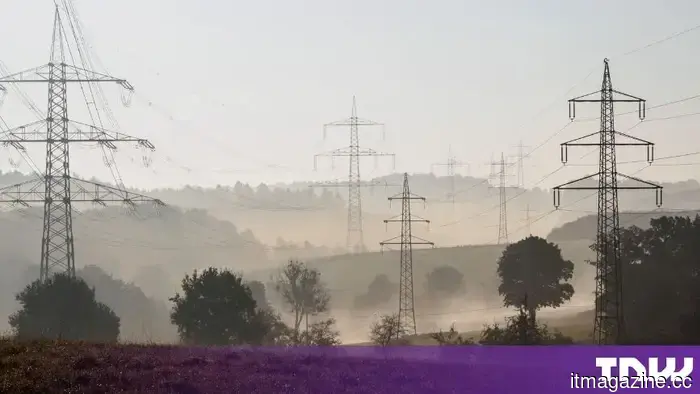
The demand for AI is pushing data center developers to seek financing from banks.
The limitation in AI is no longer related to chips; it has shifted to power. This urgent need for energy is prompting data center developers to approach banks for billions in funding commitments, according to Bloomberg. This change is significant.
During much of the AI surge, the scarce resource was Nvidia's GPUs, but now it has transformed into electricity, alongside the necessary contracts, substations, and financing to support it on a large scale.
The amounts involved are astonishing. The four largest cloud companies are projected to invest approximately $725 billion in AI infrastructure just this year, with individual projects now costing amounts that could have financed entire companies, such as Meta’s $13 billion data center in Texas.
The cost of power contributes significantly to the high expenses of these facilities. Server racks that used to require around 3kW for standard computing now demand up to 150kW for AI applications, and global data center capacity is expected to nearly double to about 200GW by 2030.
This is where banks come into play. Developers are seeking solid financing commitments before entering into power agreements and construction contracts, and the financial figures are substantial enough that no single entity wants to handle them alone.
The borrowing landscape has already altered credit markets dramatically. Lenders are entering the industry in force, with examples like a $5.9 billion loan for one data center operator and a surge of bonds and private credit arrangements fueling the buildout.
The funding methods are evolving and becoming less transparent. Oracle's $16.3 billion data center financing relied on private credit after banks became more cautious, indicating a departure from traditional funding methods.
Much of this financing remains hidden from view. Analysts believe the sector has approximately $1.65 trillion in off-balance-sheet obligations, arranged through special vehicles that prevent the debt from appearing on the tech giants' own financial statements.
The quest for power is transforming energy markets. Developers are restarting gas plants, entering nuclear agreements, and gaining priority over utilities, making data centers some of the largest new purchasers of electricity in a generation.
This added demand is affecting everyone else. Power grids are struggling with the increased load, and in some areas, households are already facing higher costs as data centers compete for the same energy resources.
Regulators are observing with concern. The Bank for International Settlements has highlighted 'circular financing' between cloud companies, their suppliers, and construction lessors as a significant risk to financial stability.
Construction itself has become a bottleneck. Fewer than ten companies worldwide can execute a hyperscale project, and one of them, Turner, is currently managing a record backlog of around $44 billion, much of which is linked to data centers.
Moreover, banks are not lending indiscriminately. As the amounts grow and the financing arrangements become more complex, some lenders have reduced their involvement, contributing to the urgency among developers for firm funding commitments rather than presuming the funds will be readily available.
Power agreements are being secured years in advance. Developers are entering long-term contracts for electricity, gas, and even nuclear power, and the bank commitments help to validate these agreements.
At the core of this situation lies an expectation for sustained demand. The expenditures will only be justified if AI usage continues to rise rapidly enough to utilize the new capacity, making every quarter of AI revenue increasingly scrutinized.
There's a self-reinforcing dynamic at play as well. The more funds that are committed to construction, the more the industry relies on AI growth to validate those investments, which is why the circular nature of this cycle poses challenges for regulators to untangle.
The scale of investment is unprecedented. Goldman Sachs anticipates that the total spending on this expansion could reach trillions by 2030, a figure that overshadows previous infrastructure booms and leaves little margin for error.
For the time being, the funds continue to flow toward energy sources. The competition for computational power has evolved into a competition for electricity, and the outcome may be determined less by superior models and more by the ability to finance the electricity necessary to operate them.
Other articles
 SpaceX is pushing competitors out of the market for the rockets they rely on.
As SpaceX increases the number of its Starlink satellites, it is pushing competing satellite companies out of the Falcon 9 launch schedule, with some reservations extending to 2028-2029.
SpaceX is pushing competitors out of the market for the rockets they rely on.
As SpaceX increases the number of its Starlink satellites, it is pushing competing satellite companies out of the Falcon 9 launch schedule, with some reservations extending to 2028-2029.
 Nvidia and Dell support the AI cloud startup Volta, which has been valued at $2.4 billion.
AI cloud startup Volta has secured $300 million in funding and arranged for $5 billion in financing, achieving a valuation of $2.4 billion, with support from a16z, Altimeter, Nvidia, and Michael Dell.
Nvidia and Dell support the AI cloud startup Volta, which has been valued at $2.4 billion.
AI cloud startup Volta has secured $300 million in funding and arranged for $5 billion in financing, achieving a valuation of $2.4 billion, with support from a16z, Altimeter, Nvidia, and Michael Dell.
 TikTok reaches another settlement to avoid a jury trial regarding harm to teens.
TikTok resolved the three lawsuits it was scheduled to contest in October, continuing a streak that has spared it from any jury trials. In contrast, Meta and Google opted to contest their cases.
TikTok reaches another settlement to avoid a jury trial regarding harm to teens.
TikTok resolved the three lawsuits it was scheduled to contest in October, continuing a streak that has spared it from any jury trials. In contrast, Meta and Google opted to contest their cases.
 Nvidia and Dell support AI cloud startup Volta, which is valued at $2.4 billion.
AI cloud startup Volta has secured $300 million in funding and arranged $5 billion in financing at a valuation of $2.4 billion, with support from a16z, Altimeter, Nvidia, and Michael Dell.
Nvidia and Dell support AI cloud startup Volta, which is valued at $2.4 billion.
AI cloud startup Volta has secured $300 million in funding and arranged $5 billion in financing at a valuation of $2.4 billion, with support from a16z, Altimeter, Nvidia, and Michael Dell.
 The 'death zone': how independent Chinese models are undermining US AI.
Bloomberg refers to it as a ‘death zone’: China’s advanced, accessible open-source AI models are impacting the mid-market segment where US model developers operate.
The 'death zone': how independent Chinese models are undermining US AI.
Bloomberg refers to it as a ‘death zone’: China’s advanced, accessible open-source AI models are impacting the mid-market segment where US model developers operate.
 Australia has just established a troubling precedent for invasive behavior with the introduction of affordable smartglasses.
Kmart's affordable AI smart glasses are selling rapidly, but they are also sparking a renewed discussion about privacy, surveillance, and whether the presence of wearable cameras has become overly commonplace.
Australia has just established a troubling precedent for invasive behavior with the introduction of affordable smartglasses.
Kmart's affordable AI smart glasses are selling rapidly, but they are also sparking a renewed discussion about privacy, surveillance, and whether the presence of wearable cameras has become overly commonplace.
The demand for AI is pushing data center developers to seek financing from banks.
As power has become the limiting factor for AI, data center developers are pursuing billions in bank financing commitments to secure electricity and facilitate construction.