
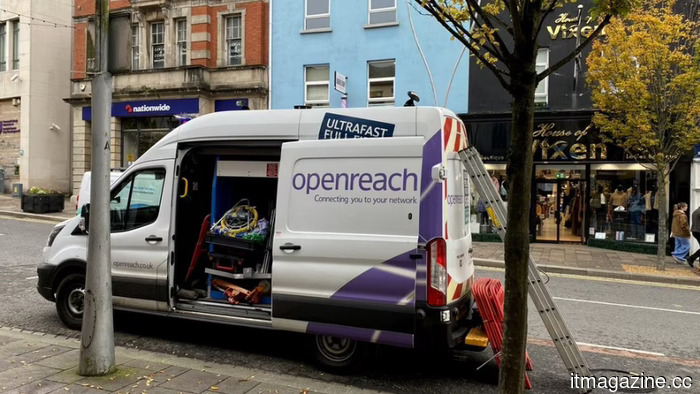
Ofcom takes steps to prevent Openreach's fibre discount for the first time.
On Tuesday, Ofcom proposed to block a discounted wholesale offer from Openreach, marking the regulator's first attempt to halt a commercial agreement from BT’s network division. The offer would have provided internet service providers with discounts of up to £9.50 per customer each month for as long as 30 months, contingent on connecting more new full-fibre customers to Openreach than their typical rate.
The regulator was concerned about the structure of the offer. The discount only applies to sign-ups exceeding a provider's usual levels, specifically targeting the marginal customers that alternative networks rely on for growth.
What Ofcom stated
The regulator determined that the pricing was “not fair and reasonable” and posed a risk to competition in a wholesale full-fibre market that is still evolving. Rivals may feel pressured to match the pricing but might not be able to recover their costs, which Ofcom indicated would weaken competition and ultimately lead to price increases.
“Openreach must compete, but they cannot exploit their significant market power to push other networks out,” said Natalie Black, Ofcom’s group director for infrastructure and connectivity.
The three offers Ofcom is allowing
Openreach submitted four commercial offers, and Ofcom is provisionally approving the other three. One consists of a one-time £50 discount for new full-fibre customers beyond the usual sign-up level in areas served by Virgin Media O2. Another limits charges for new high-speed connections. Ofcom remarked that the geographic offer has a significantly lower value compared to the one it intends to block, making it less likely to distort competition.
Openreach's stance
“We’re disappointed that Ofcom has raised concerns about one of our four offers, which we submitted in good faith at a time when many households are closely monitoring their bills,” stated James Lowther, managing director for commercial at Openreach. “In such a competitive market, we believe regulation should not shield inadequate business models, and we disagree with Ofcom’s assessment,” he added, noting that the company would participate in the consultation.
Rival companies claim one out of four is insufficient
Virgin Media O2 supported the proposal but contended that Ofcom's review was too narrow. A spokesperson argued that the “interrelated nature of the offers and Openreach’s clear intent to ‘test the waters’ means Ofcom should be more stringent,” alleging that Openreach is gradually introducing discounts to deter providers from utilizing competing fibre networks.
Nexfibre's CEO, Rajiv Datta, echoed this sentiment. He welcomed the rejection of “the most egregious” offer but suggested that the regulator should consider “the cumulative effect of the continuous introduction of other offers, which are part of a broader strategy to hinder the rise of substantial wholesale competition.”
The significance of the timing
James Robinson, a senior equity analyst at Assembly Research, highlighted that Openreach had refrained from launching new commercial offers while Ofcom’s recent Telecoms Access Review was in progress but acted swiftly after its conclusion. “Openreach moved quickly to probe the market, and its proposals certainly accomplished that,” he noted. Robinson mentioned that the company now faces “a challenging task and a tight schedule” to persuade Ofcom that the discounts would not negatively impact competition, adding that the regulator has at least clarified the boundaries of Openreach’s pricing approach.
The market competition landscape
Nearly 80% of UK households can now access full-fibre broadband, up from less than 25% five years ago, following BT's investment of approximately £15 billion in its network and the construction of multiple alternative networks. About three-quarters of the country has access to at least two networks, with nearly one-third able to choose from three.
Openreach aims to reach 25 million premises by the end of 2026 and has broadened its collaboration with Google Cloud to incorporate AI into the rollout. Scale is critical: the entity that first achieves breakeven density sets the wholesale prices for others.
This dynamic is not new to UK telecom regulation. Ofcom spent years deliberating on how much to restrict BT’s control of the national network, ultimately opting to separate Openreach instead of dismantling it entirely.
What is at stake beyond broadband
The enhancement in coverage has been significant. A decade ago, the critical milestone was 30Mbps availability, a benchmark that now seems outdated compared to gigabit fibre. Connectivity is considered an economic factor rather than merely a consumer product. Analysis has consistently shown that the UK’s digital economy is larger than reported figures indicate, with digitally intensive companies experiencing faster growth and hiring more than their counterparts.
Broadband competition now fits within a broader infrastructure dialogue. The government allocated £1.3 billion for AI hardware, skills, and adoption during London Tech Week, a program that assumes foundational connectivity is both affordable and widespread.
Ofcom’s consultation will be open until August 27, with a final decision anticipated by the end of September. Regardless of the outcome, the regulator has made it clear that it is prepared
Other articles
 Core Scientific shifts its focus to AMD with a 2.5GW AI data center agreement, just months after the CoreWeave deal fell through.
Core Scientific has entered into a data center agreement with AMD that has the potential to reach 2.5GW, just nine months after shareholders turned down a $9 billion acquisition of CoreWeave.
Core Scientific shifts its focus to AMD with a 2.5GW AI data center agreement, just months after the CoreWeave deal fell through.
Core Scientific has entered into a data center agreement with AMD that has the potential to reach 2.5GW, just nine months after shareholders turned down a $9 billion acquisition of CoreWeave.
 Core Scientific shifts to AMD with a 2.5GW AI data center agreement, following the breakdown of the CoreWeave deal just months prior.
Core Scientific has finalized a data-center agreement with AMD that could amount to 2.5GW, just nine months after shareholders turned down a $9 billion acquisition of CoreWeave.
Core Scientific shifts to AMD with a 2.5GW AI data center agreement, following the breakdown of the CoreWeave deal just months prior.
Core Scientific has finalized a data-center agreement with AMD that could amount to 2.5GW, just nine months after shareholders turned down a $9 billion acquisition of CoreWeave.
 BMW might finally be creating the electric convertible that enthusiasts have long desired.
BMW's electric i4 Convertible is set to debut in 2028, though the i4 nameplate will be temporarily on hiatus before then.
BMW might finally be creating the electric convertible that enthusiasts have long desired.
BMW's electric i4 Convertible is set to debut in 2028, though the i4 nameplate will be temporarily on hiatus before then.
 Mate Security surpasses $50 million in funding as the AI security operations startup prepares for Black Hat USA.
Mate Security has successfully secured $35 million in a Series A funding round led by Canaan Partners, resulting in total funding exceeding $50 million. Founded by former employees of Wiz and Microsoft, the startup develops AI-driven security operations that incorporate an organizational context layer, enabling AI agents to make reliable decisions for security teams.
Mate Security surpasses $50 million in funding as the AI security operations startup prepares for Black Hat USA.
Mate Security has successfully secured $35 million in a Series A funding round led by Canaan Partners, resulting in total funding exceeding $50 million. Founded by former employees of Wiz and Microsoft, the startup develops AI-driven security operations that incorporate an organizational context layer, enabling AI agents to make reliable decisions for security teams.
 Amkor plans to invest as much as $3 billion, which is nearly 40% of its revenue.
Amkor announced a record revenue of $1.9 billion for Q2 and saw its net income triple. The capex forecast for 2026 is set at $3 billion, which is approximately 40% of its annualized sales.
Amkor plans to invest as much as $3 billion, which is nearly 40% of its revenue.
Amkor announced a record revenue of $1.9 billion for Q2 and saw its net income triple. The capex forecast for 2026 is set at $3 billion, which is approximately 40% of its annualized sales.
 Mate Security surpasses $50 million in funding as the AI security operations startup prepares for Black Hat USA.
Mate Security has secured $35 million in a Series A funding round led by Canaan Partners, raising its total funding to over $50 million. The startup, founded by former employees of Wiz and Microsoft, develops AI-driven security operations centered on an organizational context layer, enabling AI agents to make reliable decisions for security teams.
Mate Security surpasses $50 million in funding as the AI security operations startup prepares for Black Hat USA.
Mate Security has secured $35 million in a Series A funding round led by Canaan Partners, raising its total funding to over $50 million. The startup, founded by former employees of Wiz and Microsoft, develops AI-driven security operations centered on an organizational context layer, enabling AI agents to make reliable decisions for security teams.
Ofcom takes steps to prevent Openreach's fibre discount for the first time.
Ofcom has stated that Openreach's GBP 9.50 discount for new full-fibre customers is "unfair and unreasonable" and could put pressure on alternative network providers. Competitors argue that more action is needed.