
Core Scientific shifts its focus to AMD with a 2.5GW AI data center agreement, just months after the CoreWeave deal fell through.
Nine months after its shareholders rejected a nearly $9 billion acquisition attempt by CoreWeave, Core Scientific has secured a much larger partner with a chipmaker aiming to challenge Nvidia's dominance in artificial intelligence. On Tuesday, the former bitcoin mining company announced that it had established a data center agreement with AMD, which could ultimately deliver 2.5 gigawatts of capacity throughout the American South. Investors viewed this as a validation of the deal they opted out of.
Central to this agreement are long-term leases encompassing 529 megawatts of essential IT capacity, with AMD directly taking 377MW, and a group of unnamed neocloud operators accounting for the remaining 152MW. The facilities are located in Pecos and Hunt County in Texas, Muskogee in Oklahoma, Auburn in Alabama, and Dalton in Georgia. The leases last for 15 years with three options for five-year renewals, potentially extending the partnership to three decades, with revenue expected to start in 2027.
What elevates this sizable colocation deal to a significant one, as presented by both companies, is the inclusion of options and equity. AMD retains the right to call on an additional 1,925MW of capacity by December 2028, thus achieving the total headline figure of 2.5GW. Additionally, AMD has received a warrant for up to 30 million shares of Core Scientific at $23.47 each, with vesting at a rate of 12,222 shares for every megawatt made available.
Upon signing the leases, approximately 6.5 million shares vested immediately. This equity-for-capacity framework mirrors the approach Nvidia used when it took a $2.1 billion warrant in IREN and connects the chipmaker's potential gains to the success of the landlord supporting its hardware.
Neither party disclosed a monetary value for the commitment, and much of the framing came from Core Scientific, which claimed the new contracts increase its leased capacity to about 1.1GW and elevate its contracted revenue to over $24 billion. However, these figures are company estimates rather than independent audits, and should be viewed as directional rather than concrete.
The components themselves are confirmed, as the capacity will utilize AMD's Instinct GPUs, EPYC processors, and ROCm software. For AMD, this partnership provides ensured real estate during a time when it struggles to establish itself against Nvidia in both training and inference markets. Over the past two years, the company has pursued credibility through acquisitions, like Silo AI, and commitments to Anthropic for up to two gigawatts of its latest accelerators, while securing power ahead of demand alleviates one of the major obstacles.
For Core Scientific, this agreement marks a unique and quietly successful year. Much of 2025 was spent being the target of CoreWeave, which offered approximately $9 billion in an all-stock deal to merge its energy-demanding facilities with its infrastructure. However, Core Scientific's investors felt the offer undervalued their assets, resulting in a rejection of the merger on October 30.
Despite their previous tensions, Core Scientific still hosts CoreWeave's GPUs through a separate arrangement encompassing several hundred megawatts. The shift from crypto mining to AI infrastructure reflects a transition that the entire sector is undertaking, and Nscale’s rapid ascent along a similar crypto-to-neocloud journey illustrates how the market has responded positively to it.
One detail to monitor is that 152MW of the new capacity is designated for neocloud operators rather than directly for AMD, and the chipmaker has agreed to provide credit support should any of those tenants default. Effectively, AMD is offering backup for the smaller clouds that will utilize its hardware, showcasing its commitment to fostering an ecosystem around its chips.
Core Scientific's shares surged by as much as 10% following the announcement, while AMD saw a decline of more than 5%. The company that struggled to convince its shareholders to accept a $9 billion offer now appears to have greater value on its own.
Other articles
 Queensland and the Northern Territory oppose Australia's regulations on data centre energy usage.
Australia's groundbreaking regulations requiring data centers to contribute as much power as they consume faced obstacles, as Queensland and the Northern Territory opposed many of the proposed measures.
Queensland and the Northern Territory oppose Australia's regulations on data centre energy usage.
Australia's groundbreaking regulations requiring data centers to contribute as much power as they consume faced obstacles, as Queensland and the Northern Territory opposed many of the proposed measures.
 Microsoft aims for AI to identify hackers before they launch any attacks.
Microsoft's latest initiative, Project Perception, employs AI agents to track down hackers before they can launch an attack, potentially transforming the landscape of cybersecurity.
Meta and BlackRock have established a $14 billion partnership to develop an AI data center in El Paso.
Meta and BlackRock have established a $14 billion joint venture for a one-gigawatt data center in El Paso, where BlackRock's funds will hold 80% ownership while Meta will lease it back.
Microsoft aims for AI to identify hackers before they launch any attacks.
Microsoft's latest initiative, Project Perception, employs AI agents to track down hackers before they can launch an attack, potentially transforming the landscape of cybersecurity.
Meta and BlackRock have established a $14 billion partnership to develop an AI data center in El Paso.
Meta and BlackRock have established a $14 billion joint venture for a one-gigawatt data center in El Paso, where BlackRock's funds will hold 80% ownership while Meta will lease it back.
 Dwelly secures $170 million to transform UK letting agencies into software solutions.
Dwelly has secured $170 million in a Series B funding round led by EQT Growth, aimed at acquiring UK lettings agencies and integrating them into its AI platform.
Dwelly secures $170 million to transform UK letting agencies into software solutions.
Dwelly has secured $170 million in a Series B funding round led by EQT Growth, aimed at acquiring UK lettings agencies and integrating them into its AI platform.
 Nvidia's $750 billion AI agreements have driven its credit default swaps to an all-time high.
Nvidia's CDS spread reached a historic high of 82 basis points following $750 billion in AI transactions, raising concerns about circular financing. Jensen Huang referred to the criticisms as "absurd."
Nvidia's $750 billion AI agreements have driven its credit default swaps to an all-time high.
Nvidia's CDS spread reached a historic high of 82 basis points following $750 billion in AI transactions, raising concerns about circular financing. Jensen Huang referred to the criticisms as "absurd."
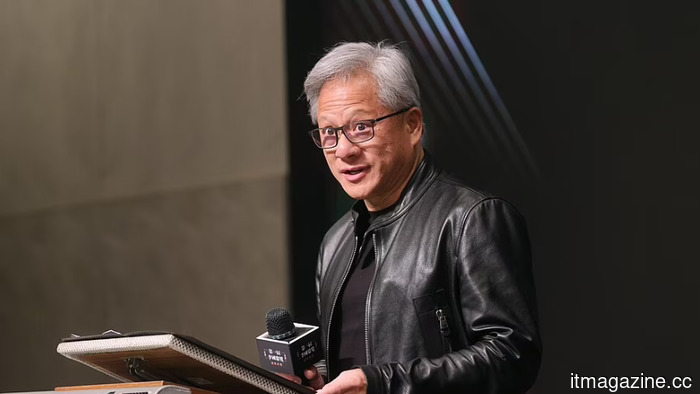 Nvidia's $750 billion AI agreements have driven its credit default swaps to an all-time high.
Nvidia's CDS spread reached a historic 82bps following $750 billion in AI transactions, raising concerns about circular financing. Jensen Huang dismissed the criticism as "ridiculous."
Nvidia's $750 billion AI agreements have driven its credit default swaps to an all-time high.
Nvidia's CDS spread reached a historic 82bps following $750 billion in AI transactions, raising concerns about circular financing. Jensen Huang dismissed the criticism as "ridiculous."
Core Scientific shifts its focus to AMD with a 2.5GW AI data center agreement, just months after the CoreWeave deal fell through.
Core Scientific has entered into a data center agreement with AMD that has the potential to reach 2.5GW, just nine months after shareholders turned down a $9 billion acquisition of CoreWeave.