
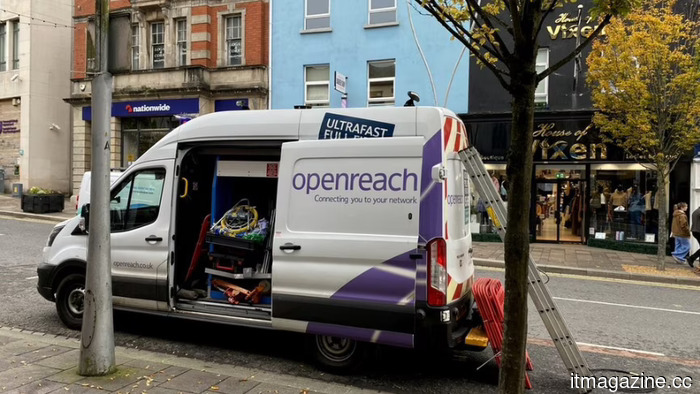
Ofcom takes steps to prevent Openreach from offering its fibre discount for the first time.
On Tuesday, Ofcom proposed to prevent a discounted wholesale offer from Openreach, marking the first occasion the regulator has sought to block a commercial arrangement from BT’s network division. This offer would have provided internet providers with discounts of up to £9.50 per customer per month for as long as 30 months, contingent upon them onboarding more new full-fibre customers to Openreach than their standard rate.
The arrangement raised concerns for the regulator. Since the discount applies only to sign-ups exceeding a provider's usual level, it specifically targets the marginal customers that alternative networks rely on for expansion.
What Ofcom stated:
The regulator determined that the pricing was “not fair and reasonable” and posed risks to competition in an evolving wholesale full-fibre market. Rivals might feel pressured to match the pricing without being able to recoup their costs, which Ofcom warned could undermine competition and ultimately drive prices higher. “Openreach must compete, but they cannot leverage their considerable market power to eliminate other networks from the market,” stated Natalie Black, Ofcom’s group director for infrastructure and connectivity.
The three offers Ofcom is allowing:
Openreach proposed four commercial offers, and Ofcom has provisionally approved the other three. One of these includes a one-off £50 discount for new full-fibre customers who exceed the usual sign-up rate in areas served by Virgin Media O2. Another limits charges for new high-speed connections. Ofcom pointed out that this geographic offer is substantially lower in value than the one they aim to block, making it less likely to distort competition.
Openreach's response:
“We’re disheartened by Ofcom’s concerns regarding one of our four offers, which we proposed in good faith at a time when many households are closely monitoring their expenses,” remarked James Lowther, managing director for commercial at Openreach. “In such a competitive marketplace, we don’t think regulation should safeguard weak business models, and we contest Ofcom’s findings,” he continued, emphasizing that the company would participate in the consultation.
Rivals argue that one out of four offers is insufficient:
Virgin Media O2 welcomed the proposal but contended that Ofcom took too narrow an approach. A spokesperson mentioned that the “interrelated nature of the offers and Openreach’s evident intention to ‘test the waters’ indicates that Ofcom should adopt a firmer stance,” alleging that Openreach is gradually offering discounts to deter providers from leveraging competing fibre networks. Nexfibre chief executive Rajiv Datta expressed a similar viewpoint. He praised the decision to block “the most prominent” offer but suggested that the regulator should consider “the cumulative impact of the steady flow of other offers, which are part of a broader strategy to inhibit the rise of robust wholesale competition.”
Why timing is significant:
James Robinson, senior equity analyst at Assembly Research, pointed out that Openreach refrained from launching new commercial offers while Ofcom’s recent Telecoms Access Review was underway, only to act swiftly once it concluded. “Openreach rushed to test the waters, and its proposals certainly accomplished that,” he remarked. Robinson stated that the company now faces “a challenging situation and a tight schedule” to persuade Ofcom that the discounts would not harm competition. He added that the regulator has at least clarified the boundaries of Openreach’s pricing approach.
The contest in the market:
Nearly 80% of UK homes can now access full-fibre broadband, a significant increase from under 25% five years ago, following BT’s investment of around £15 billion into its network alongside the efforts of numerous alternative networks. Approximately three-quarters of the nation can access at least two networks, and nearly a third can choose from three.
Openreach aims to serve 25 million premises by the end of 2026 and is expanding its partnership with Google Cloud to integrate AI into the rollout. The argument for scale is paramount: whoever reaches breakeven density first sets the wholesale prices for others.
This dynamic isn't new within UK telecom regulation. Ofcom spent years determining how much to limit BT’s control over the national network, ultimately opting to separate Openreach rather than completely dismantle it.
What is at stake beyond broadband:
The improvement in coverage is substantial. A decade ago, the milestone was availability at 30Mbps, a standard that seems modest compared to today’s gigabit fibre.
Connectivity serves as an economic input rather than merely a consumer product. Analyses have frequently shown that the UK’s digital economy is larger than initial figures indicate, with digitally-focused businesses growing more rapidly and hiring more than their traditional counterparts.
Current broadband competition is situated within a broader discourse on infrastructure. The government has pledged £1.3 billion toward AI hardware, skills, and adoption during London Tech Week, a program that assumes the necessary connectivity is both affordable and widely accessible.
Ofcom’s consultation will be open until 27 August, with a conclusive decision anticipated by the end of September. Regardless of the outcome, the regulator has clearly indicated its readiness to
Other articles
 Dwelly secures $170M to transform UK letting agencies into software platforms.
Dwelly has secured $170 million in a Series B funding round led by EQT Growth, aiming to acquire UK lettings agencies and integrate them into its AI platform.
Dwelly secures $170M to transform UK letting agencies into software platforms.
Dwelly has secured $170 million in a Series B funding round led by EQT Growth, aiming to acquire UK lettings agencies and integrate them into its AI platform.
 Queensland and the Northern Territory oppose Australia's regulations on data centre energy usage.
Australia's groundbreaking regulations requiring data centers to contribute as much power as they consume faced obstacles, as Queensland and the Northern Territory opposed many of the proposed measures.
Coforge claims that AI has improved profit margins, while competitors are observing 'AI deflation'.
Coforge reported a 49% growth in revenue in rupees and a gain of 414 basis points in EBIT margin. The company finalized a $2.35 billion acquisition but did not reveal any organic growth figures.
Queensland and the Northern Territory oppose Australia's regulations on data centre energy usage.
Australia's groundbreaking regulations requiring data centers to contribute as much power as they consume faced obstacles, as Queensland and the Northern Territory opposed many of the proposed measures.
Coforge claims that AI has improved profit margins, while competitors are observing 'AI deflation'.
Coforge reported a 49% growth in revenue in rupees and a gain of 414 basis points in EBIT margin. The company finalized a $2.35 billion acquisition but did not reveal any organic growth figures.
 Friendsurance was sold for its documentation rather than its innovative concept.
Cover Genius has acquired Friendsurance, the Berlin-based company that pioneered peer-to-peer insurance in 2010. The terms of the deal have not been disclosed, occurring two weeks after a $100 million fundraising round.
Meta and BlackRock establish a $14 billion partnership to create an AI data center in El Paso.
Meta and BlackRock have established a joint venture worth $14 billion to develop a one-gigawatt data center in El Paso, with BlackRock funds holding an 80% stake and Meta leasing the facility back.
Friendsurance was sold for its documentation rather than its innovative concept.
Cover Genius has acquired Friendsurance, the Berlin-based company that pioneered peer-to-peer insurance in 2010. The terms of the deal have not been disclosed, occurring two weeks after a $100 million fundraising round.
Meta and BlackRock establish a $14 billion partnership to create an AI data center in El Paso.
Meta and BlackRock have established a joint venture worth $14 billion to develop a one-gigawatt data center in El Paso, with BlackRock funds holding an 80% stake and Meta leasing the facility back.
 A fourth of the S&P now reports significant advantages from AI.
Morgan Stanley reports that 25% of S&P 500 companies reported tangible AI advantages in the second quarter, an increase from 14%. However, the support for this shift is not as robust as it may appear.
A fourth of the S&P now reports significant advantages from AI.
Morgan Stanley reports that 25% of S&P 500 companies reported tangible AI advantages in the second quarter, an increase from 14%. However, the support for this shift is not as robust as it may appear.
Ofcom takes steps to prevent Openreach from offering its fibre discount for the first time.
Ofcom has stated that Openreach's GBP 9.50 discount for new full-fibre customers is "unfair and unreasonable" and would put pressure on alternative networks. Competitors argue that the actions should be more stringent.