

A fourth of the S&P now reports significant advantages from AI.
Wall Street has spent the last three years investing in companies that develop AI. Now, it is beginning to invest in companies that utilize it.
This shift is backed by data. Morgan Stanley conducted a systematic analysis of earnings call transcripts, discovering that 25% of S&P 500 firms reported measurable benefits from AI implementation in the second quarter, an increase from 14% the previous year. “The market is starting to shift towards quality, which is a typical mid-cycle transition as the business cycle progresses,” stated Mike Wilson, the bank’s lead equity strategist, in a note highlighted by Business Insider. “Going forward, margin enhancement is expected to rely less on initial operating leverage and more on AI implementation.”
The bank anticipates an approximate expansion of 100 basis points in net margins by 2027 due solely to AI adoption.
Who qualifies as an adopter
The 💜 of EU tech The newest updates from the European tech landscape, a tale from our wise old founder Boris, and some questionable AI art. It's free, delivered weekly to your inbox. Sign up now! Morgan Stanley issued a screener, featuring names that are not typically seen. Along with Alphabet and Apple, the list includes Roblox, CVS, Shopify, Dick’s Sporting Goods, and Constellation Energy.
Wilson also noted that sectors perceived to be most vulnerable to AI are positioned to benefit the most. He identified transportation, software and services, and professional services as key areas.
Other financial institutions have reached similar conclusions from different perspectives. Analysts at Citi stated that “the Magnificent 7 is no longer relevant.” Piper Sandler referred to it as a significant shift away from tech.
The supply side is facing a tougher week
The other aspect of the trade can be observed in the chip market. According to the Associated Press, Micron plummeted 8.4% on Tuesday, while Advanced Micro Devices fell 7.7%. The Kospi index in South Korea dropped 10.8%, resulting in temporary trading halts.
The Philadelphia semiconductor index is now 21% below its record high from June, as reported by Reuters, although it remains up 63% year-to-date.
These two statistics illustrate the entire argument. Demand has not vanished, and executives maintain that their order books are full. The disconnect lies in expectations, not in orders. South Korea, where memory manufacturers dominate the index, has become an early indicator for the overall trade.
Cited is not the same as measured
The 25% statistic warrants further examination. It counts companies that indicated measurable benefits from AI during calls, but does not include those that actually published measurements.
Earnings calls serve primarily as marketing. Claiming AI has improved margins incurs no cost, and the potential rewards in mid-2026 are evident.
Independent evidence appears less consistent. The UK’s Office for National Statistics discovered that while adoption is spreading, it is not intensifying. More firms are incorporating AI in various areas, yet few utilize it extensively.
Some organizations do quantify their results. JPMorgan has informed investors that AI is reducing expenses and enhancing margins.
The underlying question
Vanguard expressed the matter in a more insightful manner than the rotation call did. “The next stage of the AI narrative revolves around whether ongoing investment translates into productivity improvements for the wider global economy,” the firm stated.
Shaan Raithatha, the firm’s senior economist, indicated that investors are increasingly doubtful whether the major players will achieve adequate returns on their investments.
This is a clearer perspective. The adopter trade hinges on the premise that productivity gains will materialize. The transcript count suggests that companies want investors to believe it has already happened.
What would clarify the situation
Microsoft, Amazon, Meta, and Apple are all scheduled to report this week. Analysts forecast that overall S&P 500 earnings for the second quarter will increase by 39% compared to the previous year, with AI-related stocks contributing significantly to this growth, according to LSEG I/B/E/S data cited by Reuters.
More concrete disclosures would be more beneficial than mere mentions. A company that provides a figure, function, and baseline can be verified. Conversely, a company that simply cites benefits during a call cannot.
Until more companies of the former type emerge, the shift towards AI adopters relies on the same factors that prompted the initial investment in AI developers. It remains a confident prediction.
Other articles
 Hotels are adopting ChatGPT, but not for payment processing.
Radisson and Motel 6 introduced their ChatGPT applications just one day apart. Both focus on discovery, and research from Accenture indicates that only 9% prefer AI to make purchases on their behalf.
Hotels are adopting ChatGPT, but not for payment processing.
Radisson and Motel 6 introduced their ChatGPT applications just one day apart. Both focus on discovery, and research from Accenture indicates that only 9% prefer AI to make purchases on their behalf.
 BYD's new Racco is the first electric kei car in Japan to offer a range exceeding 300 km.
BYD has introduced the Racco, its inaugural electric kei car for the Japanese market, which provides a range of up to 320 km and has a starting price lower than that of the Nissan Sakura.
BYD's new Racco is the first electric kei car in Japan to offer a range exceeding 300 km.
BYD has introduced the Racco, its inaugural electric kei car for the Japanese market, which provides a range of up to 320 km and has a starting price lower than that of the Nissan Sakura.
 Queensland and the Northern Territory oppose Australia's regulations on data centre energy usage.
Australia's groundbreaking regulations requiring data centers to contribute as much power as they consume faced obstacles, as Queensland and the Northern Territory opposed many of the proposed measures.
Queensland and the Northern Territory oppose Australia's regulations on data centre energy usage.
Australia's groundbreaking regulations requiring data centers to contribute as much power as they consume faced obstacles, as Queensland and the Northern Territory opposed many of the proposed measures.
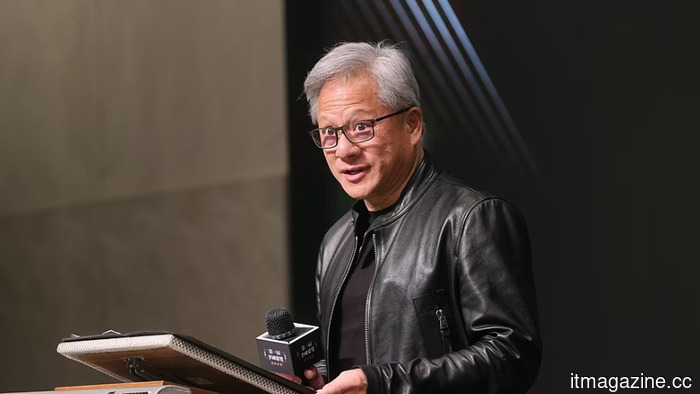 Nvidia's $750 billion AI agreements have driven its credit default swaps to an all-time high.
Nvidia's CDS spread reached an all-time high of 82 bps following $750 billion in AI transactions that sparked concerns about circular financing. Jensen Huang described the criticism as "ridiculous."
Nvidia's $750 billion AI agreements have driven its credit default swaps to an all-time high.
Nvidia's CDS spread reached an all-time high of 82 bps following $750 billion in AI transactions that sparked concerns about circular financing. Jensen Huang described the criticism as "ridiculous."
 Why Home Smart Strength Training Is Becoming More Accurate
The contemporary home gym is influenced equally by available space and fitness needs. In apartments, multipurpose areas, and houses where workout gear must coexist with other activities, establishing a large setup can be challenging. This reality has led product design to focus on creating systems that remain compact yet effectively accommodate serious strength training.
Why Home Smart Strength Training Is Becoming More Accurate
The contemporary home gym is influenced equally by available space and fitness needs. In apartments, multipurpose areas, and houses where workout gear must coexist with other activities, establishing a large setup can be challenging. This reality has led product design to focus on creating systems that remain compact yet effectively accommodate serious strength training.
 Foldable phones have progressed significantly. PITAKA's newest collection of cases showcases this change.
Foldable smartphones are setting new standards for high-end mobile design. Selecting the appropriate case is equally important. PITAKA's latest range presents an innovative take on protection, featuring a series designed to enhance Samsung's latest foldable devices.
Foldable phones have progressed significantly. PITAKA's newest collection of cases showcases this change.
Foldable smartphones are setting new standards for high-end mobile design. Selecting the appropriate case is equally important. PITAKA's latest range presents an innovative take on protection, featuring a series designed to enhance Samsung's latest foldable devices.
A fourth of the S&P now reports significant advantages from AI.
Morgan Stanley reports that 25% of S&P 500 companies reported tangible AI advantages in the second quarter, an increase from 14%. However, the support for this shift is not as robust as it may appear.