
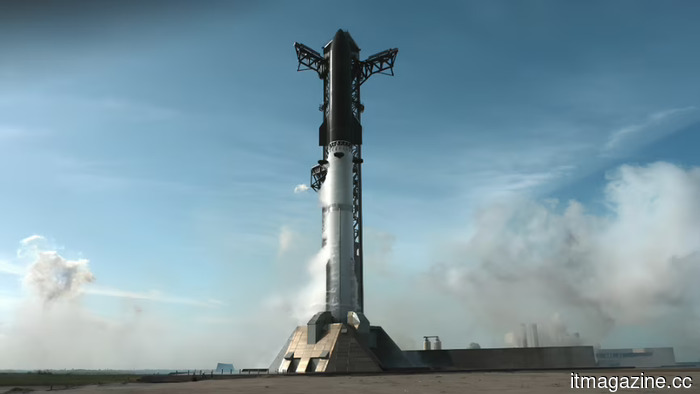
Starship flight 13 was successful. The next step is to capture the ship.
The key takeaway from Starship’s 13th flight is not the deployment of 20 satellites, but rather one significant term in SpaceX's flight report: intact. Starship lifted off from Starbase in Texas at 5:51 PM on Friday, following delays and engine replacements that postponed the launch. This marked the second flight of the V3 vehicles and was the first completed launch since the company became publicly traded, as reported by The Register. An hour, five minutes, and 21 seconds later, it was seen floating in the Indian Ocean in one piece.
Why "intact" is the main story
Starship successfully re-entered and collected heatshield data. It executed what SpaceX referred to as "a dynamic banking maneuver to simulate the trajectory that future missions will use when returning to Starbase." It guided itself to the target area using its four flaps, then reignited all three Raptor engines. It performed a landing flip followed by a landing burn, ultimately settling gently on the water. This sequence allowed the vehicle to remain whole and provided SpaceX, in their own words, “critical views of an intact heatshield for the first time.” Heatshields pose a significant challenge for reusable rockets, and until now, SpaceX had primarily assessed damage post-flight. This time, they were able to analyze one that made it through intact.
The satellites and the more important engine
Starship successfully deployed all 20 Starlink V3 satellites, marking the inaugural flight of this new generation. Engineers established radio and laser communication with each satellite and acquired telemetry data. None of the satellites were intended to remain in orbit; they were released on a trajectory that would see them descend approximately 20 minutes later. Around 39 minutes into the flight, Starship executed a less publicized action by reigniting a single Raptor engine in space. SpaceX dubbed this “a core capability for future orbital missions.” Without the ability to reignite in space, a rocket cannot alter its course. This capability is essential for Starship to achieve a stable orbit instead of following an arc back to Earth, which is also what NASA requires if Starship is to transport astronauts to the Moon. While much of the flight centered on reuse, this aspect focused on destination.
The part that didn’t succeed
The Super Heavy booster had a more challenging evening. It successfully completed the high-thrust segment of its boostback burn using all 33 engines, marking a first for a V3 booster, but then shortened the burn. It attempted to reignite for the landing burn, but only a few of the engines ignited. A smaller subset lit “before experiencing a hard splashdown in the Gulf,” according to SpaceX. In a test flight, this is seen as data rather than disaster, although it remains the last unfulfilled goal. The contrast is stark: the ship landed gently and remained intact, while the booster did not. SpaceX has previously managed to catch a booster using its launch tower, but catching the upper stage is more complex, and Musk has indicated that this is the next challenge. “Unless issues arise during the mission data review, SpaceX will attempt to catch the ship with the tower on the next flight,” he noted on X, as reported by The Information. An intact vehicle and a pristine heatshield provide the necessary evidence before attempting such a maneuver, as a ship that launches from Starbase, returns there, and is caught rather than retrieved from the ocean could potentially fly again in days instead of months. Other entities are pursuing similar feats; China recently caught a rocket booster in a net, while Blue Origin is still investigating the cause of the May explosion of New Glenn.
The market isn't celebrating yet
Starship has a lot to prove. The expansion of Starlink depends on it, especially as Amazon claims to have enough satellites to launch a competing service. Additionally, SpaceX's work with NASA is tied to its success. Investor sentiment has been lukewarm since the IPO, and the stock has gradually declined in recent weeks. The company, which made several thousand employees wealthy during its public offering, has since been navigating discussions about its valuation. Friday’s events won't resolve that uncertainty, but a ship that flies, deploys successfully, reignites, lands gently, and returns intact provides a far stronger argument than a cancellation notice.
Other articles
 The hope for extremely low-cost phones for children and seniors is essentially over due to AI.
Analysts report that the costs of memory chips for budget phones have increased by 400% this year, rendering it nearly unfeasible to manufacture devices priced under $100 profitably at this time.
The hope for extremely low-cost phones for children and seniors is essentially over due to AI.
Analysts report that the costs of memory chips for budget phones have increased by 400% this year, rendering it nearly unfeasible to manufacture devices priced under $100 profitably at this time.
 Nuclear Turbines has secured £15M in funding for compact reactors that it claims could compete with fossil fuels on price.
BAE Systems' spinout, Nuclear Turbines, has secured £15 million to develop compact reactors that claim to generate nuclear power at just one-fifth of the current expenses.
Nuclear Turbines has secured £15M in funding for compact reactors that it claims could compete with fossil fuels on price.
BAE Systems' spinout, Nuclear Turbines, has secured £15 million to develop compact reactors that claim to generate nuclear power at just one-fifth of the current expenses.
 God of War Laufey has finally received a release date, and there's positive news for fans of Kratos as well.
Santa Monica Studio has announced that God of War Laufey is set to be released on February 16, 2027, and has disclosed that another title featuring Kratos is currently in development.
God of War Laufey has finally received a release date, and there's positive news for fans of Kratos as well.
Santa Monica Studio has announced that God of War Laufey is set to be released on February 16, 2027, and has disclosed that another title featuring Kratos is currently in development.
 A new iPhone application can detect Meta smart glasses in the vicinity.
Earlier this year, Android users were introduced to a unique privacy feature that could notify them when smart glasses were in the vicinity. Now, five months later, iPhone users have access to a comparable tool, and its title clearly expresses its stance on Meta. AntiZuck is a $2.99 iPhone application that detects Bluetooth signals linked to smart glasses and sends alerts […]
A new iPhone application can detect Meta smart glasses in the vicinity.
Earlier this year, Android users were introduced to a unique privacy feature that could notify them when smart glasses were in the vicinity. Now, five months later, iPhone users have access to a comparable tool, and its title clearly expresses its stance on Meta. AntiZuck is a $2.99 iPhone application that detects Bluetooth signals linked to smart glasses and sends alerts […]
 The aspiration for extremely low-cost phones intended for children and seniors is, in essence, over, primarily due to AI.
Analysts report that the expenses for memory chips in budget smartphones have skyrocketed by 400% this year, rendering it virtually unfeasible to profitably produce devices priced under $100 at this time.
The aspiration for extremely low-cost phones intended for children and seniors is, in essence, over, primarily due to AI.
Analysts report that the expenses for memory chips in budget smartphones have skyrocketed by 400% this year, rendering it virtually unfeasible to profitably produce devices priced under $100 at this time.
 Thrift-maxxing jeopardizes the IPOs of OpenAI and Anthropic.
A million AI words are priced at $50 from Anthropic and 87 cents from DeepSeek. American companies are incorporating Chinese models, and the IPO valuations of the labs are under scrutiny.
Thrift-maxxing jeopardizes the IPOs of OpenAI and Anthropic.
A million AI words are priced at $50 from Anthropic and 87 cents from DeepSeek. American companies are incorporating Chinese models, and the IPO valuations of the labs are under scrutiny.
Starship flight 13 was successful. The next step is to capture the ship.
The Starship was launched with 20 Starlink V3 satellites, reactivated an engine in space, and made a controlled splashdown. Meanwhile, the Super Heavy booster crashed forcefully into the Gulf.