

ONS: AI adoption in the UK has tripled since 2023, yet the integration has barely advanced.
TL;DRA new ONS survey reveals that the adoption of AI in UK businesses has increased from 12% to 35% since 2023, yet the average user employs just 1.6 AI tools. Scott Pope of Nexthink suggests that the disparity between adoption and genuine transformation stems from cultural and visibility issues rather than technological ones.
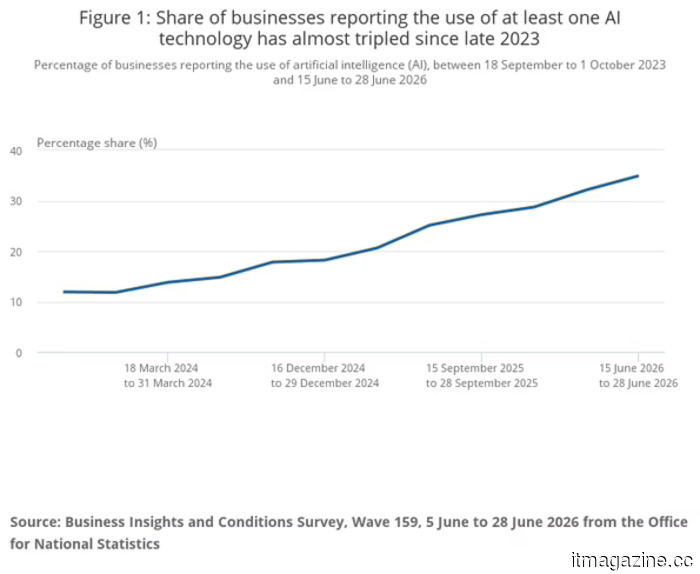
Three years ago, about one in eight UK businesses with ten or more employees reported using artificial intelligence. Today, the Office for National Statistics estimates that this figure has risen to approximately one in three, indicating a significant shift of AI from a niche tool to a standard workplace technology. The statistics present a compelling narrative of growth.
However, they also highlight certain limitations. The average business using AI has increased its toolkit from 1.4 to 1.6 technologies during this time, a minimal change that hardly signifies progress.
Current AI usage by businesses
In June 2026, large language models emerged as the most commonly utilized AI type among UK businesses, with 18% of firms employing them. Visual content creation tools followed at 16%, data processing using machine learning at 12%, and image processing at 6%.
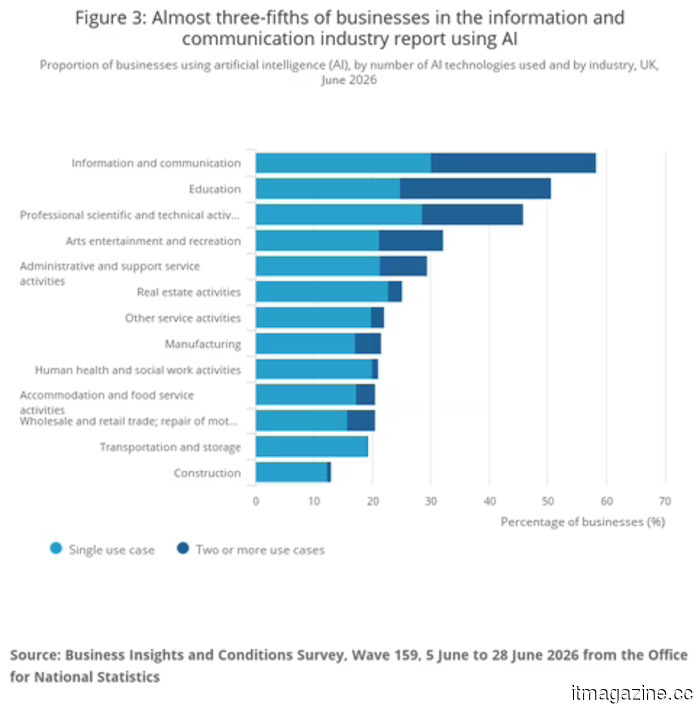
The distribution of AI adoption varies significantly across sectors. Over half of businesses in the information and communication industry (58%) report using AI, while adoption rates in sectors such as accommodation and food services remain substantially lower. The divide between digitally advanced sectors and the broader economy seems to be increasing.
According to the Business Insights and Conditions Survey (Wave 159, 5 June to 28 June 2026) from the Office for National Statistics, the proportion of businesses indicating they utilize at least one AI technology has nearly tripled since late 2023.
Adoption without transformation
Scott Pope, Director of Value Advisory at Nexthink, argues that the statistics indicate a fundamental flaw in the way organizations are approaching AI. “AI adoption in the UK is increasing but not evolving deeply; the issue is as much cultural as it is technological,” he said. “Many businesses view AI as a cost-cutting measure instead of a means to create real value, and overcoming that perspective requires a change in mindset.”
ONS data aligns with this interpretation: only 4% of businesses using AI report a reduction in their workforce, and merely 7% of UK organizations are implementing an enterprise-wide AI strategy, as shown by separate benchmark research. The vast majority are only experimenting at the edges.
Nearly 60% of companies within the information and communication sector indicate they use AI, according to the Business Insights and Conditions Survey (Wave 159, 5 June to 28 June 2026) from the Office for National Statistics.
Pope identifies a visibility gap as a major barrier. “Leaders are held back by uncertainty,” he stated, noting that many cannot answer fundamental questions about AI usage within their organization, its safety, or which tools may pose risks.
This uncertainty creates a compounding effect. In the absence of data pinpointing where AI is saving time and where it is introducing new challenges, leaders resort to conservative rollouts, which subsequently limits the data available for more substantial investments.
The productivity-profit gap
Productivity improvements are the most frequently cited advantages of AI adoption, acknowledged by over three-quarters of adopters in various surveys. However, revenue growth is significantly less common, with only around 12% of AI-utilizing businesses reporting an increase in income to date.
The disparity between efficiency improvements and tangible business benefits presents a notable challenge during this phase of adoption. Similar trends are evident across the EU, where widespread adoption figures hide a much smaller group of organizations achieving measurable value from their AI investments.
What bridging the gap looks like
Pope suggests that enhancing visibility is crucial, arguing that “clarity, data, and insights transform uncertainties into knowledge” by demonstrating to leaders which tools are adding value and which are creating risks. By identifying areas where employees are saving time versus struggling, organizations can “amplify effective use cases, address relevant risks, and invest confidently.”
“This differentiates conservative adoption from transformational adoption,” he added, “and it’s a gap that the most progressive organizations are already working to close.”
The policy context
At London Tech Week in June, the UK government announced a £1.3 billion AI hardware initiative and a £200 million adoption package, which includes an expanded Bridge AI program and a skills initiative claiming 1.7 million course completions. There’s a notable political ambition.
Whether supply-side investments will alter how organizations utilize the tools currently at their disposal remains an open question. Prime Minister Starmer has urged the UK to “move beyond” apprehensions surrounding AI, but ONS data indicates that the primary barrier is not fear; rather, it is a lack of visibility and internal data needed to act decisively.
The ONS survey indicates that 41% of businesses report having no barriers to adoption, which seems promising until one considers that many of these are already adopters executing
Other articles
 Big Tech's expenditure on AI is beginning to align with its cash flow.
The total capital expenditure on AI by the largest cloud companies is expected to surpass the cash generated by their main operations, with free cash flow being impacted first.
Big Tech's expenditure on AI is beginning to align with its cash flow.
The total capital expenditure on AI by the largest cloud companies is expected to surpass the cash generated by their main operations, with free cash flow being impacted first.
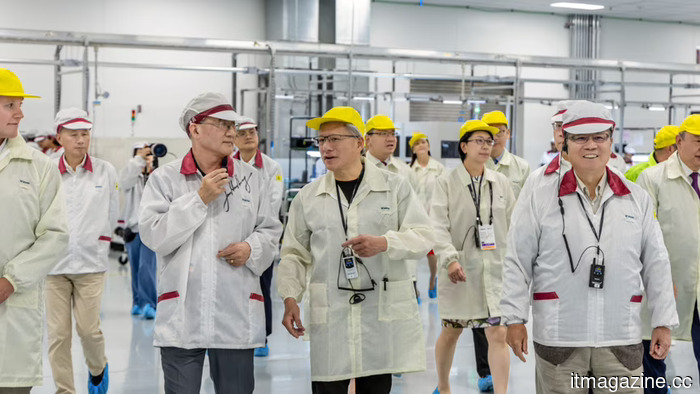 Nvidia's supplier Wistron has launched a $700 million factory in Texas for the production of Grace Blackwell superchips.
Wistron has launched its inaugural factory in the U.S. located in Fort Worth, a $700 million facility that is already in mass production of Nvidia’s GB300 Grace Blackwell Ultra superchips.
Nvidia's supplier Wistron has launched a $700 million factory in Texas for the production of Grace Blackwell superchips.
Wistron has launched its inaugural factory in the U.S. located in Fort Worth, a $700 million facility that is already in mass production of Nvidia’s GB300 Grace Blackwell Ultra superchips.
 The University of Tennessee has filed a lawsuit against Anthropic regarding patents related to neural networks.
The University of Tennessee has filed a lawsuit against Anthropic in Delaware regarding two neural network patents, marking what is believed to be the firm's inaugural patent litigation.
The University of Tennessee has filed a lawsuit against Anthropic regarding patents related to neural networks.
The University of Tennessee has filed a lawsuit against Anthropic in Delaware regarding two neural network patents, marking what is believed to be the firm's inaugural patent litigation.
 Samsung's offer of doubling free storage for preorders has ended in Austria, and the new promotion isn't as appealing.
Samsung's traditional pre-order benefit of offering double storage at no extra cost has been removed for Austria, now substituted with discounted upgrades for the Galaxy Z Fold 8 and Z Flip 8.
Samsung's offer of doubling free storage for preorders has ended in Austria, and the new promotion isn't as appealing.
Samsung's traditional pre-order benefit of offering double storage at no extra cost has been removed for Austria, now substituted with discounted upgrades for the Galaxy Z Fold 8 and Z Flip 8.
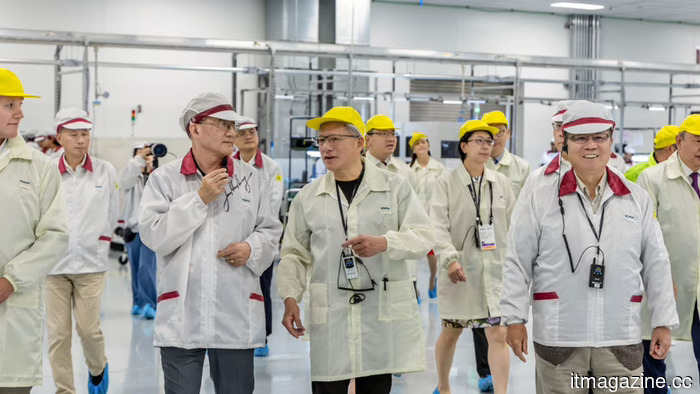 Nvidia's supplier Wistron has inaugurated a $700 million manufacturing facility in Texas to produce Grace Blackwell superchips.
Wistron has inaugurated its first factory in the US located in Fort Worth, a $700 million facility that is already in large-scale production of Nvidia's GB300 Grace Blackwell Ultra superchips.
Nvidia's supplier Wistron has inaugurated a $700 million manufacturing facility in Texas to produce Grace Blackwell superchips.
Wistron has inaugurated its first factory in the US located in Fort Worth, a $700 million facility that is already in large-scale production of Nvidia's GB300 Grace Blackwell Ultra superchips.
 A gas-rich outback station may accommodate a $28 billion off-grid AI data center.
Energy North plans to construct a 1GW off-grid AI data center at Murranji Station in Australia’s gas-abundant Barkly region, with the total project estimated to cost approximately $28 billion.
A gas-rich outback station may accommodate a $28 billion off-grid AI data center.
Energy North plans to construct a 1GW off-grid AI data center at Murranji Station in Australia’s gas-abundant Barkly region, with the total project estimated to cost approximately $28 billion.
ONS: AI adoption in the UK has tripled since 2023, yet the integration has barely advanced.
The adoption of AI in UK businesses increased from 12% to 35% since 2023, yet the typical user utilizes only 1.6 tools. According to Scott Pope from Nexthink, the issue lies within the organizational culture.