
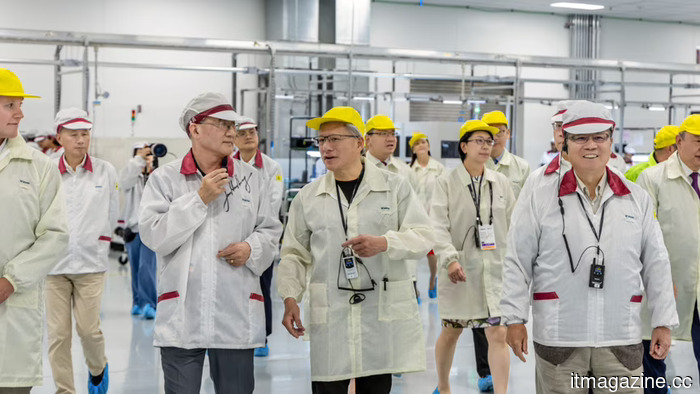
Nvidia's supplier Wistron has launched a $700 million factory in Texas for the production of Grace Blackwell superchips.
Wistron, the Taiwanese contract manufacturer responsible for producing server hardware for Nvidia, has inaugurated its first factory in the U.S., a $700 million facility in Fort Worth, Texas, which is already assembling Nvidia’s GB300 Grace Blackwell Ultra superchips. The site celebrated its grand opening on July 21, and Nvidia has stated that it is the first location in the United States where the GB300 has been manufactured and mass-produced.
This chip serves as the current flagship in Nvidia’s data center lineup, with Fort Worth also set to produce its successor, the Vera Rubin superchips, which will follow Blackwell. This move signifies a significant endorsement of domestically produced chips, a sector that was almost nonexistent at this level just a year ago.
The launch aligns with a broader trend of onshoring. Nvidia pledged in 2025 to invest half a trillion dollars into American manufacturing and AI infrastructure over four years, leading many of its suppliers to follow suit into Texas. Wistron’s facility represents one of the more tangible outcomes of this initiative, operating as a functioning factory rather than just a memorandum of understanding.
The facility spans approximately 324,000 square feet (about 30,100 square meters), and Wistron aims to ramp up production to tens of thousands of computing boards monthly, as noted by Nvidia, which referred to Fort Worth as its partner’s first manufacturing base in the U.S. So far, the plant has generated over 500 jobs across construction, plumbing, electrical, and manufacturing sectors, with an anticipated workforce of 1,000 by year’s end.
Wistron refers to the site as its D1 Smart Factory. Chairman Simon Lin stated, "The operation here is not typical manufacturing. It is new, very comprehensive, and high-tech." He emphasized the importance of speed in operations, saying, “In the AI era, the pressure of speed is also a form of responsibility. We don’t just need to build fast; we need to build right.” Lin also identified Fort Worth as crucial to Wistron’s future plans, indicating that “in the next couple of years, this location will be one of the most important, as we build AI infrastructure here in the United States.”
Jensen Huang, Nvidia’s CEO, kept his message straightforward: “Manufacturing is an essential pillar for every economy and every country.”
Building correctly involved constructing the factory twice. Before breaking ground, Wistron created a digital twin of the entire plant using Nvidia’s own Omniverse simulation software, allowing them to test the layout and workflows virtually prior to any physical construction. This reflects a recursive detail that Nvidia values: their software was used to design the factory that produces the chips running that very software.
The product itself is significant, with Huang describing a single GB300 system as comprising “one-and-a-half million parts inside, two tons, 4 million dollars.” Scaling up production to tens of thousands of boards per month from scratch poses more of a logistics challenge than a simple factory ramp-up.
Investors reacted positively to the news, with Wistron’s shares surging in Taiwan following the opening, highlighting that the AI industry extends well beyond the chip designers to include contract manufacturers, assemblers, and suppliers that integrate the systems.
Fort Worth is rapidly evolving into a center for this expansion, as the city and Texas have attracted numerous AI infrastructure projects, including an $810 million data center bond issuance nearby, as affordable land and energy draw computing resources to Texas.
This demand has also impacted the supply chain, tightening the market for the high-bandwidth memory that Grace Blackwell components require. Moving forward, Wistron needs to increase board production through 2026, hire to reach a thousand workers, and prepare for Vera Rubin while the plant is still establishing its operations.
At this moment, the more symbolic reality is that an Nvidia superchip that was previously only available as an import is now being assembled in Texas.
Other articles
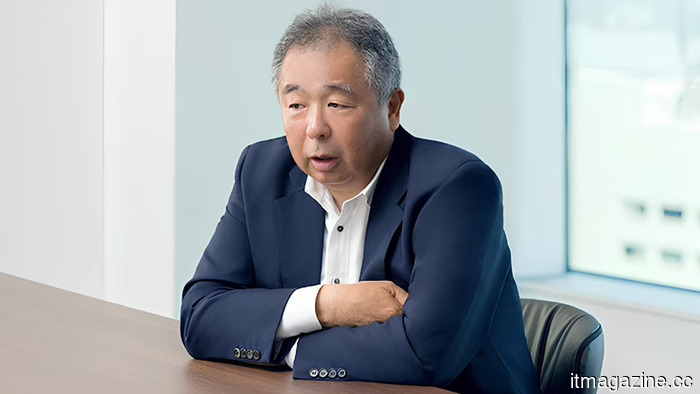 Noetra's CEO describes his robotic AI startup as Japan's 'final opportunity.'
Hironobu Tamba departed from SoftBank to head Noetra, a $6 billion state-supported initiative focused on developing AI for robots in Japan. He refers to it as the nation's last opportunity.
Noetra's CEO describes his robotic AI startup as Japan's 'final opportunity.'
Hironobu Tamba departed from SoftBank to head Noetra, a $6 billion state-supported initiative focused on developing AI for robots in Japan. He refers to it as the nation's last opportunity.
 Garmin's latest competitor to Fitbit Air features 80 workout modes and steers clear of the annoying subscription model.
The Garmin CIRQA is priced at twice that of the Fitbit Air; however, its extended battery life, comprehensive workout support, and software that doesn't require a subscription might make the higher cost worthwhile.
Garmin's latest competitor to Fitbit Air features 80 workout modes and steers clear of the annoying subscription model.
The Garmin CIRQA is priced at twice that of the Fitbit Air; however, its extended battery life, comprehensive workout support, and software that doesn't require a subscription might make the higher cost worthwhile.
 Garmin's latest competitor to Fitbit Air features 80 workout modes and steers clear of the annoying subscription model.
The Garmin CIRQA is priced at double that of the Fitbit Air; however, its extended battery life, comprehensive workout features, and software that doesn't require a subscription may warrant the higher cost.
Garmin's latest competitor to Fitbit Air features 80 workout modes and steers clear of the annoying subscription model.
The Garmin CIRQA is priced at double that of the Fitbit Air; however, its extended battery life, comprehensive workout features, and software that doesn't require a subscription may warrant the higher cost.
 The Light Flip revives the flip phone concept, eliminating all distractions.
Light has introduced the Light Flip, its inaugural flip phone that boasts a traditional clamshell design, T9 keypad, 5G connectivity, LightOS, and offers a distraction-free experience, with prices starting at $299.
The Light Flip revives the flip phone concept, eliminating all distractions.
Light has introduced the Light Flip, its inaugural flip phone that boasts a traditional clamshell design, T9 keypad, 5G connectivity, LightOS, and offers a distraction-free experience, with prices starting at $299.
 The University of Tennessee has filed a lawsuit against Anthropic regarding patents related to neural networks.
The University of Tennessee has filed a lawsuit against Anthropic in Delaware regarding two neural network patents, marking what is believed to be the firm's inaugural patent litigation.
The University of Tennessee has filed a lawsuit against Anthropic regarding patents related to neural networks.
The University of Tennessee has filed a lawsuit against Anthropic in Delaware regarding two neural network patents, marking what is believed to be the firm's inaugural patent litigation.
 Big Tech's expenditure on AI is beginning to align with its cash flow.
The total capital expenditure on AI by the largest cloud companies is expected to surpass the cash generated by their main operations, with free cash flow being impacted first.
Big Tech's expenditure on AI is beginning to align with its cash flow.
The total capital expenditure on AI by the largest cloud companies is expected to surpass the cash generated by their main operations, with free cash flow being impacted first.
Nvidia's supplier Wistron has launched a $700 million factory in Texas for the production of Grace Blackwell superchips.
Wistron has launched its inaugural factory in the U.S. located in Fort Worth, a $700 million facility that is already in mass production of Nvidia’s GB300 Grace Blackwell Ultra superchips.