
Walden Robotics begins with $300 million in funding, but without legs.
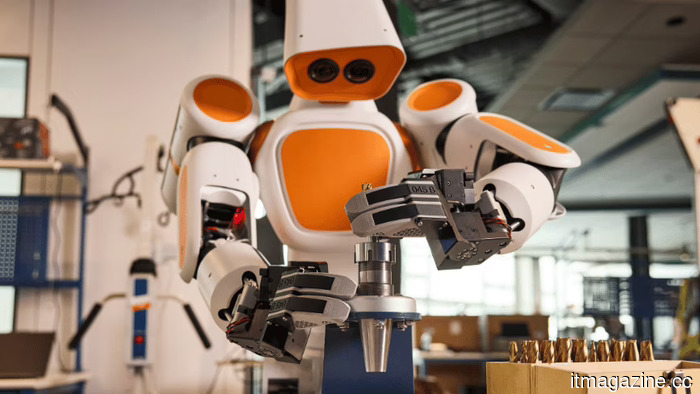
Walden Robotics has emerged from stealth mode with $300 million in funding and a valuation of $1.1 billion. This spin-off from Toyota is developing humanoid robots for manufacturing, intentionally designed without legs.
Russ Tedrake, the head of Walden Robotics, explained to Bloomberg that factory workers are not yet ready to adopt walking robots, which is why their models operate on wheels instead. Based in Cambridge, Walden Robotics has already deployed its robots in a Toyota factory since its unveiling on Wednesday.
The seed funding round was co-led by Toyota and Deviation Capital, with contributions from Nvidia, Boeing, Samsung Ventures, and CoreWeave Ventures. This is an impressive lineup for a company that's only six months old.
Unlike most humanoid robotics companies focused on walking capabilities, Walden has opted for wheeled designs. Tedrake emphasizes that wheeled robots are safer and more practical. They can navigate around people more efficiently, aligning with existing factory safety regulations, and they can also accommodate larger batteries and increased computing power essential for full operational shifts.
Walden is not just offering promises; since February, its robots have actively participated in production at a Toyota facility in North America, taking on repetitive tasks such as loading and unloading car parts, cleaning machinery, and assembling parts.
The company originated from the Toyota Research Institute in January and develops its hardware, software, and AI internally. Their robots utilize Large Behavior Models, a type of AI that the team was instrumental in advancing, allowing the robots to learn new tasks and enhance their performance through experience. Their clientele includes sectors such as automotive, aerospace, semiconductors, electronics, logistics, and life sciences.
Tedrake stated at the launch, “Delivering real value to customers requires a thorough understanding and respect for current manufacturing practices.” Meanwhile, Toyota's CTO Hiroki Nakajima highlighted the company's commitment to principles like kaizen and jidoka, emphasizing a focus on people.
Walden is entering a competitive landscape where companies like 1X, LimX, and Booster are investing heavily in humanoid robotics, with automakers integrating them into production lines. Hyundai is expanding its use of Boston Dynamics’ Atlas. According to Morgan Stanley, this market could exceed $5 trillion by 2050.
Tedrake remains cautious about the future, noting, “While everyone acknowledges the vast potential and the technology seems prepared, success is not guaranteed. A solid business case and unit economics must be carefully considered.”
The company's name, Walden, inspired by Thoreau, is intended to convey the idea of robots that enhance human work rather than replacing it. Whether robots with wheels or legs dominate the factory environment, Walden has already made significant strides with its existing Toyota partnership.
Other articles
 Miles Wang departs from OpenAI to join a $2 billion AI pharmaceuticals startup.
Miles Wang, a researcher at OpenAI, is negotiating to secure $200 million at a valuation of $2 billion for a yet-to-be-named AI drug-discovery startup that currently lacks a product.
Miles Wang departs from OpenAI to join a $2 billion AI pharmaceuticals startup.
Miles Wang, a researcher at OpenAI, is negotiating to secure $200 million at a valuation of $2 billion for a yet-to-be-named AI drug-discovery startup that currently lacks a product.
 The UK has recently suggested implementing a midnight curfew for teenagers on social media, which they can easily circumvent in a matter of seconds.
The UK government has suggested implementing a midnight curfew that would prevent 16 and 17-year-olds from accessing apps such as Instagram, TikTok, and YouTube, though this limitation can be easily disabled with just a few taps.
The UK has recently suggested implementing a midnight curfew for teenagers on social media, which they can easily circumvent in a matter of seconds.
The UK government has suggested implementing a midnight curfew that would prevent 16 and 17-year-olds from accessing apps such as Instagram, TikTok, and YouTube, though this limitation can be easily disabled with just a few taps.
 Apple increases AppleCare+ prices as the memory shortage transitions from hardware to services.
Apple has increased the monthly AppleCare+ subscription fees for Macs and iPads by 50 cents, continuing a trend of price hikes influenced by the global shortage of memory chips.
Apple increases AppleCare+ prices as the memory shortage transitions from hardware to services.
Apple has increased the monthly AppleCare+ subscription fees for Macs and iPads by 50 cents, continuing a trend of price hikes influenced by the global shortage of memory chips.
 Madden NFL 27 will be available on Apple Arcade next month, allowing you to manage an NFL franchise from beginning to end.
Madden NFL 27 Arcade Edition will be available on Apple Arcade starting August 6, featuring complete seasons, franchise management, 11-on-11 games, and no in-app purchases.
Madden NFL 27 will be available on Apple Arcade next month, allowing you to manage an NFL franchise from beginning to end.
Madden NFL 27 Arcade Edition will be available on Apple Arcade starting August 6, featuring complete seasons, franchise management, 11-on-11 games, and no in-app purchases.
 Your child can now obtain a free Spotify account that includes parental controls.
Children can now have a free Spotify account that is focused solely on music, which includes playlists, recommendations, and a personalized Wrapped summary.
Your child can now obtain a free Spotify account that includes parental controls.
Children can now have a free Spotify account that is focused solely on music, which includes playlists, recommendations, and a personalized Wrapped summary.
 Suno AI music was trained on over 2 million songs scraped from YouTube.
A breach of Suno AI music revealed its source code, indicating that it harvested millions of tracks from YouTube, Deezer, and Genius to develop its song generator.
Suno AI music was trained on over 2 million songs scraped from YouTube.
A breach of Suno AI music revealed its source code, indicating that it harvested millions of tracks from YouTube, Deezer, and Genius to develop its song generator.
Walden Robotics begins with $300 million in funding, but without legs.
Walden Robotics, a spin-off from Toyota, has emerged from stealth mode with $300 million in funding and a valuation of $1.1 billion. Its factory humanoid robots are designed to move on wheels rather than legs.