
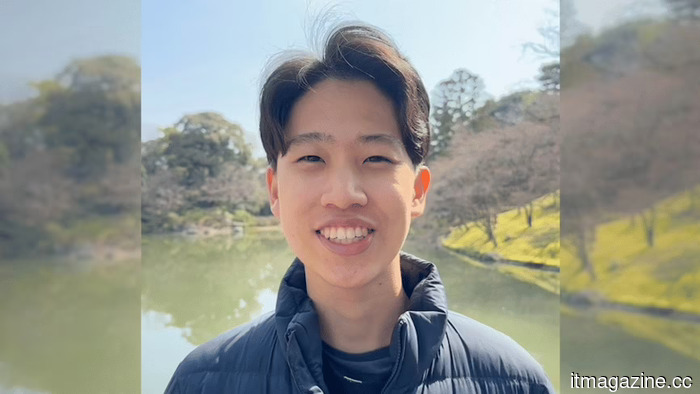
Miles Wang departs from OpenAI to join a $2 billion AI pharmaceuticals startup.
No name. No product. No confirmed funding. Yet, possibly a $2bn valuation. This outlines the latest venture in AI drug discovery.
Miles Wang, a researcher at OpenAI, is set to start his own company, according to TechCrunch. He is currently in discussions to raise around $200m at a $2bn valuation, with Lightspeed potentially leading the investment. Several other OpenAI researchers intend to join him as well.
However, there is a twist. Wang challenged both the funding figures and TechCrunch’s portrayal of the company, though he did not provide corrected specifics. Lightspeed chose not to comment. Negotiations are continuing, and the terms may evolve.
Reviving discontinued drugs
The specifics of what the startup will create remain unclear. Two sources informed TechCrunch that it may work on AI models aimed at discovering new applications for existing drugs, including those that did not succeed in previous trials.
The rationale is financial. A drug that has already been approved for safety can be administered to patients and generate revenue much more quickly than one developed from scratch. While repurposing still requires proving the drug’s efficacy for its new application, it eliminates years of preliminary testing.
Wang is an unconventional choice for leading a $2bn funding round. He transitioned from Harvard to OpenAI in March 2024 and is part of the reinforcement-learning team. According to him, his work encompasses alignment and safety, along with applications of AI in science, especially biology. He co-authored a lab study where GPT-5 proposed modifications to a cloning protocol while human researchers conducted the experiments. OpenAI later noted a 79-fold efficiency improvement in that specific setup, while emphasizing that no drug was developed.
An AI-bio gold rush
The excitement surrounding Wang reflects more on the overall market than on him personally. There is substantial investment flowing into AI applications in life sciences. Chai Discovery secured $400m at a $3.8bn valuation on the same day, with its co-founder also having links to OpenAI. Isomorphic Labs, a spin-off from Google DeepMind, raised $2.1bn in May.
The trend is noticeable. Companies like ByteDance and Anthropic are pursuing similar goals, and OpenAI researchers continue to depart to start their own ventures.
The challenge AI hasn’t tackled
This enthusiasm overlooks the most difficult aspect. Creating a molecule is the straightforward part of the development pipeline, while successfully navigating human trials is far more complex.
“Drug discovery is a ‘lighter’ aspect in the process of bringing a drug to market,” said Immunai CEO Noam Solomon to Calcalist, referring to Anthropic’s separate initiative rather than Wang’s. “The greater challenge is ensuring that drugs are effective in clinical trials.” These trials generally take about a decade, cost approximately $2.7bn, and have over a 90% failure rate.
For now, Wang has no such concerns. He has an idea, a team beginning to take shape, and a market ready to invest nine figures even without a company name established.
Other articles
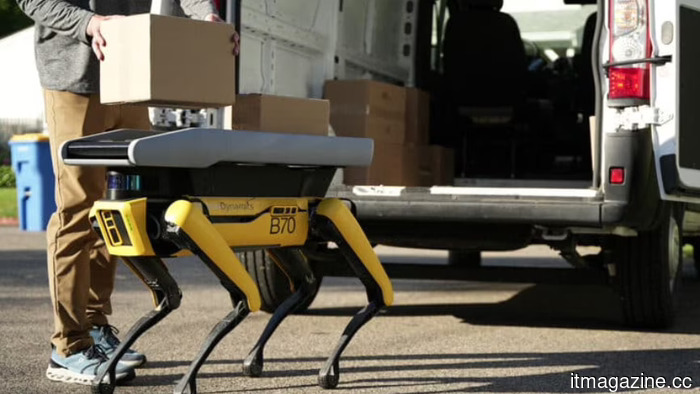 Boston Dynamics is experimenting with Spot as a delivery robot that walks from the van to the front door.
Boston Dynamics equipped Spot with a conveyor belt to transport packages from delivery vans to front doors, focusing on the final 50 feet of the logistics process.
Boston Dynamics is experimenting with Spot as a delivery robot that walks from the van to the front door.
Boston Dynamics equipped Spot with a conveyor belt to transport packages from delivery vans to front doors, focusing on the final 50 feet of the logistics process.
 What are the simplest methods for accepting payments online and in person?
This post is presented in collaboration with QuickBooks. Customers now anticipate that businesses will accommodate payments in the manner that is most convenient for them, whether that involves tapping a card at the register, settling an invoice via phone, or making an online purchase. For small businesses, fulfilling these expectations is crucial; however, handling various payment systems [...]
What are the simplest methods for accepting payments online and in person?
This post is presented in collaboration with QuickBooks. Customers now anticipate that businesses will accommodate payments in the manner that is most convenient for them, whether that involves tapping a card at the register, settling an invoice via phone, or making an online purchase. For small businesses, fulfilling these expectations is crucial; however, handling various payment systems [...]
 Suno AI music was trained on over 2 million songs scraped from YouTube.
A breach of Suno AI music revealed its source code, indicating that it harvested millions of tracks from YouTube, Deezer, and Genius to develop its song generator.
Suno AI music was trained on over 2 million songs scraped from YouTube.
A breach of Suno AI music revealed its source code, indicating that it harvested millions of tracks from YouTube, Deezer, and Genius to develop its song generator.
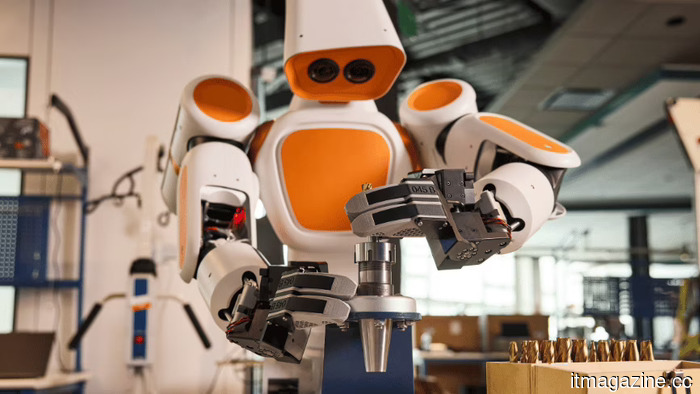 Walden Robotics debuts with $300 million in funding and legs not included.
Walden Robotics, a spin-off from Toyota, emerged from stealth mode with $300 million in funding at a valuation of $1.1 billion. Its factory humanoid robots operate on wheels instead of legs.
Walden Robotics debuts with $300 million in funding and legs not included.
Walden Robotics, a spin-off from Toyota, emerged from stealth mode with $300 million in funding at a valuation of $1.1 billion. Its factory humanoid robots operate on wheels instead of legs.
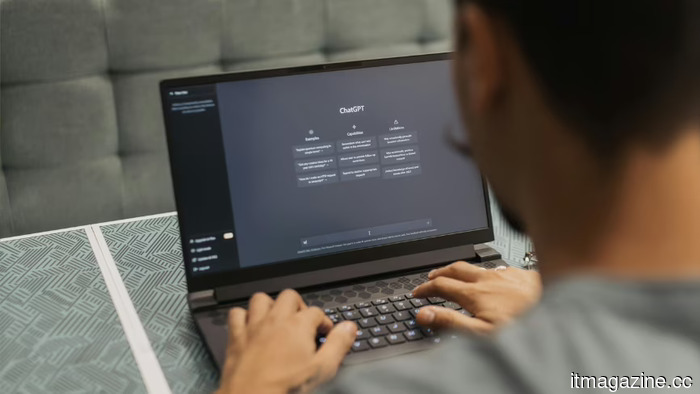 OpenAI is displaying Kalshi's World Cup betting odds within ChatGPT, marking its initial partnership with a prediction market.
ChatGPT now shows Kalshi prediction market odds for the 2026 World Cup games, representing OpenAI's initial collaboration with a regulated betting exchange.
OpenAI is displaying Kalshi's World Cup betting odds within ChatGPT, marking its initial partnership with a prediction market.
ChatGPT now shows Kalshi prediction market odds for the 2026 World Cup games, representing OpenAI's initial collaboration with a regulated betting exchange.
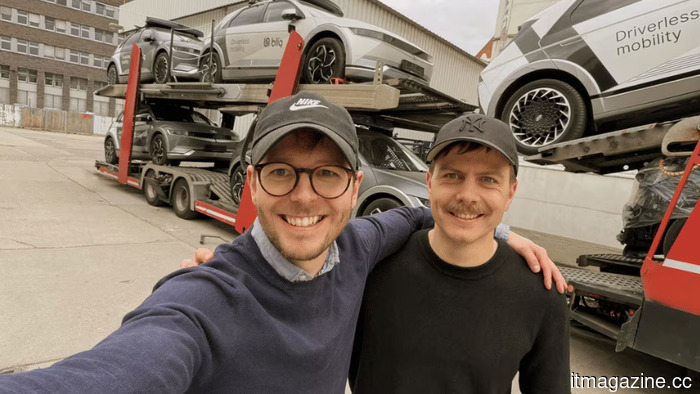 Bliq receives approval for autonomous vehicles in Finland.
Bliq.ai has received authorization to operate driverless vehicles on public roads in Finland, marking its second EU market following Estonia, beginning with a winter test in Helsinki.
Bliq receives approval for autonomous vehicles in Finland.
Bliq.ai has received authorization to operate driverless vehicles on public roads in Finland, marking its second EU market following Estonia, beginning with a winter test in Helsinki.
Miles Wang departs from OpenAI to join a $2 billion AI pharmaceuticals startup.
Miles Wang, a researcher at OpenAI, is negotiating to secure $200 million at a valuation of $2 billion for a yet-to-be-named AI drug-discovery startup that currently lacks a product.