
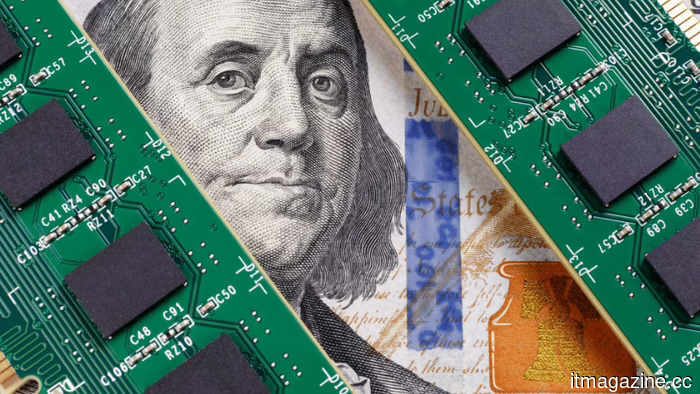
The AI memory shortage is not expected to improve until 2028.
The AI boom has shattered the oldest principle of the memory market. Prices, which should be decreasing, are unexpectedly rising, and the AI memory shortage is not anticipated to improve until 2028. The aftermath, when it arrives, could be severe.
Memory has typically been mundane. For many years, DRAM and NAND flash have acted like any other commodity, going through predictable cycles of booms and busts triggered by the influx of new factories that drive prices down. That cycle has now been disrupted.
As The Register explains, the rapid expansion of AI has consumed every available chip, resulting in an AI memory shortage without a quick resolution.
The cycle that has been disrupted
According to the previous norms, 2025 and 2026 were expected to see a decline. Prices should have decreased as supply caught up with demand. Instead, they have risen. GPU servers require immense quantities of high-bandwidth memory, including DDR5 and NAND, which has absorbed all available resources.
The outcome has affected the retail market, increasing the prices of consumer electronics and, as The Register notes, making affordable smartphones scarce. For manufacturers, however, this has been financially beneficial. SK Hynix and Micron have tripled their revenues within a year, while Samsung has approximately doubled its earnings.
A solution that takes years
The clear solution is to build more factories, and investment is shifting in that direction. In June, South Korean President Lee Jae Myung announced a $576 billion initiative led by SK Hynix and Samsung. Micron recently stated it would allocate up to $3 billion to strengthen its supply chain in the US, with additional investments in Singapore, Taiwan, and Japan.
None of this will materialize quickly. Establishing a new memory fabrication facility is one of the most challenging tasks in the industry, involving permits, ultra-pure water systems, and lithography tools that require months to calibrate. Any new project initiated today will take at least three years to come online and longer to achieve full production capacity. The analyst firm IDC does not foresee any relief until 2028.
Costs borne by everyone downstream
In the meantime, the burden falls on all those downstream from the memory giants. Chip manufacturers are already redesigning their products in response to the shortage. Samsung is preparing an economical solid-state drive that eliminates its onboard DRAM entirely, according to TechRadar, taking a portion of system memory to reduce costs.
AI companies are experiencing the impact as well. Each developer utilizing AI infrastructure is facing increased costs, which negatively affects already tight profit margins. Over the past four years, the labs have invested hundreds of billions in venture capital and still need to turn their cost per token into profit, with escalating memory prices complicating that equation.
The downturn that no one anticipates
This leads to the dilemma. Memory vendors finance their massive fabs based on booming demand. They are acutely aware that when the new supply finally becomes available, it can flood the market and crash prices. This is the established cycle, and the influence of AI has only amplified the fluctuations.
The entire structure relies on one key assumption: that demand for AI continues to rise. If demand falls short just as new manufacturing facilities begin operations, the producers could face what The Register terms a catastrophic bust. Therefore, the true race is not between memory supply and demand but whether the new fabs become operational before the AI bubble bursts and the music ceases.
For Europe, observing from the margins of a supply chain it has limited control over, this pressure highlights its vulnerability. The region is racing to construct its own AI data centers, yet only a few companies in Korea, Taiwan, and the United States control and set prices for the necessary components.
The current "RAMpocalypse" serves as an excellent opportunity for memory manufacturers, while it is a tense time for everyone else. The reckoning has merely been postponed, not eliminated.
Other articles
 The most cutting-edge calorie tracking applications of 2026.
Five calorie tracking applications advancing the field in 2026 through AI-driven food logging, adaptive algorithms, GLP-1 integration, and customized meal planning that adjusts to personal health conditions.
The most cutting-edge calorie tracking applications of 2026.
Five calorie tracking applications advancing the field in 2026 through AI-driven food logging, adaptive algorithms, GLP-1 integration, and customized meal planning that adjusts to personal health conditions.
 Apple's lawsuit is already impacting OpenAI's competitor to the iPhone.
Apple's trade-secret lawsuit could take years to resolve, but Bloomberg reports that it's already having a chilling effect on OpenAI's recruitment efforts and creating uncertainty around its product launch prior to any decision.
Apple's lawsuit is already impacting OpenAI's competitor to the iPhone.
Apple's trade-secret lawsuit could take years to resolve, but Bloomberg reports that it's already having a chilling effect on OpenAI's recruitment efforts and creating uncertainty around its product launch prior to any decision.
 Cursor Sand: the competitor to Claude Cowork with a Musk twist.
Cursor Sand is a versatile agent designed to compete with Claude Cowork and ChatGPT Work. Whether it will be released by Musk’s SpaceX is still uncertain.
Cursor Sand: the competitor to Claude Cowork with a Musk twist.
Cursor Sand is a versatile agent designed to compete with Claude Cowork and ChatGPT Work. Whether it will be released by Musk’s SpaceX is still uncertain.
 The pressure on AI memory is not expected to alleviate until 2028.
The surge in AI has disrupted the boom-bust cycle of the memory market. The current memory shortage driven by AI is expected to persist until 2028, and the subsequent downturn could be unprecedented.
The pressure on AI memory is not expected to alleviate until 2028.
The surge in AI has disrupted the boom-bust cycle of the memory market. The current memory shortage driven by AI is expected to persist until 2028, and the subsequent downturn could be unprecedented.
 The AI penalty: employees penalized for using AI in good faith
Managers encourage employees to utilize AI, only to give credit to the technology instead. Researchers refer to this phenomenon as the AI penalty, and workers claim it is impacting their chances for promotions and salary increases.
The AI penalty: employees penalized for using AI in good faith
Managers encourage employees to utilize AI, only to give credit to the technology instead. Researchers refer to this phenomenon as the AI penalty, and workers claim it is impacting their chances for promotions and salary increases.
 Meta AI detector fails to identify half of its own cropped fakes.
A Reuters test revealed that the Meta AI detector failed to identify 55% of its Muse Image photos after they were cropped, highlighting the limitations of AI watermarks.
Meta AI detector fails to identify half of its own cropped fakes.
A Reuters test revealed that the Meta AI detector failed to identify 55% of its Muse Image photos after they were cropped, highlighting the limitations of AI watermarks.
The AI memory shortage is not expected to improve until 2028.
The surge in AI technology disrupted the typical boom-bust cycle of the memory market. The current memory shortage driven by AI is expected to persist until 2028, and the subsequent downturn may be unprecedented.