

The most cutting-edge calorie tracking applications of 2026.
In the mid-2000s, tracking calories and macronutrients was a specialized practice. You would weigh your food, refer to a database, and log how many calories and grams of protein, fat, and carbohydrates you consumed daily. This method was primarily utilized by bodybuilders, strength athletes, and competitors aiming to stay within a weight category.
Then, in the early to mid-2010s, platforms like social media and YouTube brought it into the limelight. Fitness enthusiasts aspiring to resemble their favorite influencers began tracking their intake, and by that time, several apps were available. However, these apps didn’t simplify the process much. Logging was still tedious and laborious, making it seem unsuitable for everyone.
This changed in the post-COVID-19 years, especially with the advent of AI. Calorie tracking gained a much broader audience beyond traditional gym-goers, prompting the industry to enhance the speed, accessibility, and ease of integrating it into daily life. The focus on accessibility and personalization is where the current competition lies, with some companies advancing further than others.
However, not every calorie tracking app on the market today, nor every app branded with AI capabilities, offers something truly novel. Below are five apps that are actually advancing calorie tracking this year, along with their key innovations.
**Fitia**
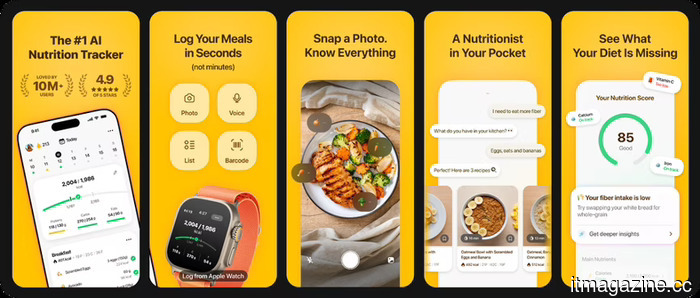
If there's an app that merges the precision of traditional trackers with modern, quick logging, it's Fitia. It launched in 2019, founded on the idea of personalized meal plans integrated with calorie tracking sourced from an in-house database created by nutrition experts.
Subsequently, it enhanced both the tracking and meal planning components and incorporated AI to diversify meal logging options. Users can either photograph their food for calorie calculation, use voice input, or manually list what they consumed as if texting a friend.
In 2026, Fitia introduced new features, including a 24/7 AI Coach capable of answering any nutrition-related inquiries, devising recipes, and assessing diet quality. Additionally, there is a comprehensive Social Hub where users can exchange photos and posts, chat amongst themselves, and compete in groups for motivation.
The standout feature Fitia has launched this year is its innovative AI meal planner, which crafts entire weekly meal plans tailored to a user’s goals, dietary preferences, favorite recipes, and health conditions such as diabetes, hypertension, hypothyroidism, and insulin resistance. Pregnant or breastfeeding women can also specify their status, allowing the app to adjust their macros and meal plans accordingly.
**Noom**
When Noom came into the market, it introduced a psychological perspective that few competitors had at the time. The app emphasized behavior change regarding food choices and personal coaching, with calorie tracking added on.
In 2026, Noom has incorporated AI and recent medical advancements to enhance these features, including AI coaching and GLP-1 programs for eligible users.
It has also introduced a Body Scan tool that uses the phone's camera to generate a 3D avatar of the user’s body and estimate body fat percentage, lean mass, and measurements such as waist, hips, and chest, without the need for specialized equipment. Noom claims a precision margin of about ±0.50% for the body fat percentage. This, alongside GLP-1 medications, enables users to monitor their lean mass retention during weight loss phases and gain a clearer understanding of their diet's effects on their body.
**Cal AI**
In discussions of innovation within calorie tracking, Cal AI must be mentioned. It was an early adopter of using a language model to analyze food from photos for estimating calorie and macronutrient content. More notably, its aggressive influencer marketing propelled calorie tracking to broader demographics and created marketing opportunities for other apps. While not the originator of food photo recognition, it streamlined the process more than anyone else, demonstrating that there was a demand for expedited logging.
By 2026, many of Cal AI's competitors had implemented photo tracking, but its expertise gained the attention of MyFitnessPal, the largest player in the market, leading to a complete acquisition earlier this year.
**MacroFactor**
MacroFactor was a trailblazer in creating adaptive targets. Its proprietary algorithm assesses calorie expenditure based on user logs and current weight trends, then autonomously adjusts calorie and macronutrient goals when progress stalls.
By this year, MacroFactor has also embraced AI for more efficient logging, enhancing the photo tracking feature by allowing users to combine images with descriptions of their meals. Although adaptive algorithms are no longer as unique as they once were, the team diligently continues to refine it based on recent research.
**MyFitnessPal**
Operating since 2005, MyFitnessPal has developed one of the largest communities in the calorie tracking space and has established itself as a leading app. Ironically, this app, which previously set industry standards, has spent recent years trying to catch up with those advancements.
Its primary strategy has involved acquiring
Other articles
 Apple's lawsuit is already impacting OpenAI's competitor to the iPhone.
Apple's trade-secret lawsuit could take years to resolve, but Bloomberg reports that it's already having a chilling effect on OpenAI's recruitment efforts and creating uncertainty around its product launch prior to any decision.
Apple's lawsuit is already impacting OpenAI's competitor to the iPhone.
Apple's trade-secret lawsuit could take years to resolve, but Bloomberg reports that it's already having a chilling effect on OpenAI's recruitment efforts and creating uncertainty around its product launch prior to any decision.
 The AI memory shortage will not improve until 2028.
The surge in AI has disrupted the typical boom-bust cycle of the memory market. The current memory shortage caused by AI is expected to persist until 2028, and the subsequent downturn could be unprecedented.
The AI memory shortage will not improve until 2028.
The surge in AI has disrupted the typical boom-bust cycle of the memory market. The current memory shortage caused by AI is expected to persist until 2028, and the subsequent downturn could be unprecedented.
 Never-skilling: studies indicate that junior developers who rely on AI do not acquire debugging skills.
A randomized trial showed that developers utilizing AI scored 50% on a quiz concerning code they had just created, compared to 67% for those who coded manually.
Never-skilling: studies indicate that junior developers who rely on AI do not acquire debugging skills.
A randomized trial showed that developers utilizing AI scored 50% on a quiz concerning code they had just created, compared to 67% for those who coded manually.
 The AI memory shortage is unlikely to improve until 2028.
The surge in AI has disrupted the memory market's cycle of boom and bust. The current memory shortage due to AI is expected to last until 2028, and the subsequent downturn could be unprecedented.
The AI memory shortage is unlikely to improve until 2028.
The surge in AI has disrupted the memory market's cycle of boom and bust. The current memory shortage due to AI is expected to last until 2028, and the subsequent downturn could be unprecedented.
 'Scam Altman': Musk and Altman's weekend clash on X
Over the weekend, Musk referred to Sam Altman as a 'scammer' on X following Apple's lawsuit against OpenAI. In response, Altman suggested that the lawsuit demonstrated the effectiveness of his new model. Here's a look at the ongoing conflict.
'Scam Altman': Musk and Altman's weekend clash on X
Over the weekend, Musk referred to Sam Altman as a 'scammer' on X following Apple's lawsuit against OpenAI. In response, Altman suggested that the lawsuit demonstrated the effectiveness of his new model. Here's a look at the ongoing conflict.
 Not acquiring skills: research indicates that junior developers using AI fail to learn debugging.
A randomized trial showed that developers who utilized AI achieved a score of 50% on a quiz related to the code they had just created, compared to a score of 67% for those who coded manually.
Not acquiring skills: research indicates that junior developers using AI fail to learn debugging.
A randomized trial showed that developers who utilized AI achieved a score of 50% on a quiz related to the code they had just created, compared to a score of 67% for those who coded manually.
The most cutting-edge calorie tracking applications of 2026.
Five calorie tracking applications advancing the field in 2026 through AI-driven food logging, adaptive algorithms, GLP-1 integration, and customized meal planning that adjusts to personal health conditions.