
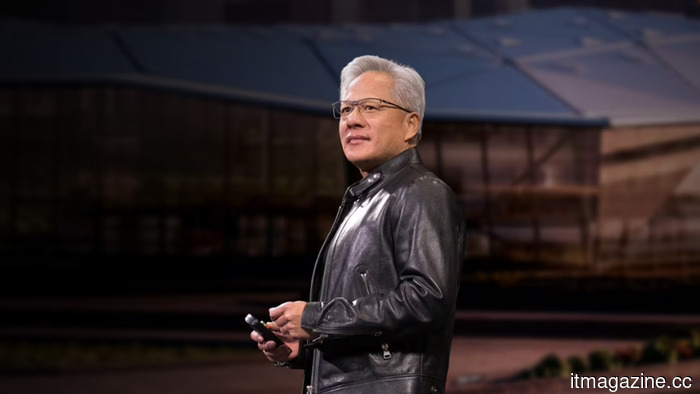
Jensen Huang mentions that his engineers prefer to create agents instead of writing code.
Nvidia's software engineers are coding less than ever, and their CEO states this is a preference they embrace. Jensen Huang remarked this week that his engineers favor creating AI agents over writing Python, framing this shift as an advancement rather than a setback. "These agentic systems require new skills, and now many software engineers are engaged in building agents," Huang mentioned in an interview released by the company on Wednesday.
“If you ask me, my software engineers would rather work on building agents than on writing Python code.” This is a message he has been refining for months, from a commencement speech at Carnegie Mellon University to the stage at Computex. The distinction he makes is between coding as a task and engineering as a craft. He believes that the routine work of converting ideas into syntax can now be performed by an agent.
“You're offloading all the tedious tasks to the agent,” he explained. “That necessitates imagination, creativity, and advanced technology.” Rather than simply generating Python code, his engineers now focus on developing agents, drafting benchmarks, and creating the safety measures that ensure these systems operate correctly.
An AI agent takes a large objective and breaks it down into smaller steps, addressing each step sequentially, allowing the software to plan and act, rather than just responding to a single prompt. Huang, who co-founded Nvidia in 1993, has emerged as a prominent advocate for incorporating AI assistants within businesses. He has consistently shared his vision of deploying agents in every division to enhance productivity, a goal that aligns well with their sale of the chips and platforms that support them.
This commercial rationale is always apparent. Over the last year, Nvidia has positioned itself as a foundational infrastructure in the agent economy, and a workforce dedicated to building agents also increases the demand for computing power.
Regarding employment, Huang diverges from many of his contemporaries. He dismissed the growing concern that AI will diminish white-collar jobs, asserting that technology is actually creating positions instead of eliminating them. “The workload involved in bringing AI to life is substantial,” he noted. “So it’s generating many new jobs. And my software engineers enjoy this.”
His hopeful perspective contrasts with views from leaders like Anthropic’s Dario Amodei and Amazon’s Andy Jassy, who have warned that AI might displace numerous entry-level and administrative roles. Huang has consistently rejected that narrative, even as other companies indicate that advancements in agent technology are less swift than anticipated.
“This is what many people overlook about AI: right now, it’s generating a vast number of jobs," he stated during a television interview in May. “AI creates jobs. It represents the best opportunity for the United States to re-industrialize.”
Whether this observation extends to the broader economy is a different matter from the situation at Nvidia, where the engineers Huang describes remain employed. His assertion is more targeted and harder to dispute—that providing skilled individuals with better tools significantly reduces mundane tasks.
For now, this message resonates with both investors and employees. A company where its engineers instinctively use agents sends a compelling signal about the hardware Nvidia produces, and Huang is aware of this. The true challenge will be to see if his enthusiasm withstands the complexities of software development, where critical thinking, debugging, and accountability still fall to people. After all, constructing an agent involves its own form of coding.
Other articles
 Criterion states that Burnout is not overlooked, yet that is precisely what concerns me.
Criterion indicates that Burnout is still a significant aspect of the studio's identity, but Battlefield is now its focus moving forward. Although this decision is sound from a business perspective following the success of Battlefield 6, it also underscores the scarcity of genuine arcade racing games in the current market.
Criterion states that Burnout is not overlooked, yet that is precisely what concerns me.
Criterion indicates that Burnout is still a significant aspect of the studio's identity, but Battlefield is now its focus moving forward. Although this decision is sound from a business perspective following the success of Battlefield 6, it also underscores the scarcity of genuine arcade racing games in the current market.
 Thick phone or exhausted nervous system?
Imagine you are in an unfamiliar city, a bill rustling in your pocket, but the smartphone screen is dead, like a mammoth. A power outlet is a myth, and the power bank was left at home. For 48.7% of Russians, this nightmare is comparable in stress level to having no money at all.
Thick phone or exhausted nervous system?
Imagine you are in an unfamiliar city, a bill rustling in your pocket, but the smartphone screen is dead, like a mammoth. A power outlet is a myth, and the power bank was left at home. For 48.7% of Russians, this nightmare is comparable in stress level to having no money at all.
 Spotify has finally allowed users to pin more than four items in their library, a change that has been a long time coming.
Spotify's library pin limit had been fixed at four for many years. It has now been increased to 20, making it the most generous pin limit among the leading music streaming services.
Spotify has finally allowed users to pin more than four items in their library, a change that has been a long time coming.
Spotify's library pin limit had been fixed at four for many years. It has now been increased to 20, making it the most generous pin limit among the leading music streaming services.
 US states may file a lawsuit next week to prevent Paramount's $110 billion deal with Warner Bros.
Sources informed Reuters that California, New York, and several other states may file lawsuits as early as next week to prevent Paramount’s $110 billion acquisition of Warner Bros. Discovery.
US states may file a lawsuit next week to prevent Paramount's $110 billion deal with Warner Bros.
Sources informed Reuters that California, New York, and several other states may file lawsuits as early as next week to prevent Paramount’s $110 billion acquisition of Warner Bros. Discovery.
 Jensen Huang mentioned that his engineers prefer creating agents to writing code.
Nvidia's CEO Jensen Huang stated that all of his engineers favor developing AI agents over coding in Python, asserting that AI is generating jobs rather than eliminating them.
Jensen Huang mentioned that his engineers prefer creating agents to writing code.
Nvidia's CEO Jensen Huang stated that all of his engineers favor developing AI agents over coding in Python, asserting that AI is generating jobs rather than eliminating them.
 Meta's CTO stated that employee-tracking information ended up 'in places it shouldn't have.'
Meta's CTO Andrew Bosworth stated that a researcher incorrectly relocated keystroke-tracking data, which contributed to the company halting its Model Capability Initiative.
Meta's CTO stated that employee-tracking information ended up 'in places it shouldn't have.'
Meta's CTO Andrew Bosworth stated that a researcher incorrectly relocated keystroke-tracking data, which contributed to the company halting its Model Capability Initiative.
Jensen Huang mentions that his engineers prefer to create agents instead of writing code.
Nvidia's CEO Jensen Huang states that all of his engineers favor developing AI agents over coding in Python, and he emphasizes that AI is generating jobs rather than eliminating them.