
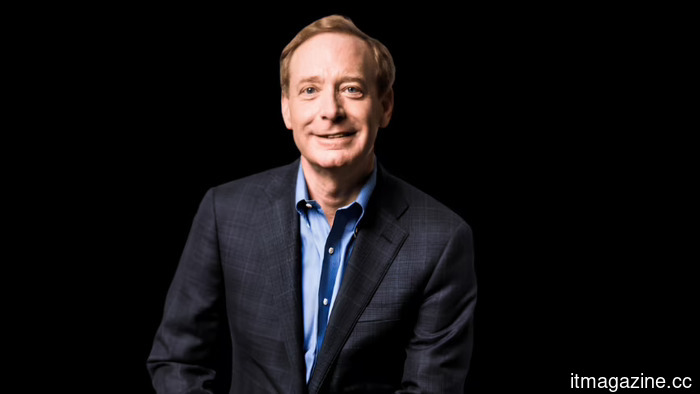
Brad Smith: The United States governs AI without specific regulations.
Microsoft's president, Brad Smith, has stated that the U.S. is currently regulating AI without a clear framework of rules. He cautioned that this uncertainty poses a problem for the entire industry. He expressed his views to Fortune during the AI for Good Global Summit.
"What we really have is regulation lacking transparent or comprehensive rules," Smith remarked. "Without established rules, businesses cannot strategize effectively."
His concerns were heightened by two sudden actions taken by the Trump administration. Last month, the Commerce Department invoked export-control laws to restrict Anthropic’s Fable 5 and Mythos 5 models worldwide, citing cybersecurity threats. A few weeks later, officials pressured OpenAI to postpone the public release of its GPT-5.6 family, granting early access only to government-approved partners.
Both restrictions have since been lifted, with Fable 5 returning online this month and GPT-5.6 being released publicly. Smith asserted that Washington was justified in addressing the Fable issue but criticized the regulatory approach used.
"The government received information indicating an urgent cybersecurity risk, and I believe it was right to act on that information," he commented. "However, it only had a single regulatory instrument available: an export control." Legal experts have pointed out that these controls existed before API-served models came into play, raising questions about the potential for a legal challenge to this action.
Critics argue that this has resulted in a licensing regime lacking legislative support. A June executive order established a voluntary pre-release review process but did not outline formal approval regulations. The government has yet to disclose who qualifies as a "trusted partner" or which models will undergo review next.
"The government lacks the necessary tools," Smith stated. "Common sense dictates not to be too heavy-handed, but to have sufficient flexibility to take appropriate action."
The situation with Anthropic has also intensified discussions around sovereign AI, which refers to efforts by governments to regulate the models and the underlying infrastructure. A French politician compared the shutdown to a blockade of the Strait of Hormuz, while Canadian Prime Minister Mark Carney remarked that it highlighted the risks of depending on a limited number of providers.
Smith believes that people have misinterpreted the export action as an attempt to isolate foreign entities. He clarified that the intention was to withdraw the model from all markets. "They requested Anthropic to remove Fable from sale," he explained. "When Anthropic refused, they utilized an export-control mechanism to enforce that removal, both domestically and internationally."
Regardless, he contended that the responsibility now lies with Washington and U.S. companies to demonstrate the reliability of their systems. "Consumers will not purchase our offerings unless they have confidence in a steady supply," he said. Salesforce's chief, Marc Benioff, presented an opposing view at the same event, expressing satisfaction with the block and asserting that Europe had misinterpreted a security measure as aggression.
The significance of this situation lies in the considerable influence the U.S. wields over which AI models are available globally. However, this power has largely not been formally articulated, which poses a greater concern for companies that market AI internationally. While one can negotiate around established rules, it is significantly more challenging to navigate an opaque policy.
Other articles
 Your dog has the ability to run, but Fi’s new tracker, supported by Starlink satellites, ensures you can always locate them.
Fi Ultra employs Starlink satellite connectivity to ensure that lost dogs remain traceable outside of cellular coverage, reducing the likelihood of adventurous pups disappearing without a trace.
Your dog has the ability to run, but Fi’s new tracker, supported by Starlink satellites, ensures you can always locate them.
Fi Ultra employs Starlink satellite connectivity to ensure that lost dogs remain traceable outside of cellular coverage, reducing the likelihood of adventurous pups disappearing without a trace.
 The recent update for Google Home simplifies the process of initiating automations.
Google Home version 4.20 introduces pre-configured automations that can be activated with a simple tap, simplifying one of the app's most beneficial features for users new to automation.
The recent update for Google Home simplifies the process of initiating automations.
Google Home version 4.20 introduces pre-configured automations that can be activated with a simple tap, simplifying one of the app's most beneficial features for users new to automation.
 The reliance of Britain on US cloud services has become a billion-pound risk.
Almost all public organizations in the UK rely on US hyperscale companies, consolidating billions of pounds and essential services within systems that Whitehall cannot entirely monitor.
The reliance of Britain on US cloud services has become a billion-pound risk.
Almost all public organizations in the UK rely on US hyperscale companies, consolidating billions of pounds and essential services within systems that Whitehall cannot entirely monitor.
 Britain's reliance on US cloud services has become a billion-pound risk.
Almost all public institutions in the UK rely on US hyperscalers, centralizing billions of pounds and essential services in systems that Whitehall cannot fully access.
Britain's reliance on US cloud services has become a billion-pound risk.
Almost all public institutions in the UK rely on US hyperscalers, centralizing billions of pounds and essential services in systems that Whitehall cannot fully access.
 Xiaomi has created an SUV that also functions as a camping tent, and its range specifications are just as impressive.
Xiaomi has introduced its new sub-brand, Sky Nomad, which launches with a 5.3-meter family EREV SUV featuring a retractable camper-tent roof in one of its trims.
Xiaomi has created an SUV that also functions as a camping tent, and its range specifications are just as impressive.
Xiaomi has introduced its new sub-brand, Sky Nomad, which launches with a 5.3-meter family EREV SUV featuring a retractable camper-tent roof in one of its trims.
 Britain's reliance on US cloud services has now become a billion-pound risk.
Almost all public organizations in the UK rely on US hyperscalers, which centralize billions of pounds and essential services within systems that Whitehall cannot completely oversee.
Britain's reliance on US cloud services has now become a billion-pound risk.
Almost all public organizations in the UK rely on US hyperscalers, which centralize billions of pounds and essential services within systems that Whitehall cannot completely oversee.
Brad Smith: The United States governs AI without specific regulations.
Microsoft president Brad Smith has stated that Washington is imposing regulations on AI without clear guidelines, following sudden export control actions affecting Anthropic and OpenAI.