
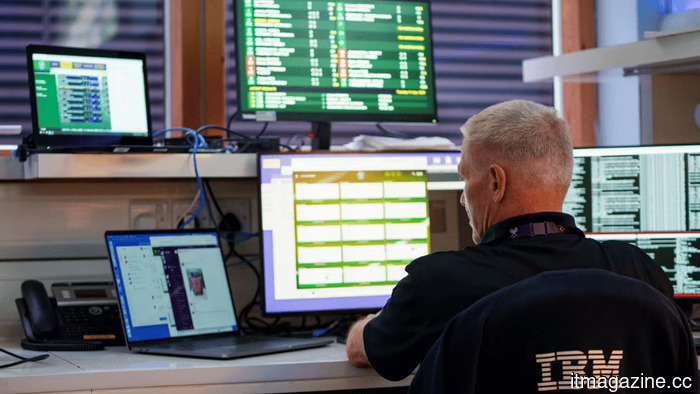
Within IBM's concealed 'Court 19' at Wimbledon
A serve lights up the Wimbledon scoreboard just before the ball settles. That statistic is derived from a collaboration that predates many players currently competing. IBM has been the technological partner of Wimbledon for 36 years, having introduced serve-speed radar behind the baselines in 1991. This year, the two extended their partnership until 2030, according to Fortune.
The influence of this partnership has expanded beyond the grass courts. Over the two-week event, more than half a million attendees are just a fraction of the overall audience. In 2025, Wimbledon generated approximately 18 billion impressions across its digital platforms, reaching an estimated 730 million people, as stated by the All England Lawn Tennis and Croquet Club.
Website and app visits increased by over 20 percent in the last year. The hub of activity operates out of sight. IBM’s center, known as “Court 19,” is located beneath the 18th grass court. During the tournament, it processes around 2.7 million data points, including ball speed, shot placement, and momentum shifts, converting this information into features users interact with on the app.
For IBM, tennis is not the primary focus; Wimbledon serves as a testing ground. Kameryn Stanhouse, vice-president of global sports and entertainment partnerships at IBM, mentions the “real fear around AI” among executives. “It’s not that they doubt its necessity,” she explains, “but they fear for their jobs if mistakes occur.” The high-pressure environment allows IBM to demonstrate that it can effectively implement technology.
When the system fails
This apprehension is not unfounded. In 2025, Wimbledon replaced its 300 line judges, who had been a staple for 147 years, with automated electronic line-calling. The initial implementation faced challenges, with the system missing three calls during one quarter-final and mistakenly declaring “fault” in the middle of a rally, necessitating intervention from the umpire. Jack Draper raised concerns about its accuracy, while Emma Raducanu criticized some calls as “dodgy.”
Sony’s Hawk-Eye operates that system, not IBM. However, this incident casts a shadow over discussions about allowing machines to make pivotal match decisions. IBM emphasizes that its features are “human-led,” with a governance layer that ensures confidence and checks for biases before any data is presented to fans. This distinction may be lost on irate fans when a mistake is made.
Some of the traditional drama has also diminished. In the past, players would challenge a call, prompting a quiet crowd while a replay was shown on the big screen. Even IBM’s “Likelihood to Win,” which updates odds after every point, removes a bit of the suspense. Stanhouse views this as a fair trade, noting that “fans argue less about marginal calls and focus more on the tennis itself."
A showcase for enterprise AI
The commercial rationale is evident. The global sports market is projected to exceed $600 billion by 2030, according to Kearney. IBM is not the only company using sports to validate its AI technology before deploying it in other sectors. Stanhouse points out that matches provide a unique opportunity with substantial live data volumes, high pressure, and public visibility.
The productivity benefits are even more pronounced. To revamp the app and website, IBM utilized an accelerator called Bob, migrating over 15,000 digital assets to a new platform. A task that would traditionally require five specialists several months was accomplished by one engineer in a month, according to Stanhouse. The final transfer took just 47 minutes.
Looking ahead, the focus will shift to more personalized and remote experiences. IBM has already developed a Master's golf app for Apple Vision Pro and anticipates similar advancements in tennis. Quantum computing may also have a future role, though IBM has yet to identify its application in sports.
Why it matters
Wimbledon serves as a unique public trial of AI’s ability to integrate into beloved traditions without detracting from them. A 2025 Capgemini study revealed that 70 percent of fans desire real-time data, yet over half are concerned that excessive technology detracts from the live sports experience. This creates a delicate balancing act. As Stanhouse emphasizes, no technology will ever predict the winner in advance.
“Someone could wake up with a sore neck and not be able to serve as they used to.”
Other articles
 Lyzr utilized its own AI agent to assist in securing a $100 million funding round.
Enterprise AI startup Lyzr reports that its agent, Agent Sam, engaged with over 130 investors during its $100 million Series B funding round, achieving a valuation of approximately $500 million.
Lyzr utilized its own AI agent to assist in securing a $100 million funding round.
Enterprise AI startup Lyzr reports that its agent, Agent Sam, engaged with over 130 investors during its $100 million Series B funding round, achieving a valuation of approximately $500 million.
 Brad Smith: The United States governs AI without specific regulations.
Microsoft president Brad Smith has stated that Washington is imposing regulations on AI without clear guidelines, following sudden export control actions affecting Anthropic and OpenAI.
Brad Smith: The United States governs AI without specific regulations.
Microsoft president Brad Smith has stated that Washington is imposing regulations on AI without clear guidelines, following sudden export control actions affecting Anthropic and OpenAI.
 Researchers compromise GitHub Copilot's safety using a workflow.
Researchers at the Alan Turing Institute were able to get GitHub Copilot to generate harmful content that it typically denies in chat, by distributing the request throughout a coding workflow.
Researchers compromise GitHub Copilot's safety using a workflow.
Researchers at the Alan Turing Institute were able to get GitHub Copilot to generate harmful content that it typically denies in chat, by distributing the request throughout a coding workflow.
 Britain's reliance on US cloud services has become a billion-pound risk.
Almost all public institutions in the UK rely on US hyperscalers, centralizing billions of pounds and essential services in systems that Whitehall cannot fully access.
Britain's reliance on US cloud services has become a billion-pound risk.
Almost all public institutions in the UK rely on US hyperscalers, centralizing billions of pounds and essential services in systems that Whitehall cannot fully access.
 Meta addresses privacy issue in Ray-Ban glasses with a fix.
Meta's update turns off the camera if the recording light is damaged, effectively disabling a spy-camera modification, while rival Even Realities, which doesn't use cameras, reaches a valuation of $1 billion.
Meta addresses privacy issue in Ray-Ban glasses with a fix.
Meta's update turns off the camera if the recording light is damaged, effectively disabling a spy-camera modification, while rival Even Realities, which doesn't use cameras, reaches a valuation of $1 billion.
 Alleged Chinese agents break into university email servers.
Proofpoint reports that a group aligned with China is infiltrating mailboxes of universities in the US and Canada by exploiting vulnerabilities in Roundcube to obtain research in physics and defense.
Alleged Chinese agents break into university email servers.
Proofpoint reports that a group aligned with China is infiltrating mailboxes of universities in the US and Canada by exploiting vulnerabilities in Roundcube to obtain research in physics and defense.
Within IBM's concealed 'Court 19' at Wimbledon
Underneath Wimbledon's 18th court, IBM's 'Court 19' processes 2.7 million data points during each tournament, showcasing the Championships as a platform for AI.