
The city claims that a contractor for Meta polluted Cheyenne's water.
A contractor for Meta released a rare and potentially hazardous bacterium into Cheyenne’s wastewater system, prompting the city in Wyoming to halt all discharges from data centers. This incident highlights the ongoing conflict regarding the water needs of AI development.
Officials in Cheyenne, Wyoming, have ceased to accept industrial wastewater from data centers due to this event, which was linked to a contractor working on Meta’s new AI campus. According to the Guardian, the contractor introduced a rare bacterium into the city’s water system.
The Cheyenne Board of Public Utilities identified Goat Systems, a contractor for Meta, as the responsible party. The company discharged water containing Cupriavidus gilardii, a rare and multidrug-resistant pathogen that entered the city’s reuse system designed to treat water for irrigation purposes, although it did not contaminate the drinking water supply.
Detection of the rare bacterium occurred during routine lab tests in February, but tracing its source took several months. Frank Strong, a member of the utilities board, told the Wyoming Tribune Eagle, which first covered the story, “This isn’t something we normally test for, and we went through quite a process to identify it.”
Cupriavidus gilardii is infrequently known to infect humans, but when it does, it poses serious health risks. According to one review, the mortality rate is 31 percent across 32 recorded cases since 2009. As a result, the board revoked Goat Systems’ discharge rights in March, and more recently, it has suspended all fill-and-flush and closed-loop discharges from data centers while working to prevent similar incidents.
The fill-and-flush process involves flooding a data center's cooling pipes with water to remove debris before the facility becomes operational. Meta claims that the upcoming campus will utilize a closed-loop system that recycles water.
Meta is collaborating with its contractor, Fortis, to address the situation. A spokesperson informed Business Insider, “When the board informed us about finding the substance in the city’s wastewater, not in the public drinking water, Fortis immediately stopped discharging industrial wastewater and began hauling it offsite.” Fortis conducted its own testing and reported no evidence of the bacterium.
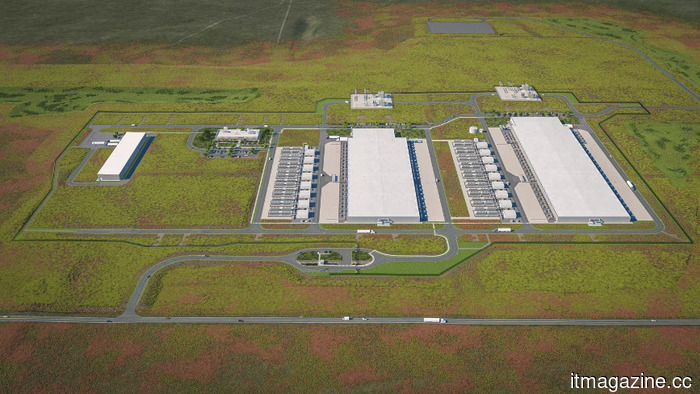
The $800 million campus, previously referred to as Project Cosmo during its planning stages, covers nearly 800,000 square feet to the south of the city. Meta announced the project in 2024 and intends to be "water-positive" by 2030, meaning it plans to replenish more water than it uses.
The significance of this incident lies in the extensive clean-up operations it necessitated. The board had to drain and disinfect the entire reuse system and temporarily switch affected irrigation to potable water. City councilman Pete Laybourn remarked, “It’s a very, very unpleasant surprise.”
Although Cheyenne's decision to suspend discharges is minor, it reflects a broader trend. In other areas, residents are opposing new data center developments due to increasing energy costs and noise disturbances, attending planning meetings to protest and urging legislators to hold large tech companies accountable for the expenses. In some instances, moratoriums have been proposed, with Senators Bernie Sanders and Alexandria Ocasio-Cortez suggesting a federal moratorium on AI data centers.
By the end of 2025, over 1,400 data centers are projected to be completed or approved across 45 states. This incident in Wyoming underscores how quickly local support can diminish.
Other articles
 Privacy concerns surrounding smart glasses: New York's ban confronts Meta's solution.
New York has prohibited smart glasses in all 1,240 courts as Meta secures its recording indicator, despite experimenting with always-on "super-sensing" eyewear.
Privacy concerns surrounding smart glasses: New York's ban confronts Meta's solution.
New York has prohibited smart glasses in all 1,240 courts as Meta secures its recording indicator, despite experimenting with always-on "super-sensing" eyewear.
 Google's Pixel Watch 5 might not be immune to the price increases expected in 2026.
Pricing details for the Pixel Watch 5 have surfaced before Google's event in August, suggesting minor price increases for certain models.
Google's Pixel Watch 5 might not be immune to the price increases expected in 2026.
Pricing details for the Pixel Watch 5 have surfaced before Google's event in August, suggesting minor price increases for certain models.
 Nvidia collaborates with chip competitor d-Matrix on inference technology.
Nvidia is partnering its GPUs with d-Matrix's inference chips in a collaborative system, marking the latest indication that it prefers to ally with chip competitors rather than oppose them.
Nvidia collaborates with chip competitor d-Matrix on inference technology.
Nvidia is partnering its GPUs with d-Matrix's inference chips in a collaborative system, marking the latest indication that it prefers to ally with chip competitors rather than oppose them.
 HubSpot retracts its decision regarding the use of customer data for AI purposes.
HubSpot has abandoned its proposal to aggregate customer data for an AI feature following a backlash that lasted four days, highlighting how sensitive the issue of AI and data collection has become.
HubSpot retracts its decision regarding the use of customer data for AI purposes.
HubSpot has abandoned its proposal to aggregate customer data for an AI feature following a backlash that lasted four days, highlighting how sensitive the issue of AI and data collection has become.
 SpaceXAI introduces Grok 4.5, its inaugural model featuring Cursor.
SpaceXAI has introduced Grok 4.5, the initial model developed using Cursor. Musk refers to it as "Opus-class" but more affordable, targeting tasks in coding, legal, and finance sectors.
SpaceXAI introduces Grok 4.5, its inaugural model featuring Cursor.
SpaceXAI has introduced Grok 4.5, the initial model developed using Cursor. Musk refers to it as "Opus-class" but more affordable, targeting tasks in coding, legal, and finance sectors.
 Venus Aerospace secures $91 million for its detonation engine project.
Venus Aerospace has secured $91 million in a Series B funding round to develop its rotating detonation rocket engine into hardware suitable for missiles and high-speed spacecraft.
Venus Aerospace secures $91 million for its detonation engine project.
Venus Aerospace has secured $91 million in a Series B funding round to develop its rotating detonation rocket engine into hardware suitable for missiles and high-speed spacecraft.
The city claims that a contractor for Meta polluted Cheyenne's water.
According to the Guardian, a Meta contractor introduced a rare bacterium into Cheyenne's water system, prompting the Wyoming city to halt all data center discharges.