
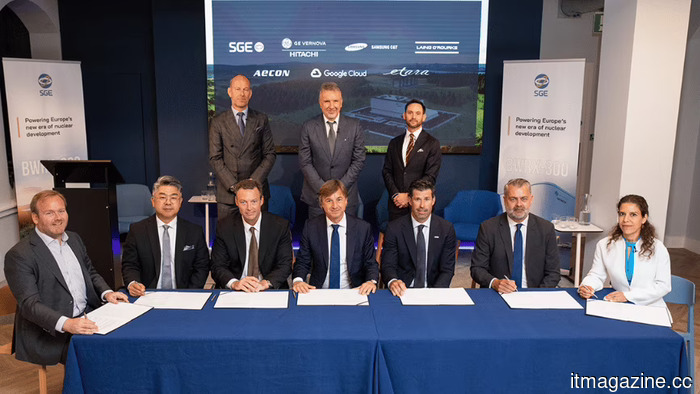
A £35 billion initiative to construct 14 small nuclear reactors in the UK.
A Polish billionaire has outlined a proposal to establish a fleet of small nuclear reactors throughout Britain, with an estimated cost of £35 billion, according to TechRadar. Michał Sołowow’s company, SGE, aims to install 14 GE Vernova Hitachi BWRX-300 reactors at three locations in the UK, targeting initial power generation by 2034.
The scale is significant. Collectively, these reactors would produce 4.2GW, sufficient to power around eight million homes, which accounts for roughly 11 percent of the UK's electricity demand for a minimum of 60 years. SGE, a Warsaw-based developer established in 2019, has submitted plans under the UK's new Advanced Nuclear Framework. Their delivery team includes GE Vernova Hitachi, Samsung C&T, and Laing O’Rourke.
Why small reactors and why now?
Small modular reactors, or SMRs, represent the industry's expectation for efficiency. Each BWRX-300 generates about 300MW, a small fraction of a conventional plant's output. The argument is that these factory-built, standardized units are cheaper and quicker to deploy than a single large, custom-built facility.
The timing of this initiative is deliberate. The demand for power is rising rapidly due to AI data centers, electric vehicles, and heat pumps. Governments that have invested years in renewable energy are now looking for reliable, consistent power sources. After being sidelined for years, nuclear energy has re-entered the discussion.
However, there are challenges. Reports estimate the cost of each 300MW reactor to be between £2.2 billion and £2.5 billion. SGE advocates for a privately funded initiative but seeks a Contract for Difference, which guarantees a price supported by the government, alongside involvement from the National Wealth Fund. Under this framework, consumers wouldn’t incur costs until the reactors become operational.
Moreover, SMRs have yet to be proven on a large scale. No BWRX-300 has been commercially operational thus far, and the history of nuclear projects features numerous delays and budget overruns. A start date in 2034 allows for significant potential delays.
Why is this significant?
If successful, this plan could position a foreign entrepreneur as one of the largest builders of power infrastructure in Britain. It also indicates the direction the AI era is taking. The competition is evolving from chips and models to the more practical issue of who can produce sufficient electricity and where this generation will take place. As Britain focuses on data centers, there is a growing need for a reliable energy source to support them.
Other articles
 Rilla spends $1.7 million annually on rent for staff working 72 hours a week.
The AI startup Rilla invests $1.7 million annually in housing stipends, enabling employees to reside close to its New York City office while putting in 72-hour work weeks. The CEO states that the focus is on maintaining flow rather than prioritizing comfort.
 Palmer Luckey: American universities are lagging behind those in China.
Palmer Luckey of Anduril claims that U.S. universities cultivate "architecture astronauts," whereas China develops genuine engineers, a sentiment also expressed by the CEO of Pfizer.
Fi places Starlink satellites inside a dog collar.
Fi's latest product, the Fi Ultra, is the inaugural dog collar that utilizes Starlink's direct-to-cell satellites, allowing for pet tracking beyond the reach of mobile towers, according to Fortune.
Irish drone delivery company Manna is establishing a factory in Tulsa that will employ 1,000 people to compete with Zipline and Wing.
Manna secured $50 million in funding and plans to establish a manufacturing center in Tulsa, which will create 1,000 jobs. The company departed from Ireland due to regulatory challenges. Six cities in the US were evaluated for this project.
 NATO's AI 'Kill Web' along its eastern border
NATO is developing an AI-driven 'Kill Web' composed of sensors, drones, and satellites positioned along its eastern border to identify and respond to a Russian assault before it occurs.
 Rilla spends $1.7 million annually on rent for staff working 72 hours a week.
AI startup Rilla allocates $1.7 million annually for housing stipends to ensure that employees reside close to its New York City office while working 72-hour weeks. The CEO emphasizes that the focus is on productivity rather than comfort.
A £35 billion initiative to construct 14 small nuclear reactors in the UK.
Michał Sołowow's SGE intends to develop 14 GE Vernova Hitachi BWRX-300 small modular reactors at three locations in the UK, making a £35 billion investment in power for the AI era by 2034.