
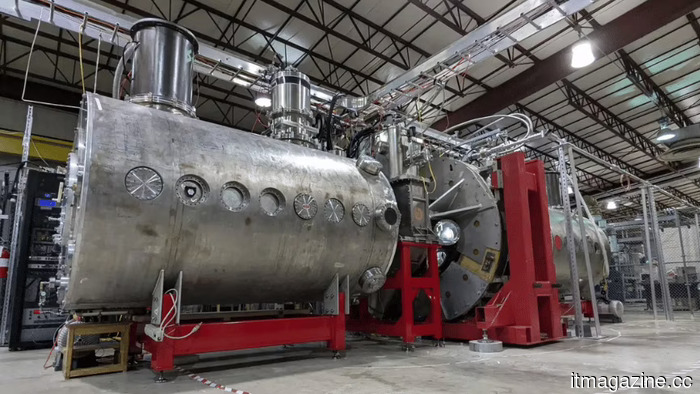
Realta Fusion drives a bulb directly from its reactor.
The challenging issue with fusion has been producing more energy than is consumed. The next challenge lies in transforming that energy into affordable electricity. A startup in Wisconsin claims to have made progress by successfully illuminating a few light bulbs directly from its reactor.
The company, Realta Fusion, announced on June 30 its initial demonstration of direct energy conversion by a commercial fusion entity. During an experiment on June 19, its device provided several amps of current at approximately 100 volts, sufficient to power a few light bulbs, according to the company.
Direct energy conversion, or DEC, offers an attractive shortcut for fusion. Most reactors, similar to current fission plants, intend to generate electricity in the traditional manner by using heat to boil water, which then turns a turbine and operates a generator. This method involves energy losses, whereas DEC directly captures electricity from the charged particles released during the fusion reaction.
The significance of bypassing steam lies in efficiency. A steam turbine within a fission plant typically converts about a third of its energy into electricity, whereas Realta estimates DEC at over 90 percent efficiency. Chief Executive Kieran Furlong emphasized to TechCrunch the importance of this enhancement, noting that every fusion plant must consume power for its operations. "We can take power from a plasma," he stated, underscoring that greater energy recycling could enable quicker profitability for the plant.
Realta conducted the test on WHAM, the experimental machine in collaboration with the University of Wisconsin-Madison. They attached a prototype converter at one end, which decelerates the charged particles, generating voltage and driving current. In Realta's intended first-generation plants, a conventional steam cycle would still perform the majority of the energy conversion. DEC is anticipated to manage one-fifth of the power from charged particles and reclaim energy used to initiate the fusion reaction.
While this achievement is significant, it comes with disclaimers. Realta acknowledges the limitations; WHAM does not yet utilize deuterium-tritium fuel, meaning the converter collected input power rather than the alpha particles a functional fusion plant would generate. Therefore, while the hardware is operational, this does not yet constitute net electricity from fusion.
"This is not yet a demonstration of net electricity," stated Derek Sutherland, the company's chief scientific officer, declaring these milestones as targets for future fusion technology.
The concept of DEC is not new; it was proposed in 1974 by a physicist at Lawrence Livermore, and national laboratories have demonstrated variations since the 1970s. What Realta claims as a first is the application of this technology within a private fusion company's machine, achieving a scale sufficient to illuminate bulbs.
The field of fusion is gaining traction. Following a 2022 experiment proving a reaction could release more energy than it uses, the focus has shifted from physics to engineering and economics. Financial backing has surged, involving companies like Germany's Proxima Fusion and its stellarator, along with Marvel Fusion and its lasers. Investors view this technology as a potential foundational element of clean energy.
Realta is not alone in pursuing direct conversion; Helion, another startup associated with Sam Altman, has designed its entire framework around DEC but has yet to publicly demonstrate the technology. Last year, Realta raised $36 million in a Series A funding round led by Future Ventures and is currently seeking additional funds. It is among eight firms participating in the U.S. Department of Energy’s premier fusion initiative.
As it stands, the achievement is modest yet sincere: a few lit bulbs powered by a converter on a machine that hasn't yet become a power plant. Realta aims to develop its first commercial reactors by the mid-2030s, and if direct conversion proves effective at that scale, it could reduce fusion electricity costs by 10 to 20 percent. That is the gamble, with the shining bulbs serving as the initial proof of concept.
Other articles
 Android 17 makes it more difficult for malicious individuals to guess and break the PIN on your device.
Android 17 enhances lock-screen security by implementing stricter protections that restrict the number of failed PIN and password inputs, lengthen lockout periods, identify repeated guesses, and increase the difficulty of brute-force attacks.
Android 17 makes it more difficult for malicious individuals to guess and break the PIN on your device.
Android 17 enhances lock-screen security by implementing stricter protections that restrict the number of failed PIN and password inputs, lengthen lockout periods, identify repeated guesses, and increase the difficulty of brute-force attacks.
 I dislike sharing my Mac, but a face-recognition app has ultimately alleviated my privacy concerns.
A newly released free and open-source Mac application named FaceGate allows users to secure individual apps with Face Unlock, Touch ID, or a password, with all processing done locally on the device.
I dislike sharing my Mac, but a face-recognition app has ultimately alleviated my privacy concerns.
A newly released free and open-source Mac application named FaceGate allows users to secure individual apps with Face Unlock, Touch ID, or a password, with all processing done locally on the device.
 Dominion Dynamics secures CA$139 million for Arctic defense technology.
Ottawa's Dominion Dynamics has secured CA$139 million, marking the largest Series A funding round in Canadian defense history, aimed at developing autonomous drones and software for Arctic command.
Dominion Dynamics secures CA$139 million for Arctic defense technology.
Ottawa's Dominion Dynamics has secured CA$139 million, marking the largest Series A funding round in Canadian defense history, aimed at developing autonomous drones and software for Arctic command.
 Queue secures $12.6 million for its autonomous robotic pharmacy.
Queue has come out of stealth mode, securing a $12.6 million seed round led by AlleyCorp and introducing what it claims to be the world's first fully autonomous robotic pharmacy.
Queue secures $12.6 million for its autonomous robotic pharmacy.
Queue has come out of stealth mode, securing a $12.6 million seed round led by AlleyCorp and introducing what it claims to be the world's first fully autonomous robotic pharmacy.
 Build secures $8.5 million to automate due diligence in data centers.
Build has secured $8.5 million in funding, led by Index Ventures, for its AI technology that reduces data center and infrastructure due diligence by 95%, offered as a service rather than as software.
Build secures $8.5 million to automate due diligence in data centers.
Build has secured $8.5 million in funding, led by Index Ventures, for its AI technology that reduces data center and infrastructure due diligence by 95%, offered as a service rather than as software.
 Dominion Dynamics secures CA$139 million for Arctic defense technology.
Ottawa's Dominion Dynamics has secured CA$139 million, marking the largest Series A funding round in the history of Canadian defence, aimed at developing autonomous drones and Arctic command software.
Dominion Dynamics secures CA$139 million for Arctic defense technology.
Ottawa's Dominion Dynamics has secured CA$139 million, marking the largest Series A funding round in the history of Canadian defence, aimed at developing autonomous drones and Arctic command software.
Realta Fusion drives a bulb directly from its reactor.
Realta Fusion claims to be the first commercial fusion company to generate electricity directly from its device. This is a proof of concept but has not yet achieved net power.