
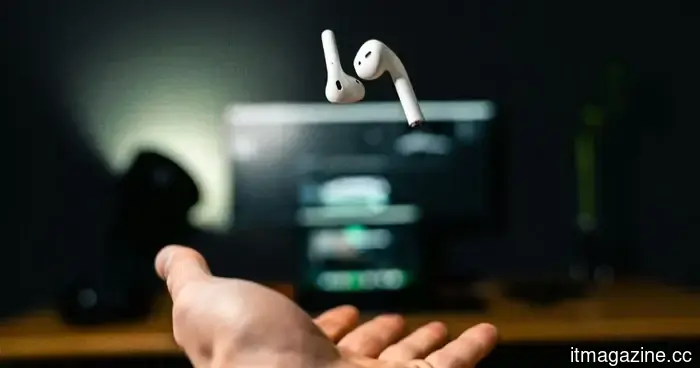
AirPods didn't destroy public life; they made it simpler to navigate through it.
Each day, I walk to the gym with my AirPods in place. The reason is rather mundane: they allow me to adjust one small element before the chaotic city starts to bombard me with distractions. Horns, engines, conversations, heat, gym music seeping through the door, and someone’s phone blasting videos at full volume—all of these city sounds don’t ask for permission before invading my mind.
This notion is often dismissed when earbuds are viewed as evidence that people no longer care for those around them. While public silence can indeed feel impolite, often, it’s a form of self-maintenance—an individual deciding how much noise they can tolerate before really starting their day.
The accusation against earbuds is an easy one to make. In the past, people engaged more in conversation. Today, many walk around enclosed in their own personal soundtracks, with tiny devices in their ears. It’s a neat narrative that enhances a particular notion of shared public spaces, where every passerby represents an opportunity for conversation, and every silent individual signifies a small societal failure.
However, I’m not entirely convinced. Sidewalks aren’t exactly designed for fostering gentle human interactions; they are filled with construction sounds, traffic, throngs of people, alerts from devices, and individuals making speakerphone calls as if hosting a podcast that no one subscribes to.
There’s also something suspiciously extroverted about viewing every missed interaction as a loss. Not every stranger deserves a conversation.
Yet, there is genuine anxiety beneath this perception. TIME recently reported research indicating that the number of words spoken daily has dropped by 28% from 2005 to 2019, going from about 16,600 to under 12,000. That’s a notable decline, but it doesn’t prove that earbuds are the cause, which is where the concern begins to feel quite convenient.
Once numbers are presented, noise loses its status as merely a personal grievance. The European Environment Agency estimates that around 145 million individuals in Europe—over 30% of the population—are subjected to unhealthy levels of transportation noise according to WHO standards. Consequently, the desire to reduce daily noise feels a bit more justified.
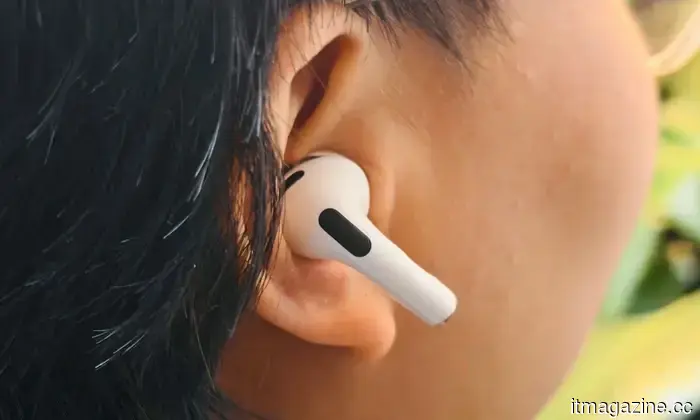
When I see someone with AirPods outside, I don’t immediately perceive them as rejecting those around them. Instead, I see someone adding a filter. From the outside, this might seem rude or disengaged, but from within that space, it can be the difference between remaining functional and feeling excessively overwhelmed.
There’s something oddly extroverted about considering every obstructed interaction as a loss. Not every stranger is entitled to a conversation, nor does every quiet journey need to serve as evidence of societal decay.
When convenience resembles accessibility
A person using industrial ear protection in a grocery store might attract attention, whereas someone donning AirPods appears quite ordinary, or even dull. While their functions may overlap, the presentation alters how people react.
Noise cancellation, transparency mode, and personal audio features were introduced as lifestyle elements, yet they often act as informal sensory shields. They lower the volume without needing a visible indication that someone requires an accommodation.
Apple’s support resources already place AirPods in this context. AirPods Pro includes Hearing Assistance settings, Ambient Noise Reduction, Own Voice Amplification, and Conversation Boost, focusing on the individual speaking directly in front of the wearer.
This distinction matters for introverts, anxious travelers, or neurodivergent individuals. AirPods enable someone to navigate crowded environments without having to explain why they need a bit less stimulation. They render self-regulation appear normal, which is beneficial in a society that often feels awkward about openly requesting accommodations.
Why boundaries appear antisocial
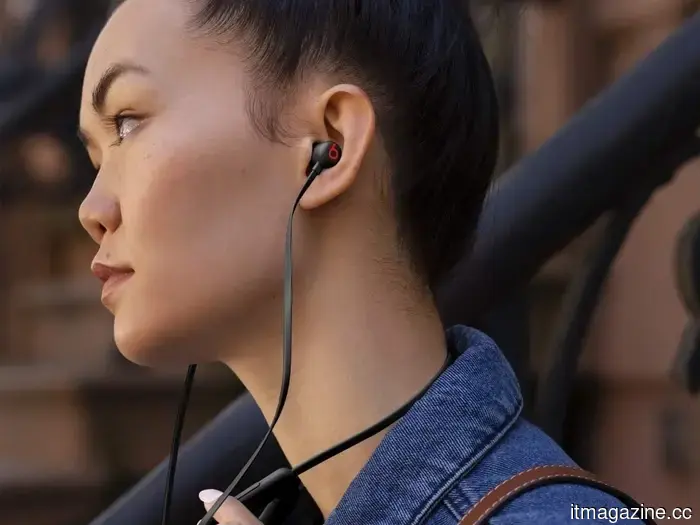
Earbuds have now become personal boundaries, likely explaining why they annoy some. They’re small enough to seem innocuous yet visible enough to convey a message: I’m present, but I’m not entirely available.
Of course, this signal can be misused. Anyone can use earbuds as a shield to evade conversations. However, blaming the device still feels overly simplistic. We continue to expect strangers to be accessible. Earbuds provide a simple switch in the opposite direction.
By the time I arrive at the gym, it’s not as if I’ve escaped the city; I haven’t. The horns persist, the heat remains, and someone is probably still watching TikTok without hesitation. I’ve merely dulled the intensity of the chaos around me.
Perhaps that’s why the insulation irritates some. It serves as a reminder that the noise was never merely neutral; someone had to draw a boundary somewhere, and this particular one conveniently fits in a pocket.

Other articles
 The Liquid Glass slider in iOS 27 appears straightforward, but it's actually more beneficial than I anticipated.
Having used iOS 27 on my iPhone for more than a week, I’ve discovered that the Liquid Glass slider is one of the most overlooked features of the update. Here’s how it functions and why you should give it a try.
The Liquid Glass slider in iOS 27 appears straightforward, but it's actually more beneficial than I anticipated.
Having used iOS 27 on my iPhone for more than a week, I’ve discovered that the Liquid Glass slider is one of the most overlooked features of the update. Here’s how it functions and why you should give it a try.
 A study reveals that almost 60% of TikTok videos presented to new users are low-quality AI-generated content.
A Kapwing analysis of 10,742 TikTok videos revealed that 59% of the content presented to new accounts consists of AI-generated material deemed low quality, which is three times more than what is found on YouTube Shorts.
A study reveals that almost 60% of TikTok videos presented to new users are low-quality AI-generated content.
A Kapwing analysis of 10,742 TikTok videos revealed that 59% of the content presented to new accounts consists of AI-generated material deemed low quality, which is three times more than what is found on YouTube Shorts.
 Soft pings will occur, each accompanied by notes.
Smart rings, glasses, earbuds, and glucose patches are transforming everyday life into a series of reminders, alerts, and small adjustments.
Soft pings will occur, each accompanied by notes.
Smart rings, glasses, earbuds, and glucose patches are transforming everyday life into a series of reminders, alerts, and small adjustments.
 The Liquid Glass slider in iOS 27 may appear straightforward, but it proves to be more functional than I anticipated.
Having used iOS 27 on my iPhone for more than a week, I've discovered that the Liquid Glass slider is one of the most overlooked features of this update. Here’s an explanation of how it functions and why it’s worth giving a shot.
The Liquid Glass slider in iOS 27 may appear straightforward, but it proves to be more functional than I anticipated.
Having used iOS 27 on my iPhone for more than a week, I've discovered that the Liquid Glass slider is one of the most overlooked features of this update. Here’s an explanation of how it functions and why it’s worth giving a shot.
 Apple users are being targeted by a well-known tech support scam.
Following years of scammers pretending to be Microsoft support, reports indicate that Apple users are now experiencing a comparable surge of fraudulent tech support alerts.
Apple users are being targeted by a well-known tech support scam.
Following years of scammers pretending to be Microsoft support, reports indicate that Apple users are now experiencing a comparable surge of fraudulent tech support alerts.
 A study reveals that almost 60% of TikTok videos presented to new users consist of low-quality AI content.
A Kapwing analysis of 10,742 TikTok videos revealed that 59% of the content presented to new accounts consists of AI-generated material, which is three times higher than the rate seen on YouTube Shorts.
A study reveals that almost 60% of TikTok videos presented to new users consist of low-quality AI content.
A Kapwing analysis of 10,742 TikTok videos revealed that 59% of the content presented to new accounts consists of AI-generated material, which is three times higher than the rate seen on YouTube Shorts.
AirPods didn't destroy public life; they made it simpler to navigate through it.
AirPods are often criticized for contributing to antisocial behavior, yet these small earbuds have also become a common method for making noisy public environments more tolerable.