
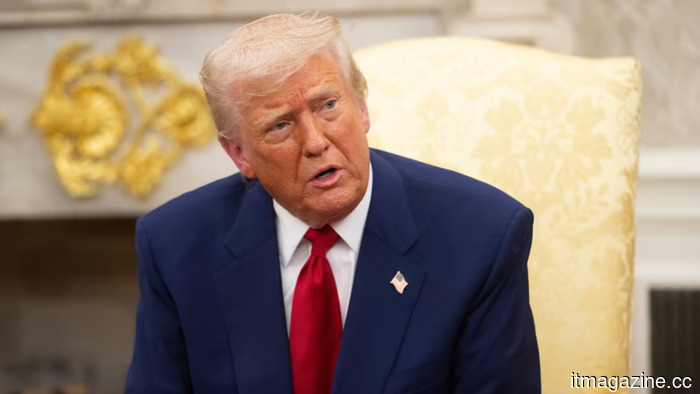
Trump announces that Apple will manufacture chips in collaboration with Intel in the United States.
The announcement that Apple has agreed to manufacture its chips in the United States did not originate from the company itself. Instead, it was shared on Thursday via a post by President Donald Trump on Truth Social, revealing that Apple would collaborate with Intel to design and produce chips domestically. Apple, however, remained silent on the matter.
This imbalance is the most revealing aspect of the announcement. The news of a business deal between the world's most valuable company and a chipmaker partly owned by the federal government was communicated by the President rather than by either of the companies involved.
By the time Trump’s post was published, neither Apple nor Intel had confirmed any details, and the post itself provided scant information: there were no specifics on production volumes, timelines, chip types, or financial figures.
What can be confirmed is the series of discussions that led to this point. Intel and Apple have been in talks for over a year. In May, the Wall Street Journal reported that the two companies had tentatively agreed on a deal for Intel to produce some chips for Apple, following prolonged and sporadic negotiations. Trump’s post seems less like a new development and more like a public announcement designed to serve the administration's interests.
Those interests are significant. Last year, the Trump administration acquired approximately a 10 percent stake in Intel and pledged around $10 billion to the company to construct and expand domestic factories, effectively making Washington both a shareholder and a prominent advocate for Intel.
Trump has personally urged Intel’s case to Apple CEO Tim Cook, including during a meeting at the White House, according to sources familiar with the situation. An administration that is part-owner of a supplier is motivated to promote its customer.
For Apple, the rationale is based on supply rather than nationalism. The company relies almost entirely on Taiwan’s TSMC for its advanced processors. Currently, TSMC’s leading-edge production lines are highly contested by competitors like Nvidia and AMD, who require the same limited capacity for their AI accelerators.
Having a second source would provide Apple with a safety net against this competition. The company has engaged in exploratory discussions with Intel and Samsung to achieve this, with Intel’s 18A process being the first American technology potentially capable of meeting their needs.
However, "potentially" carries significant implications. The cost per chip at Intel is roughly three times that of TSMC, and its production yields fall short. Nevertheless, Intel's stock price has tripled this year, buoyed by government support and talks with Apple, a surge propelled more by relationships than by successful manufacturing results as yet unproven at scale.
Apple harbors internal concerns about whether chips from non-TSMC sources can achieve the levels of yield, performance, and timing on which it has historically relied.
Additionally, Intel is pursuing other major customers; companies like Google and Nvidia are looking at it as a backup for TSMC in terms of AI chips, reflecting a broader push for alternative sources amid the strategic risks associated with Taiwan's dominance. Whether Apple becomes the customer that validates Intel’s manufacturing capabilities or remains just another participant in discussions will depend on actual production results, not just announcements.
The political context surrounding Intel has taken on a personal dimension. Under CEO Lip-Bu Tan, the company's stock has more than tripled this year—a rally driven by Tan’s connections with Trump, Elon Musk, and Apple, as much as by any operational developments. This disconnect between narrative and execution poses a risk to Thursday’s announcement.
A government that serves as a shareholder, financier, and now public supporter has ample motivation to promote the partnership; however, actual manufacturing must follow through.
Furthermore, there is a question about what "Apple chips" would even entail in this context. Apple’s most advanced processors, the chips powering its latest iPhones and Macs, are the toughest to transfer away from TSMC, where the company has structured its product timeline around reliable yields and schedules.
If an initial order from Intel does occur, it is more likely to involve less cutting-edge components, allowing both parties to nurture the relationship without risking the flagship products on an unproven production line. Neither Trump’s post nor the companies involved have specified which chips are being considered.
At this point, there is only a presidential post and two quiet companies. Any orders that do materialize will convey more than the post has.
Other articles
 Bosch to compensate $36 million for unauthorized shipments to Huawei.
Germany's Bosch will pay $36 million to the US to resolve allegations that its subsidiaries sent phone components to Huawei without the necessary licenses.
Bosch to compensate $36 million for unauthorized shipments to Huawei.
Germany's Bosch will pay $36 million to the US to resolve allegations that its subsidiaries sent phone components to Huawei without the necessary licenses.
 The EU cybersecurity agency is set to hold discussions with Anthropic under the framework of US export regulations.
According to the EU Commission, ENISA was scheduled to meet with Anthropic on Thursday regarding access to Mythos, a meeting that was arranged prior to a US export directive that complicated matters.
The EU cybersecurity agency is set to hold discussions with Anthropic under the framework of US export regulations.
According to the EU Commission, ENISA was scheduled to meet with Anthropic on Thursday regarding access to Mythos, a meeting that was arranged prior to a US export directive that complicated matters.
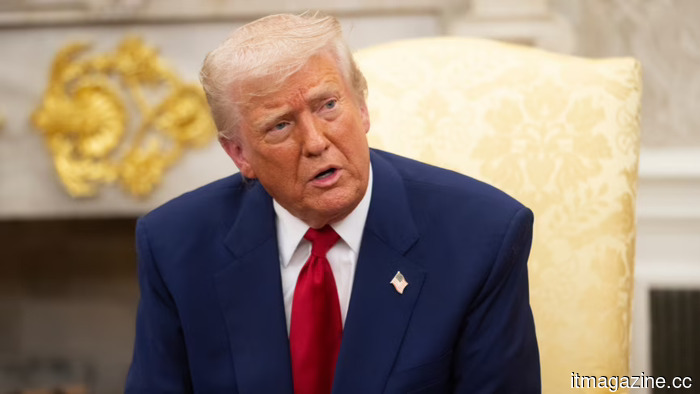 Trump states that Apple will manufacture chips in collaboration with Intel in the United States.
Trump states that Apple has committed to designing and manufacturing chips alongside Intel in the US, a year following Washington's investment in the chip company.
Trump states that Apple will manufacture chips in collaboration with Intel in the United States.
Trump states that Apple has committed to designing and manufacturing chips alongside Intel in the US, a year following Washington's investment in the chip company.
 SK Hynix has delivered its initial samples of 12-layer HBM4E to AI customers.
SK Hynix announced that it has delivered samples of its 12-layer HBM4E to key customers, boasting a speed of 16Gbps per pin and more than a 20% improvement in efficiency.
SK Hynix has delivered its initial samples of 12-layer HBM4E to AI customers.
SK Hynix announced that it has delivered samples of its 12-layer HBM4E to key customers, boasting a speed of 16Gbps per pin and more than a 20% improvement in efficiency.
 ChatGPT's updated Scheduled page consolidates all your automated tasks into a single location.
OpenAI is introducing a specific Scheduled page for ChatGPT, allowing users to view, manage, and oversee all active tasks through the sidebar.
ChatGPT's updated Scheduled page consolidates all your automated tasks into a single location.
OpenAI is introducing a specific Scheduled page for ChatGPT, allowing users to view, manage, and oversee all active tasks through the sidebar.
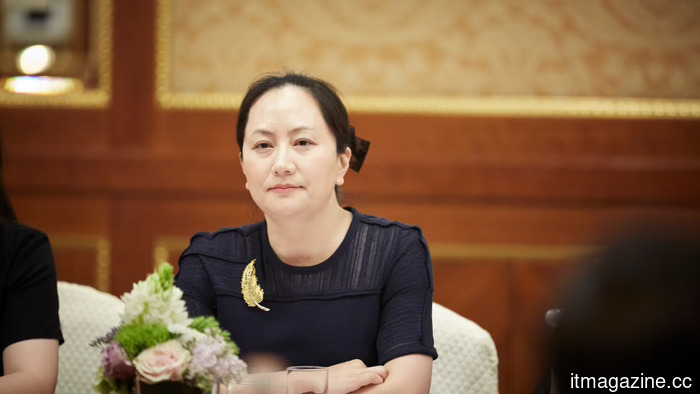 A US judge has determined that the statements made by Huawei's CFO can be utilized as evidence against the company.
A US judge has determined that Meng Wanzhou's statements regarding sanctions compliance from 2021 can be used as evidence against Huawei in its criminal trial set for September.
A US judge has determined that the statements made by Huawei's CFO can be utilized as evidence against the company.
A US judge has determined that Meng Wanzhou's statements regarding sanctions compliance from 2021 can be used as evidence against Huawei in its criminal trial set for September.
Trump announces that Apple will manufacture chips in collaboration with Intel in the United States.
Trump states that Apple has consented to collaborate with Intel in designing and manufacturing chips within the United States, following a year after Washington invested in the chipmaker.