
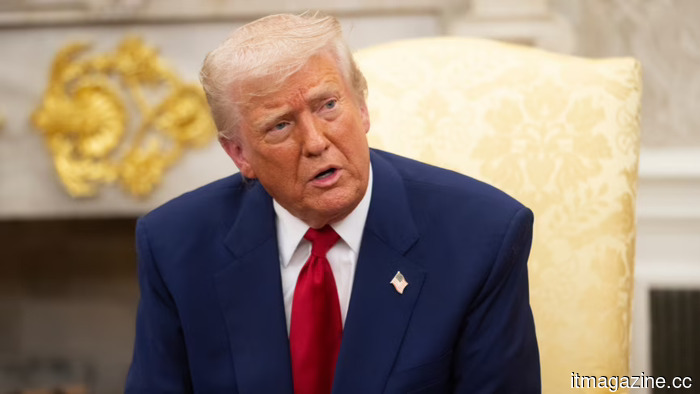
Trump states that Apple will manufacture chips in collaboration with Intel in the United States.
The announcement that Apple would be manufacturing its chips in the United States did not originate from the company itself. Instead, it was revealed on Thursday via a post by President Donald Trump on Truth Social, stating that Apple had agreed to collaborate with Intel to design and produce chips domestically. Apple, however, remained silent on the matter.
This lack of communication is significant. The disclosure of a business agreement between the world's most valuable company and a partially government-owned chipmaker was made public by the President instead of either company.
By the time Trump's post was made, neither Apple nor Intel had confirmed the details, which were notably sparse—lacking specifics on quantities, timelines, chip types, or financial figures.
What is clear is the context leading to this point. Intel and Apple have been in discussions for over a year. In May, the Wall Street Journal reported that a preliminary agreement had been reached for Intel to produce certain chips for Apple after extensive and intermittent negotiations. Trump's announcement appears less like a new development and more like a public declaration aligned with the administration's interests.
These interests are significant. Last year, the Trump administration acquired about a 10 percent stake in Intel and pledged roughly $10 billion to help build and expand domestic factories, making Washington both a shareholder and an enthusiastic promoter of Intel.
Trump has personally engaged with Tim Cook, Apple's CEO, to advocate for Intel, including during a meeting at the White House, according to sources familiar with the discussions. An administration with a financial stake in a supplier has strong incentive to promote that supplier's customer.
For Apple, the motivation lies in securing a reliable supply rather than patriotic sentiment. The company is almost entirely reliant on Taiwan’s TSMC for its most advanced processors, and TSMC's top production lines are now highly competitive, with companies like Nvidia and AMD vying for the same limited capacity due to their AI accelerators.
Having a second source would provide Apple with a safeguard against this competitive pressure. The company has engaged in discussions with Intel and Samsung regarding this issue, and Intel’s 18A process represents the first American fabrication technology theoretically capable of meeting its needs.
However, the term "theoretically" carries weight. Intel's cost per chip is approximately three times higher than TSMC's, and its production yields are considerably lower. Despite this, Intel's stock price has tripled this year, buoyed by governmental support and the potential deal with Apple—a rise based more on relationships than on proven manufacturing capabilities at scale.
Apple internally harbors skepticism about whether silicon not sourced from TSMC can match the yield, performance, and timing that are integral to its product development.
Additionally, Intel is seeking other major customers; Google and Nvidia have considered it as a backup to TSMC for AI chips, part of a broader effort to find alternative suppliers as Taiwan's dominance presents a strategic risk. Whether Apple becomes the customer that validates Intel’s foundry capabilities or merely another name in ongoing discussions will depend on actual output, rather than just announcements.
The political landscape surrounding Intel has become notably personal. The company's stock has surged under CEO Lip-Bu Tan this year, with gains driven as much by Tan's relationships with Trump, Elon Musk, and Apple as by developments in manufacturing. This disconnect between narrative and execution poses a risk for Thursday's announcement.
A government that acts as a shareholder, financier, and public advocate has ample reason to promote the partnership; however, manufacturing must ultimately follow the talk.
Additionally, there’s uncertainty surrounding what “Apple chips” would actually entail. The company’s most advanced processors, found in its latest iPhones and Macs, are particularly challenging to transition away from TSMC, where Apple has structured its product timeline based on trusted yields and delivery schedules.
Should an initial order from Intel materialize, it is likely to involve less cutting-edge components, allowing the relationship to develop without risking the primary product line on an untried manufacturing process. Neither Trump's post nor either company has specified which chips might be involved.
For now, there is a presidential statement and two reticent companies. Future orders, if they occur, will provide more insight than the post itself.
Other articles
 Meta executive in charge of the internal AI revamp leaves after just two months.
Emily Dalton Smith, who spearheaded Meta's initiative to restructure around AI agents, is departing just two months after assuming the position.
Meta executive in charge of the internal AI revamp leaves after just two months.
Emily Dalton Smith, who spearheaded Meta's initiative to restructure around AI agents, is departing just two months after assuming the position.
 ChatGPT's updated Scheduled page consolidates all your automated tasks into a single location.
OpenAI is introducing a specific Scheduled page for ChatGPT, allowing users to view, manage, and oversee all active tasks through the sidebar.
ChatGPT's updated Scheduled page consolidates all your automated tasks into a single location.
OpenAI is introducing a specific Scheduled page for ChatGPT, allowing users to view, manage, and oversee all active tasks through the sidebar.
 Apple plans to increase prices due to the impact of the memory chip shortage, according to Tim Cook.
Tim Cook informed the WSJ that price hikes at Apple are inevitable due to rising memory chip costs driven by demand for AI.
Apple plans to increase prices due to the impact of the memory chip shortage, according to Tim Cook.
Tim Cook informed the WSJ that price hikes at Apple are inevitable due to rising memory chip costs driven by demand for AI.
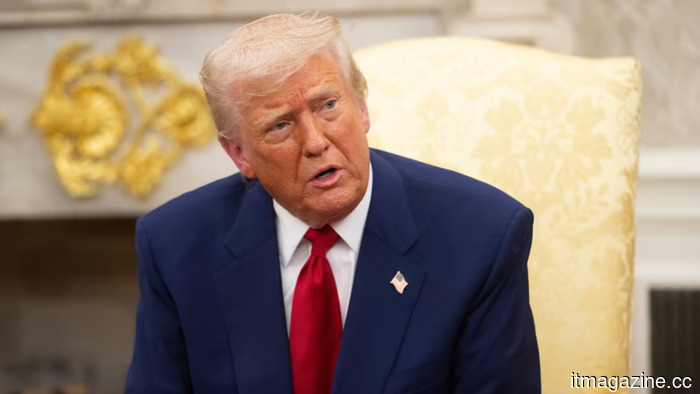 Trump announces that Apple will manufacture chips in collaboration with Intel in the United States.
Trump states that Apple has consented to collaborate with Intel in designing and manufacturing chips within the United States, following a year after Washington invested in the chipmaker.
Trump announces that Apple will manufacture chips in collaboration with Intel in the United States.
Trump states that Apple has consented to collaborate with Intel in designing and manufacturing chips within the United States, following a year after Washington invested in the chipmaker.
 SK Hynix has delivered its initial samples of 12-layer HBM4E to AI customers.
SK Hynix announced that it has delivered samples of its 12-layer HBM4E to key customers, boasting a speed of 16Gbps per pin and more than a 20% improvement in efficiency.
SK Hynix has delivered its initial samples of 12-layer HBM4E to AI customers.
SK Hynix announced that it has delivered samples of its 12-layer HBM4E to key customers, boasting a speed of 16Gbps per pin and more than a 20% improvement in efficiency.
 Bosch to compensate $36 million for unauthorized shipments to Huawei.
Germany's Bosch will pay $36 million to the US to resolve allegations that its subsidiaries sent phone components to Huawei without the necessary licenses.
Bosch to compensate $36 million for unauthorized shipments to Huawei.
Germany's Bosch will pay $36 million to the US to resolve allegations that its subsidiaries sent phone components to Huawei without the necessary licenses.
Trump states that Apple will manufacture chips in collaboration with Intel in the United States.
Trump states that Apple has committed to designing and manufacturing chips alongside Intel in the US, a year following Washington's investment in the chip company.